


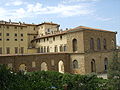


Photo: Almaak, CC BY-SA 3.0 · Wikimedia Commons
Historic villa / palace, 1458
Palazzo Pitti
Renaissance palace and museum in Florence, Italy
- Within the UNESCO World Heritage Site “Historic Centre of Florence”
- Free on the first Sunday
At a glance
- Period
- Middle Ages, 1458
- Style
- Renaissance architecture
- Architects
- Filippo Brunelleschi, Luca Fancelli
- Protection
- Italian national heritage
- Coordinates
- 43°45′55″ N, 11°15′00″ E
- Address
- Piazza de' Pitti, 1
History and description
The Palazzo Pitti, in English sometimes called the Pitti Palace, is a vast, mainly in the Renaissance style, palace in Florence, Italy. It is situated on the south side of the River Arno, a short distance from the Ponte Vecchio. The core of the present palazzo dates from 1458 and was originally the town residence of Luca Pitti, an ambitious Florentine banker.
The palace was bought by the Medici family in 1549 and became the chief residence of the ruling family of the Grand Duchy of Tuscany. It grew as a great treasure house, for generations amassing paintings, plates, jewelry and luxurious possessions. The Medici also added the extensive Boboli Gardens to the palace estate.
In the late 18th century, the palazzo was used as a power base by Napoleon during his conquests of Europe. For a brief period, it later served as the principal royal palace of the newly united Italy under the House of Savoy. The palace and its contents were donated to the Italian people by King Victor Emmanuel III in 1919.
The palazzo is now the largest museum complex in Florence. The principal palazzo block, often in a building of this design known as the corps de logis, is 32,000 square metres.
History
The construction of this severe and forbidding building was commissioned in 1458 by the Florentine banker Luca Pitti (1398–1472), a principal supporter and friend of Cosimo de' Medici. The early history of the Palazzo Pitti is a mixture of fact and myth. Pitti is alleged to have instructed that the windows be larger than the entrance of the Palazzo Medici. The 16th-century art historian Giorgio Vasari proposed that Brunelleschi was the palazzo's architect, and that his pupil Luca Fancelli was merely his assistant in the task, but today it is Fancelli who is generally credited. Besides obvious differences from the elder architect's style, Brunelleschi died 12 years before construction of the palazzo began. The design and fenestration suggest that the unknown architect was more experienced in utilitarian domestic architecture than in the humanist rules defined by Alberti in his book De Re Aedificatoria.
Though impressive, the original palazzo would have been no rival to the Florentine Medici residences in terms of either size or content. Whoever the architect of the Palazzo Pitti was, he was moving against the contemporary flow of fashion. The rusticated stonework gives the palazzo a severe and powerful atmosphere, reinforced by the three-times-repeated series of seven arch-headed apertures, reminiscent of a Roman aqueduct. The Roman-style architecture appealed to the Florentine love of the new style all'antica. This original design has withstood the test of time: the repetitive formula of the façade was continued during the subsequent additions to the palazzo, and its influence can be seen in numerous 16th-century imitations and 19th-century revivals. Work stopped after Pitti suffered financial losses following the death of Cosimo de' Medici in 1464. Luca Pitti died in 1472 with the building unfinished. …
Palatine Gallery
The Palatine Gallery, the main gallery of Palazzo Pitti, contains a large ensemble of over 500 principally Renaissance paintings, which were once part of the Medicis' and their successors' private art collection. The gallery, which overflows into the royal apartments, contains works by Raphael, Titian, Perugino (Lamentation over the Dead Christ), Correggio, Peter Paul Rubens, and Pietro da Cortona. The character of the gallery is still that of a private collection, and the works of art are displayed and hung much as they would have been in the grand rooms for which they were intended rather than following a chronological sequence, or arranged according to school of art.
The finest rooms were decorated by Pietro da Cortona in the high baroque style. Initially Cortona frescoed a small room on the piano nobile called the Sala della Stufa with a series depicting the Four Ages of Man which were very well received; the Age of Gold and Age of Silver were painted in 1637, followed in 1641 by the Age of Bronze and Age of Iron. They are regarded among his masterpieces. The artist was subsequently asked to fresco the grand ducal reception rooms; a suite of five rooms at the front of the palazzo. In these five Planetary Rooms, the hierarchical sequence of the deities is based on Ptolomeic cosmology; Venus, Apollo, Mars, Jupiter (the Medici Throne room) and Saturn, but minus Mercury and the Moon which should have come before Venus. These highly ornate ceilings with frescoes and elaborate stucco work essentially celebrate the Medici lineage and the bestowal of virtuous leadership. Cortona left Florence in 1647, and his pupil and collaborator, Ciro Ferri, completed the cycle by the 1660s. They were to inspire the later Planet Rooms at Louis XIV's Palace of Versailles, designed by Charles Le Brun.
The collection was first opened to the public in the late 18th century, albeit rather reluctantly, by Grand Duke Leopold I, Tuscany's first enlightened ruler, keen to obtain popularity after the demise of the Medici.
The Palatine Gallery has 28 rooms, among them the following: …
Other galleries
This is a suite of 14 rooms, formerly used by the Medici family, and lived in by their successors. These rooms have been largely altered since the era of the Medici, most recently in the 19th century. They contain a collection of Medici portraits, many of them by the artist Giusto Sustermans. In contrast to the great salons containing the Palatine collection, some of these rooms are much smaller and more intimate, and, while still grand and gilded, are more suited to day-to-day living requirements. Period furnishings include four-poster beds and other necessary furnishings not found elsewhere in the palazzo. The Kings of Italy last used the Palazzo Pitti in the 1920s. By that time it had already been converted to a museum, but a suite of rooms in the Meridian wing (now the Gallery of Modern Art) was reserved for them when visiting Florence officially.
This gallery originates from the remodeling of the Florentine academy in 1748, when a gallery of modern art was established. The gallery was intended to hold those art works which were prize-winners in the academy's competitions. The Palazzo Pitti was being redecorated on a grand scale at this time and the new works of art were being collected to adorn the newly decorated salons. By the mid-19th century so numerous were the modern paintings in the grand ducal collection that many were transferred to the Palazzo della Crocetta, which became the first home of the newly formed "Modern Art Museum".
Following the Risorgimento and the expulsion of the grand ducal family from the palazzo, all the grand ducal modern artworks were brought together under one roof in the newly titled "Modern gallery of the Academy". The collection continued to expand, particularly so under the patronage of Victor Emmanuel II. However, it was not until 1922 that this gallery was moved to the Palazzo Pitti, where it was complemented by further modern works of art in the ownership of both the state and the municipality of Florence. The collection was housed in apartments recently vacated by members of the Italian royal family. The gallery was first opened to the public in 1928. …
The palazzo today
Today, transformed from a royal palace to a museum, the Palazzo Pitti is owned by the Italian state. Once under the management of the Polo Museale Fiorentino, an institution which administered twenty museums, since 2015 it has been a department of the Gallerie degli Uffizi, as a separate and independent structure within the Ministry of Culture, and has ultimate responsibility for 250,000 catalogued works of art. In spite of its metamorphosis from royal residence to a state-owned public building, the palazzo, sitting on its elevated site overlooking Florence, still retains the air and atmosphere of a private collection in a grand house. This is to a great extent due to the Amici di Palazzo Pitti (Friends of the Palazzo Pitti), an organisation of volunteers and patrons founded in 1996, which raises funds and makes suggestions for the ongoing maintenance of the palazzo and the collections, and for the continuing improvement of their visual display.
Text from Wikipedia, the free encyclopedia, under CC BY-SA 4.0. Full article: «Palazzo Pitti».
Timeline
- 1458Built
- 1919Opened
Events and people from Wikidata (CC0).
Photos
Getting there
Firenze Santa Maria NovellaTrain, nearest
1.4 km as the crow flies
Palazzo PittiPiazza de' Pitti, 1
Aeroporto Firenze Amerigo Vespucci6.2 km
Distances are as the crow flies, not walking or driving.
Loading map…
Nearby
See on the mapMore historic villas and palaces in Tuscany

- UNESCO
- Free 1st Sunday

- UNESCO
- Free 1st Sunday

- Free 1st Sunday


Frequently asked questions
Where is Palazzo Pitti?
Palazzo Pitti is in Florence, in the province of Firenze (Tuscany), Italy. Address: Piazza de' Pitti, 1. GPS coordinates: 43.76515, 11.25001.
What are the opening hours of Palazzo Pitti?
According to OpenStreetMap the opening hours are: Every day: 8:15–18:50. Always check the official website before your visit.
How much does it cost to visit Palazzo Pitti?
There is an admission charge, but entry is free on the first Sunday of the month (Domenica al museo). Up-to-date prices are on the official website.
Is Palazzo Pitti wheelchair accessible?
According to OpenStreetMap data, the site is wheelchair accessible.
How old is Palazzo Pitti?
Wikidata dates it to 1458.
What else is there to see near Palazzo Pitti?
Nearby you’ll find: Galleria Palatina (0 m away), Gallery of Costume (0 m away), Tesoro dei Granduchi (0 m away).
Sources and licences
Text. Wikipedia, the free encyclopedia (CC BY-SA 4.0).
Data. Wikidata (CC0); opening hours and contacts OpenStreetMap (ODbL).
Photos. Wikimedia Commons, author and licence on every image.
Credits for the 9 photos
- Palazzo Pitti nel tardo pomeriggio — Almaak, CC BY-SA 3.0
- Alessandro allori, luca pitti davanti a palazzo pitti — Alessandro Allori, Public domain
- Boboli, palazzina della meridiana, esterno 01 — sailko, CC BY 2.5
- Jardín de Bóboli, Florencia, Italia, 2022-09-19, DD 15 — Diego Delso, CC BY-SA 4.0
- Palacio Pitti, Florencia, Italia, 2022-09-18, DD 136-138 HDR — Diego Delso, CC BY-SA 4.0
- Palacio Pitti, Florencia, Italia, 2022-09-18, DD 143-145 HDR — Diego Delso, CC BY-SA 4.0
- Palazzo Pitti 2019 — Photo2023, CC BY 4.0
- Palazzo Pitti Gartenfassade Florenz — Stefan Bauer, http://www.ferras.at, CC BY-SA 2.5
- Palazzo pitti, appartementi estivi al pian terreno 01 — sailko, CC BY 2.5
Updated 28 October 2026. All sources and licences