



- Free 1st Sunday
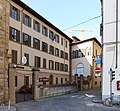
Photo: Arek N., CC BY-SA 3.0 · Wikimedia Commons
Historic villa / palace, 1560
Palace and art museum in Florence, Italy
The Uffizi Gallery is a prominent art museum adjacent to the Piazza della Signoria in the Historic Centre of Florence in the region of Tuscany, Italy. One of the most important Italian museums and the most visited, it is also one of the largest and best-known in the world. It holds a collection of priceless works, particularly from the period of the Italian Renaissance.
After the ruling House of Medici died out, their art collections were given to the city of Florence under the famous Patto di famiglia ("family pact") negotiated by Anna Maria Luisa, the last Medici heiress. The Uffizi is one of the first modern museums. The gallery had been open to visitors by request since the sixteenth century, and in 1769 it was officially opened to the public, formally becoming a museum in 1865.
The building of the Uffizi complex was begun by Giorgio Vasari in 1560 for Cosimo I de' Medici as a means to consolidate his administrative control of the various committees, agencies, and guilds established in Florence's Republican past so as to accommodate them all in one place, hence the name uffizi, "offices". The construction was later continued by Alfonso Parigi and Bernardo Buontalenti; it was completed in 1581. The top floor was made into a gallery for the family and their guests and included their collection of Roman sculptures.
The cortile (internal courtyard) is so long, narrow, and open to the Arno at its far end through a Doric screen that articulates the space without blocking it, that architectural historians treat it as the first regularized streetscape of Europe. Vasari, a painter and architect as well, emphasized its perspective length by adorning it with the matching facades' continuous roof cornices, and unbroken cornices between storeys, as well as the three continuous steps on which the museum fronts stand. The niches in the piers that alternate with columns of the Loggiato were filled with sculptures of famous artists in the 19th century.
The Uffizi brought together under one roof the administrative offices and the Archivio di Stato, the state archive. The project was intended to display prime artworks of the Medici collections on the piano nobile; the plan was carried out by his son, Grand Duke Francesco I. He commissioned the architect Buontalenti to design the Tribuna degli Uffizi that would display a series of masterpieces in one room, including jewels; it became a highly influential attraction of a Grand Tour. The octagonal room was completed in 1584.
Over the years, more sections of the building were recruited to exhibit paintings and sculptures collected or commissioned by the Medici. For many years, 45 to 50 rooms were used to display paintings from the 13th to 18th century.
Because of its vast collection, some of the Uffizi's works have in the past been transferred to other museums in Florence—for example, some famous statues to the Bargello. A project was finished in 2006 to expand the museum's exhibition space some 6,000 metres2 (64,000 ft2) to almost 13,000 metres2 (139,000 ft2), allowing public viewing of many artworks that had usually been in storage.
The Nuovi Uffizi (New Uffizi) renovation project, which started in 1989, was progressing well from 2015 to 2017. It was intended to modernize all of the halls and more than double the display space. A new exit was also planned, and the lighting, air conditioning, and security systems were updated. During construction, the museum remained open, although rooms were closed as necessary, with the artwork temporarily moved to another location. For example, the Botticelli rooms and two others with early Renaissance paintings were closed for 15 months but reopened in October 2016.
Over two million people visited the Uffizi in 2016, making it the most visited art gallery in Italy. At peak periods (particularly in July), waiting times for entry can be up to five hours. Advance tickets can be bought online to significantly reduce the waiting time. In 2018, a revised ticketing system was introduced to reduce queuing times to just minutes.
Due to the COVID-19 pandemic, the museum was closed for 150 days in 2020, and attendance plunged by 72 percent to 659,043. Nonetheless, the Uffizi was 27th in the list of most-visited art museums in the world in 2020. Works from the Uffizi gallery collection are now available for remote viewing on Google Arts and Culture. The museum reopened in May 2021 following a renovation that included an addition of 14 new rooms and a display of additional 129 artworks, with the museum attempting to give more voice to historically under-represented groups including women and people of color.
The flood of 1966 severely damaged collections in Florence, including the Uffizi's. The superintendent of the gallery, Ugo Procacci, and other employees went to the museum early in the morning to save as much as possible. Cimabue's crucifix in Santa Croce Church was one of the most damaged artifacts and a symbol of the devastation of the flood. The Uffizi Photographic Department rooms were affected, damaging equipment and photographs.
On 27 May 1993, the Sicilian Mafia carried out a car bomb explosion in Via dei Georgofili which damaged parts of the palace and killed five people. The blast destroyed five pieces of art and damaged another 30. Some of the paintings were fully protected by bulletproof glass. The most severe damage was to the Niobe room and classical sculptures and neoclassical interior, which have since been restored. However, its frescoes were damaged beyond repair.
On 22 July 2022, members of the climate activist group Ultima Generazione (Last Generation) glued themselves to the glass protecting Sandro Botticelli's Primavera demanding an end to fossil fuel usage. The painting was undamaged.
On 13 February 2024, members of Ultima Generazione glued images of flooding in Tuscany in 2023 to the glass protecting Sandro Botticelli's Birth of Venus in protest over the Italian government's inaction on climate change. The painting was undamaged, and the images were removed.
Text from Wikipedia, the free encyclopedia, under CC BY-SA 4.0. Full article: «Uffizi Gallery».
Events and people from Wikidata (CC0).
Distances are as the crow flies, not walking or driving.


Uffizi Gallery is in Florence, in the province of Firenze (Tuscany), Italy. Address: Piazzale degli Uffizi 6, I-50122 Firenze. GPS coordinates: 43.76833, 11.25528.
According to OpenStreetMap the opening hours are: Tuesday to Sunday: 8:15–18:30; Monday: Closed; 1 January: Closed; 25 December: Closed. Always check the official website before your visit.
There is an admission charge. Up-to-date prices are on the official website.
According to OpenStreetMap data, the site is wheelchair accessible.
Wikidata dates it to 1560.
Nearby you’ll find: Uffizi Gallery (0 m away), Torre dei Pulci (0 m away), Residenza dell'Arte dei Vaiai e Pellicciai (0 m away).
Text. Wikipedia, the free encyclopedia (CC BY-SA 4.0).
Data. Wikidata (CC0); opening hours and contacts OpenStreetMap (ODbL).
Photos. Wikimedia Commons, author and licence on every image.
Updated 28 October 2026. All sources and licences