


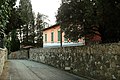

Photo: sailko, CC BY-SA 3.0 · Wikimedia Commons
At a glance
- Coordinates
- 43°46′48″ N, 11°19′42″ E
History and description
Villa Gamberaia, built in the Tuscan style by the Florentine gentleman-merchant Zanobi Lapi in the early 1600s, is located on the hillside of Settignano, overlooking the city of Florence, Italy and the surrounding Arno Valley.
The villa is celebrated for the unique design of its gardens, originally laid out by Zanobi Lapi and his nephews in the first half of the seventeenth century and preserved until now with few major changes. According to Edith Wharton, the Gamberaia was "probably the most perfect example of the art of producing a great effect on a small scale". The design has inspired landscape and garden architects throughout the world, including Charles Platt, A. E. Hanson, and Ellen Shipman in the United States and Cecil Pinsent and Pietro Porcinai in Italy and the UK. In 2010 the Gamberaia was chosen as the model for the "RCSF Tuscan garden", recreated at Snug Harbor, Staten Island, New York.
History
The first mention of the property dates to the late fourteenth century and refers to the grant to Giovanni Benozzo in 1398 of a farm and house in the place called Gamberaia by the Abbess of San Martino a Mensola. The place-name "gamberaia" probably refers to the farming of fresh-water shrimp in local ponds. During the fifteenth and sixteenth centuries a house with land, in part cultivated, in part planted with vineyards belonged to the Gamberelli family: Matteo, his sons, among whom the well-known sculptors and architects Antonio and Bernardo "Rossellino", and their descendants.
In 1610 the property was acquired by Zanobi Lapi, a wealthy and cultivated Florentine merchant with ties to the Medici court, and it is he and his nephews who were responsible for the construction of the villa, on the foundations of an earlier casa da signore, and the subsequent layout of the gardens. Evidence of Lapi ownership and patronage is visible in an inscription on the architrave of a door inside the east entrance to the villa ("Zenobius Lapius erexit ac fundavit A.D. MDCX") and in the heraldic lions carved on vases above the gate to the gabinetto rustico and in the relief sculptures of the nymphaeum (or 'Neptune grotto'). Documents of Zanobi's time mention a limonaia, a lawn area, and ilex woods, which remain essential parts of the garden plan, and the conduits that convey water from the springs above the nymphaeum to the several fountains, a complex hydraulic system that still functions today. The architects who built the villa and carried out the massive engineering project that extended the main terrace of the villa to the south, thus creating the long north-south axis of the bowling green and the area of the parterre, have not been identified. Recent studies, however, point to the Florentine architectural tradition of Bartolomeo Ammannati, Bernardo Buontalenti, and Giovanni Battista Caccini and the influence in the gardens and grottos of the theatrical designer Giulio Parigi. …
Select Bibliography
History and Design of the Villa and Gardens
Villa Gamberaia: Sources and Interpretations, special issue of Studies in the History of Gardens & Designed Landscapes, 22 (2002), guest ed., P. Osmond. Includes essays on the Gamberaia by Mario Bevilacqua, Marcello Fagiolo, Maia Gahtan, Margherita Caputo, Patricia Osmond, Vincenzo Cazzato.
Revisiting the Gamberaia: An Anthology of Essays, ed. with Preface, Introduction, and Notes by P. J. OsmondIncludes historic essays on the Gamberaia (1901-1973) by Janet Ross, Edith Wharton, E. March Phillipps (with photos by Charles Latham), H. Inigo Triggs, Henry V. Hubbard, Geoffrey Jellicoe (with drawings by J.C. Shepherd), Georgina Masson, and Harold Acton, with Introduction, prefaces to each essay, and notes.
Judith Kinnard, ““The Villa Gamberaia in Settignano: The Street in the Garden,” Journal of Garden History 6 (1986): 1-18.
Gian Luca Simonini. “Il giardino di Gamberaia e l’addizione di Catherine Jeanne Ghyka,” Storia urbana 85 (1998) 151-70.
Luigi Zangheri,. "Pietro Porcinai e La Gamberaia," in I giardini del XX secolo: l'opera di Pietro Porcinai, ed. Maria Chiara Pozzana (Florence: Alinea, 1998), 131-138.
Luigi Zangheri,. “Islamische Einflüsse in der Europäischen Gartenkunst am Beispiel der Villa Gamberaia,” in Historische Gärten heute, ed. M. Rohde and R. Schomann (Leipzig: 2003), 52-57.
Guides
Mariachiara Pozzana, Villa Gamberaia (Florence: Edizioni Casalta, 2015).
Photographic Studies
Balthazar Korab, Gamberaia. Photo essay, with text by Harold Acton. (Florence: Centro Di, 1971).
Text from Wikipedia, the free encyclopedia, under CC BY-SA 4.0. Full article: «Villa Gamberaia».
Photos
Getting there
Firenze RovezzanoTrain, nearest
2.0 km as the crow flies
Villa Gamberaia
Aeroporto Firenze Amerigo Vespucci10.6 km
Distances are as the crow flies, not walking or driving.
Loading map…
Nearby
See on the mapMore historic villas and palaces in Tuscany

- Free 1st Sunday

- UNESCO
- Free 1st Sunday

- UNESCO
- Free 1st Sunday

- Free 1st Sunday

Frequently asked questions
Where is Villa Gamberaia?
Villa Gamberaia is in Florence, in the province of Firenze (Tuscany), Italy. GPS coordinates: 43.78000, 11.32828.
What else is there to see near Villa Gamberaia?
Nearby you’ll find: Villa Il Quercione (500 m away), Villa Michelangelo (700 m away), Villa La Pastorella (800 m away).
Sources and licences
Text. Wikipedia, the free encyclopedia (CC BY-SA 4.0).
Data. Wikidata (CC0); opening hours and contacts OpenStreetMap (ODbL).
Photos. Wikimedia Commons, author and licence on every image.
Credits for the 9 photos
- Villa gamberaia 02 — sailko, CC BY-SA 3.0
- Maxfield Parrish - Villa Gamberaia, Settignano (1903) — Maxfield Parrish, Public domain
- Settignano, vista su villa gamberaia — Sailko, CC BY 3.0
- Veduta di firenze da villa gamberaia 01 — sailko, CC BY-SA 3.0
- Vial del crocifissalto, veduta su villa gamberaia 01 — Francesco Bini, CC BY-SA 4.0
- Vial del loretino, villa gamberaia, cancello meridionale 01 — Francesco Bini, CC BY-SA 4.0
- Vial del loretino, villa gamberaia, spigolo meridionale 01 — Francesco Bini, CC BY-SA 4.0
- Villa gamberaia 01 — sailko, CC BY-SA 3.0
- Villa gamberaia 06.1 — sailko, CC BY-SA 3.0
Updated 28 October 2026. All sources and licences