




- UNESCO
- Free 1st Sunday
Photo: Patrik Kunec, CC BY-SA 4.0 · Wikimedia Commons
Archaeological site
Archaeological complex in Tivoli, Italy
Hadrian's Villa (Italian: Villa Adriana; Latin: Villa Hadriana) was a monumental villa or palace complex built around AD 120 by emperor Hadrian (r.117–138) near Tivoli, about 20 km from Rome. Its remains are now included in a UNESCO World Heritage Site.
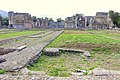
It is one of the most imposing and complex Roman villas known. The complex contains over 30 monumental and scenic buildings arranged on a series of artificial esplanades at different heights and surrounded by gardens decorated with water basins and nymphaea (fountains). The whole complex covers an area of at least a square kilometre, an area larger than the city of Pompeii. In addition to the villa's impressive layout, many of the buildings are considered masterpieces of Roman architecture, making use of striking curved shapes enabled by extensive use of concrete. They were ingenious for the complex symmetry of their ground plans and are considered unrivalled until the arrival of Baroque architecture in the 17th century, initiated by Borromini, who used Hadrian's Villa for inspiration.
Several Republican-era villas, one or more of which were possibly inherited by his wife Vibia Sabina, occupied artificial terraces on the site. Hadrian began construction on the villa early in his reign at the end of 118 or the beginning of 119, a few months after his arrival in Rome, as the majority of the first brick stamps are dated to 117 and would have been made in advance.
However, Hadrian spent many years of his reign visiting the empire and his first presence at the Villa is documented in 125 after the return from his first trip. He started using the villa as his official residence around 128 although already in the summer of 125 an official letter was sent by Hadrian from the villa. The Villa was greatly expanded after Hadrian's first trip as most brick stamps date to 123 and building continued while he was away during his absence on the second and third trips so that he could enjoy completed buildings on his return in about 130. This left him at most only six years of residence here. Nevertheless a large court lived here permanently and large numbers of visitors would have to have been entertained and housed temporarily on site.
His presence here is also documented in 135 after the return from his last trip. He is believed to have retired here towards the end of his life. Building also continued from the late 130's as shown by brick stamps, and some may not have been finished at his death, as brick stamps from the South Theatre date from 137. …
The buildings are constructed in travertine, brick, lime, pozzolana, and tufa. Villas were typically sited on hilltops, but with its fountains, pools and gardens, Hadrian's villa required abundant sources of water, which was supplied by aqueducts feeding Rome, including the Aqua Anio Vetus, Aqua Anio Novus, Aqua Marcia, and Aqua Claudia. To avail themselves of those sources, the villa had to be located on land lower than the aqueduct.
The complex of the villa contains many structures from different cultures. For example, the villa has a small river running through it which relates back to the Egyptian Nile river. The villa contains several Greek figures called Poikilos. All surviving written evidence of Hadrian's Villa in ancient writing is from the Historia Augusta, which describes how Hadrian named rooms of the villa after various significant locations within the Roman Empire (the Lyceum, the Academy, Hades) and these continue today to be the terms scholars use to describe sections of the villa.
The architecture goes beyond the mere naming of its structures after places and monuments seen by Hadrian on his extensive travels across the empire. Certain buildings clearly attempt to recreate specific features of landscapes or architecture that had personal significance for the emperor.
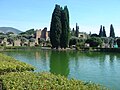
Thus, the area known as the Canopus, named after the Egyptian city and a section of the Nile which leads to the city, features a long, stately reflecting pool representing the Nile. It is a large open-air dining area with a covered triclinium with a huge stibadium (a semicircular masonry couch) located in an enormous domed exedra overlooking the lake. This area's sculptural program is the most complete including copies of famous sculptures including the caryatids of the Erechtheion, a statue depicting the Egyptian dwarf and fertility god Bes, and a crocodile. …
The United Nations Educational, Scientific and Cultural Organization (UNESCO) designated Hadrian's Villa as a World Heritage Site in 1999. The designation specified the boundaries of the site and created a buffer zone around it in which no new construction was permitted. In 2011, the communal government of Tivoli announced plans, later cancelled, to build a waste dump in the vicinity of the villa and approved the construction of public housing on 120,000 sq. meters within the buffer zone. At its 36th Annual Meeting, UNESCO formally addressed these encroachments on the site. While they commended the Italian government for its decision to abandon the construction of a waste dump in the Corcolle area, the committee requested the government "to inform the World Heritage Centre in due time about any major development project planned in the buffer zone of the property, including the housing development at Comprensorio di Ponte Lucano, for which a Heritage Impact Assessment should be included, in accordance with Paragraph 172 of the Operational Guidelines, before any irreversible commitment is made." UNESCO also requested "the State Party to submit... an updated report on the state of conservation of the property," by February 2014, reflecting concerns over the deterioration of the exposed ruins.
The reasons for making the villa a World Heritage Site are: it is a masterpiece that brings together the material culture of the Mediterranean world, it inspired the Renaissance and baroque period, it inspires the modern world as well, and the villa is an exceptional survival of the early Roman Empire.
In 2019, UNESCO designated Hadrian's Villa as a site with special immunity from wartime activity due to its profound symbolic value. In 2021 February, archaeologists led by researcher Rafael Hidalgo Prieto from the Pablo de Olavide University announced the discovery of remains of Hadrian's breakfast room which used to show his imperial power. They revealed a structure as a water triclinium and a separate dining room that served as a model for the well-known Serapeum.
"The emperor wanted to show things that would overwhelm the visitor, something that had not been seen anywhere else in the world and that exists only in Villa Adriana" said Prieto.
Text from Wikipedia, the free encyclopedia, under CC BY-SA 4.0. Full article: «Hadrian's Villa».
Events and people from Wikidata (CC0).
Distances are as the crow flies, not walking or driving.


Hadrian's Villa is in Tivoli, in the province of Roma (Lazio), Italy. Address: Piazza Trento, 5, 00019 Tivoli (RM). GPS coordinates: 41.94194, 12.77528.
There is an admission charge, but entry is free on the first Sunday of the month (Domenica al museo). Up-to-date prices are on the official website.
Nearby you’ll find: Maritime theatre at the Villa Adriana (100 m away), Villa Adriana, Pecile (100 m away), Antinoeion (200 m away).
Text. Wikipedia, the free encyclopedia (CC BY-SA 4.0).
Data. Wikidata (CC0); opening hours and contacts OpenStreetMap (ODbL).
Photos. Wikimedia Commons, author and licence on every image.
Updated 28 October 2026. All sources and licences