


- UNESCO
- Free 1st Sunday
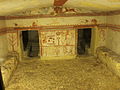
Photo: Unknown author Unknown author, Public domain · Wikimedia Commons
Archaeological site
Etruscan chamber tomb at Tarquinia
The Tomb of the Augurs (Italian: Tomba degli Àuguri) is an Etruscan burial chamber so called because of a misinterpretation of one of the fresco figures on the right wall thought to be a Roman priest known as an augur. The tomb is located within the Necropolis of Monterozzi near Tarquinia, Lazio, Italy, and dates to around 530-520 BC. This tomb is one of the first in Tarquinia to have figural decoration on all four walls of its main or only chamber, as well as a painted ceiling. The wall decoration was frescoed between 530-520 BC by an Ionian Greek painter, perhaps from Phocaea, whose style was associated with that of the Northern Ionic workers active in Elmali. This tomb is also the apparent first time we see the depictions of funerary ritual take precedent over mythology. Many of the figures depicted in the frieze, specifically those on the left and front walls, have been lost as the frescos have deteriorated over time from exposure. The entrance wall has figures placed on it, yet because of deterioration, no one can say for certain who or what these figures are and the actions that they are depicting.
There are generally four different surviving ceiling patterns from tombs created in the 5th-6th century BCE found in Tarquinia. Three of these are undoubtedly reminiscent of common textile patterns found across Italy around this time. The ceiling from the Tomb of the Augurs falls into this category, and has been assigned to that of a Four Dot Rosettes pattern. The red and blue textile pattern is split down the middle by a thick red line, outlined by two thin ones on either side. Scholars have interpreted that the ceiling pattern is meant to symbolize a fabric tent, to give shelter to the funerary proceedings regarding the deceased. Additionally, the tent is used as a method of breaking up space and creating separate areas in which the frescoes take place, presumably far away from where the false door is intended to be.
The frescoes on the entrance wall are unfortunately almost entirely chipped away, yet scholars have still made efforts to hypothesize on what they might have depicted. The most commonly accepted one is that of it being acroamatic scenes in respect to the deceased. Scholars have interpreted that Acroamata, in ancient Rome, likely related to activities regarding safeguarded oral traditions, whether it be singing, reading, or performing in any other vocal manner.
On the center of the rear wall a painted door is placed. This has been interpreted by scholars as a symbolic door or portal to the Underworld that acts as a barrier between the kingdom of the living and of the dead, being a common motif found in Greco-Roman antiquity, which has been described as a "false door" throughout scholarship. This motif has been viewed as a method of safe transition from the over to the underworld. …
Text from Wikipedia, the free encyclopedia, under CC BY-SA 4.0. Full article: «Tomb of the Augurs».
Distances are as the crow flies, not walking or driving.


Tomb of the Augurs is in Tarquinia, in the province of Viterbo (Lazio), Italy. GPS coordinates: 42.23818, 11.79473.
Nearby you’ll find: Tomb of the Bulls (200 m away), Tomb of the Leopards (2.2 km away), Tomb of the Triclinium (2.2 km away).
Text. Wikipedia, the free encyclopedia (CC BY-SA 4.0).
Data. Wikidata (CC0); opening hours and contacts OpenStreetMap (ODbL).
Photos. Wikimedia Commons, author and licence on every image.
Updated 28 October 2026. All sources and licences