


Photo: Mentnafunangann, CC BY-SA 3.0 · Wikimedia Commons
Archaeological site
Suburban Baths
Buildings in Pompeii
- Within the UNESCO World Heritage Site “Archaeological Areas of Pompei, Herculaneum and Torre Annunziata”
At a glance
- Type
- Archaeological site
- Protection
- Italian national heritage
- Coordinates
- 40°44′55″ N, 14°28′58″ E
- Address
- Scavi archeologici di Pompei - Regio VII - Fuori le mura - 1
History and description
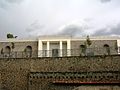
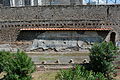
The Suburban Baths (Italian: Terme Suburbane) are a building in Pompeii, Italy, a town in the Italian region of Campania that was buried by the eruption of Mount Vesuvius in 79 AD, which consequently preserved it.
The Suburban Baths were publicly owned, as were also the Stabian, Forum, and Central baths in the city. They were built in the early empire, possibly under the Emperor Tiberius (14–37 AD), much later than the others and thus were built outside the city walls near the Porta Marina, one of the city gates. By this time, land was more easily available outside the city as the walls had lost their defensive role after the town became a Roman colony.
The baths also benefitted from the increased supply of running water after the connection of the city to the Aqua Augusta aqueduct in 30–20 BC.
The bathhouse was renovated after the earthquake of 62 AD, when a piscina calida, a heated swimming pool, was added to the north of the complex.
The baths were discovered in 1958, much later than the rest of the city, though a systematic excavation had to wait until 1985–1987.
Structure
The building was a two-story structure: the upper floor, as in the Palaestra/Sarno baths, was divided into three apartments for rent, with views towards the port and the Bay of Naples through the large glass windows. These rooms may also have provided space for the selling of sexual services. This upper floor was either accessed by a staircase from the floor below or via a door on the Via Marina.
The baths were built to a higher standard of luxury and thermal effectiveness than the earlier baths in the town and have many hallmarks of the "newer" bath architecture of the 1st century AD: "single-axis row" type (with rooms in a linear increasingly warm arrangement promoting a particular route through the baths and bordering a palaestra), large windows facing southwest, and an outdoor pool with a fountain.
Construction was first limited to the apodyterium (dressing room), frigidarium (cold room), tepidarium (warm room), laconicum (hot dry room) and caldarium (hot room); the natatio was added later as three rooms, including a nymphaeum with a water cascade, providing an alternative route to the existing one of the tepidarium followed by the caldarium. The entrance to the bathhouse is through a long corridor that leads into the apodyterium. The bathers would also have had access to a latrine, seating between six and eight people.
The piscina calida (hot pool) used an innovative heating system called a samovar, a domed metal plate which was part of the pool floor above the furnace to heat the pool water directly.
Only one apodyterium or dressing room has led to speculation by archaeologists that both men and women shared these baths, or that it was male-only or time-shared with females bathing at one time and males bathing at a different time. If it had been time shared the dressing room that contains the erotic wall paintings would have been used by everyone when they attended.
Erotic art in the Suburban Baths
A room that is thought to be a dressing room in the suburban baths has on a wall inside it seven wall paintings of sexual scenes and one wall painting of a figure with an enlarged scrotum. These wall paintings were found in 1986 when the room was first excavated. The paintings are dated to 62 to 79 AD.
The erotic wall paintings in the Suburban Baths are the only set of such art found in a public Roman bath house. Explicit sex scenes of group sex and oral sex are depicted in these paintings and these scenes cannot be easily found in collections of erotic Roman art. As the sexual acts portrayed are all considered "debased" according to the customs of ancient Rome, it is possible that the intention behind their reproduction was to provide a source of humor to visitors of the building.
Each wall painting of a sexual scene has a painting just below it of a box with a number on it. It is thought that there were actual boxes that were placed under these paintings of boxes.` These boxes would have been placed on a wooden shelf. This wooden shelf would have run along two walls of this dressing room just underneath where the paintings of numbered boxes are.` There are some holes in the rear and right wall where brackets that held the selves could have been.` It is thought that these boxes that were sitting on this wooden shelf under these paintings would have been where people attending the baths would have put their clothes after they had undressed in this room. The only remains of the boxes themselves are metal straps. In the wall paintings of the boxes you can see an "X" shape at the front of the boxes that indicates where the straps were. The wall painting also shows the wooden shelf underneath the boxes.
One idea that has been speculated is that spintria tokens were used as locker tokens in this dressing room. These tokens have on one side an image of a sexual scene and on the reverse side a numeral between I - XVI.
It is speculated that the sexual scenes and numerals on the tokens related to the wall paintings of sexual scenes and numerals. When the token was given to a person it then gave them access to a place to put their clothing. Possibly they may have put their clothing inside the box that was sitting on the wooden shelf in the dressing room. …
Text from Wikipedia, the free encyclopedia, under CC BY-SA 4.0. Full article: «Suburban Baths».
Photos
Getting there
Pompei Scavi - Villa dei MisteriTrain, nearest
200 m as the crow flies
Suburban BathsScavi archeologici di Pompei - Regio VII - Fuori le mura - 1
Porto di Castellammare di Stabia6.2 km
Aeroporto di Napoli Capodichino22.2 km
Distances are as the crow flies, not walking or driving.
Loading map…
Nearby
See on the mapMore archaeological sites in Campania

- UNESCO
- Free 1st Sunday

- UNESCO

- UNESCO

- UNESCO
- Free 1st Sunday

- Free 1st Sunday
Frequently asked questions
Where is Suburban Baths?
Suburban Baths is in Pompei, in the province of Napoli (Campania), Italy. Address: Scavi archeologici di Pompei - Regio VII - Fuori le mura - 1. GPS coordinates: 40.74860, 14.48280.
What else is there to see near Suburban Baths?
Nearby you’ll find: Antiquarium in Pompeii (0 m away), Villa Imperiale (0 m away), Temple of Venus (100 m away).
Sources and licences
Text. Wikipedia, the free encyclopedia (CC BY-SA 4.0).
Data. Wikidata (CC0); opening hours and contacts OpenStreetMap (ODbL).
Photos. Wikimedia Commons, author and licence on every image.
Credits for the 9 photos
- Terme Suburbane 2 — Mentnafunangann, CC BY-SA 3.0
- Exterior of the Suburban Baths at Pompeii (14429530620) — Amphipolis, CC BY-SA 2.0
- Ancient Roman mosaic in the Suburban Thermae, Pompeii 01 — Adam Harangozó, CC BY-SA 4.0
- Ancient Roman stuccos in Suburban Thermae (Pompeii)-2 — Yair Haklai, CC BY-SA 4.0
- 80045 Pompeii, Metropolitan City of Naples, Italy - panoramio (2) — Francis Cook, CC BY-SA 3.0
- Pompei (28457057273) — sébastien amiet;l, CC BY 2.0
- Pompei 17 33 21 573000 — Robot8A, CC BY-SA 4.0
- Pompei 17 34 16 978000 — Robot8A, CC BY-SA 4.0
- Pompei 2012 (8057056554) — ho visto nina volare from Italy, CC BY-SA 2.0
Updated 28 October 2026. All sources and licences