

Photo: Rabax63, CC BY-SA 4.0 · Wikimedia Commons
Archaeological site
Stabian Baths
Public baths at Pompeii located at the intersection of the Via Stabiana and the Via dell'Abbondanza
- Within the UNESCO World Heritage Site “Archaeological Areas of Pompei, Herculaneum and Torre Annunziata”
At a glance
- Type
- Archaeological site
- Protection
- Italian national heritage
- Coordinates
- 40°44′60″ N, 14°29′15″ E
- Address
- Scavi archeologici di Pompei - Regio VII - Insula 1 - 8
History and description
The Stabian Baths are an ancient Roman bathing complex in Pompeii, Italy. They were the oldest and the largest of the five public baths in the city and centrally located at the intersection of two main streets. Their original construction dates to c. 125 BC, making them one of the oldest bathing complexes known from the ancient world. They were remodelled and enlarged many times up to the eruption of Vesuvius in 79 AD.
Excavations in 2021 and 2023 have revised the layout of several phases of the baths and discovered two previously unknown laconica (saunas or sweat baths) under the palaestra courtyard.
Description
The Stabian Baths are located at the intersection of two main streets in Pompeii: the Via dell'Abbondanza to the south and the Via Stabiana to the east (the latter gives them their modern name), taking up the whole insula. On the west side, the baths are bordered by the Vicolo del Lupanare, and to the north by the house of P. Vedius Siricus. A row of shops fronted the streets. As was typical of ancient Roman bathhouses, the facilities were divided according to gender.
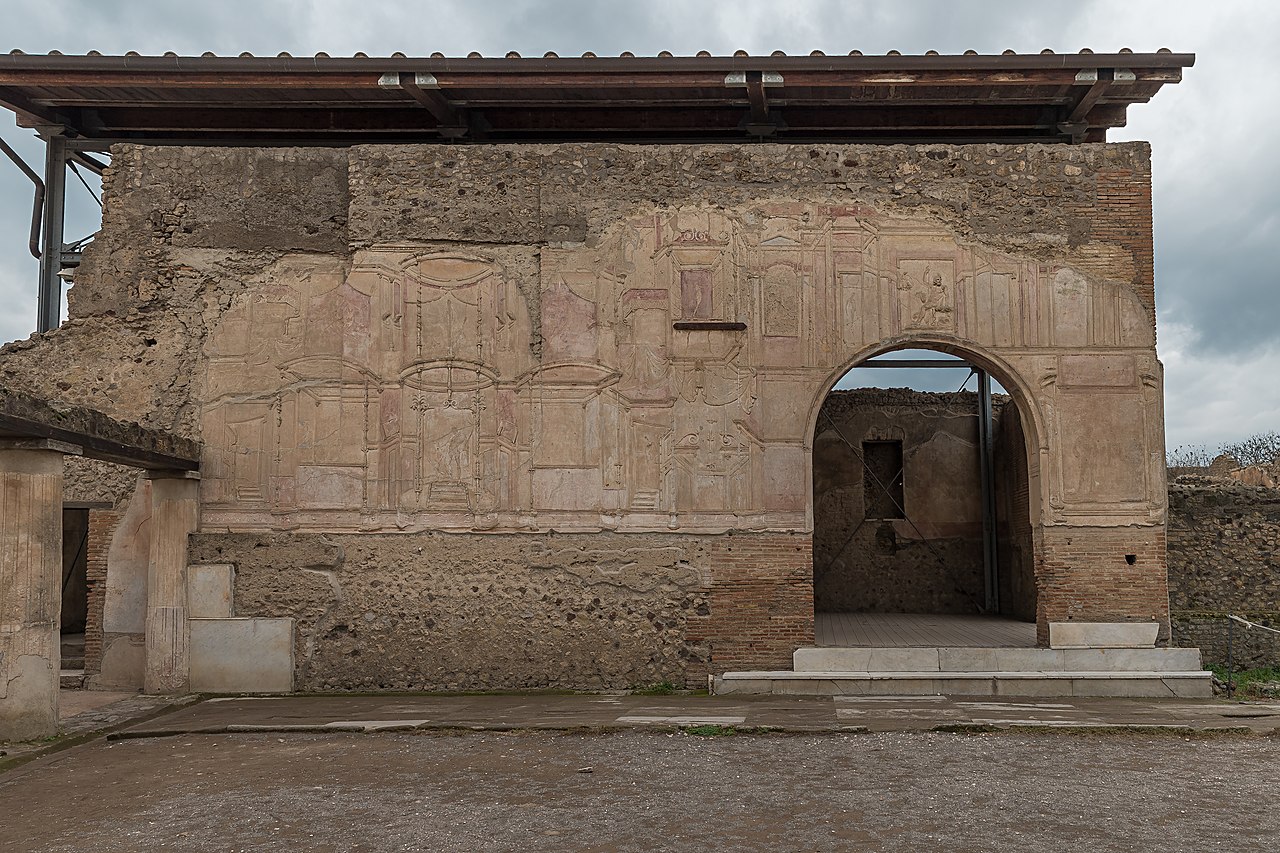
In their final phase the layout was as follows: the main (men's) entrance was from the Via dell'Abbondanza, through a vestibule (1) into the palaestra (2), a large open-air exercise ground or gymnasium. Other men's entrances were (26) (into the apodyterium or changing room) and (8) from the Vicolo del Lupanare. On the right-hand side of the palaestra is a colonnade which screened the entrance to the men's bath suite: the apodyterium (25), followed by the tepidarium (warm room) (23), caldarium (hot room) (21) and frigidarium (22). These rooms are rectangular, barrel-vaulted and parallel to one another in an arrangement known as the "single-axis row type", the most common model for baths adopted all over the Roman world. On the left-hand side of the palaestra was a swimming pool (natatio) (6); the rooms flanking it (5,7) were nymphaea with garden frescoes painted on the walls above a marble dado (lower portion of the wall above the plinth). The destrictarium (4) (room for preparing before, and cleaning after, gymnastic exercise) adjoining the nymphaeum (5) in the southwest corner of the palaestra has an exterior wall covered with elaborate stucco decoration, once brightly painted. On the left side of the palaestra is a bowling alley (3) with 9 tracks where 2 stone bowling balls were found. To the north is a latrine (14). …
History
Before the construction of the baths proper, the site was used primarily as a palaestra. There were also small rooms containing hip baths to the north during this early period.
In ca. 125 BC, as commemorated by a sundial with an inscription in Oscan found on the site, a magistrate had the first bath building constructed using fines levied by the local administration. The Stabian Baths then became a sizeable building occupying half an insula (city block). The building contained two sets of bath suites each with apodyterium, tepidarium and caldarium, a latrine and, for the men, two laconica (dry-sweating rooms) and the rectangular palaestra with Doric porticoes on three sides. Water was drawn from a well and stored in a reservoir on the roof.
When Pompeii became a Roman colony in 80 BC, the baths were extended by the duoviri (city magistrates) Caius Uulius and Publius Aninius as recorded in an inscription. The two earlier laconica were demolished and the palaestra was extended westwards into the triangular area over their sites, while the eastern portico was moved further west to allow two new rooms to be added in the former portico: a new, more substantial laconicum, using part of the tepidarium, and with a concrete dome and four semi-circular niches in the corners. The destrictarium (room for scraping the body clean with strigils, and the only place this is known in the Roman world) was built north of it in the portico and this probably also served as the entrance to the laconicum.
The work having been undertaken by the duoviri suggests that the Stabian Baths were publicly owned.
Around the turn of the first century AD under Augustus, running water was supplied to the baths for the first time when they were connected to the city's aqueduct. It is likely that around this time the house to the west of the palaestra was demolished to make room for an outdoor swimming pool (natatio) with two nymphaea with shallow pools on either side, a bowling alley and a second changing room. The shallow pools may have been used by patrons to wash their feet before they entered the swimming pool. Open rooms, probably exedrae, were added to the north wing of the baths facing onto the palaestra. …
Text from Wikipedia, the free encyclopedia, under CC BY-SA 4.0. Full article: «Stabian Baths».
Photos
Getting there
Pompei Scavi - Villa dei MisteriTrain, nearest
600 m as the crow flies
Stabian BathsScavi archeologici di Pompei - Regio VII - Insula 1 - 8
Porto di Castellammare di Stabia6.4 km
Aeroporto di Napoli Capodichino22.4 km
Distances are as the crow flies, not walking or driving.
Loading map…
Nearby
See on the mapMore archaeological sites in Campania

- UNESCO
- Free 1st Sunday

- UNESCO

- UNESCO

- UNESCO
- Free 1st Sunday

- Free 1st Sunday
Frequently asked questions
Where is Stabian Baths?
Stabian Baths is in Pompei, in the province of Napoli (Campania), Italy. Address: Scavi archeologici di Pompei - Regio VII - Insula 1 - 8. GPS coordinates: 40.74992, 14.48762.
Is Stabian Baths wheelchair accessible?
According to OpenStreetMap data, the site is wheelchair accessible.
What else is there to see near Stabian Baths?
Nearby you’ll find: Temple of Isis (100 m away), House of P. Casca Longus (I.6.11) (100 m away), House of M. Lucretius (100 m away).
Sources and licences
Text. Wikipedia, the free encyclopedia (CC BY-SA 4.0).
Data. Wikidata (CC0); opening hours and contacts OpenStreetMap (ODbL).
Photos. Wikimedia Commons, author and licence on every image.
Credits for the 9 photos
- Stabianer Thermen Auskleidehaus — Rabax63, CC BY-SA 4.0
- Pompei - Terme Stabiane - 2026-09-19 09-41-59 001 — Francoamantea, CC BY-SA 4.0
- Pompeii Terme Stabiane 03 — Ad Meskens You are free to use this picture for any purpose as long as you credit its author, Ad Meskens. Example: © Ad Meskens / Wikimedia Commons If you use this work outside of the Wikimedia…, CC BY-SA 4.0
- Termas Stabianas (Terme Stabiane) - Entrada (1436569470) — Cristian Martinez from Mexico, CC BY-SA 2.0
- Terme Stabiane - Pompei 26 — Anitsircana, CC BY-SA 4.0
- Terme Stabiane 1 — Mentnafunangann, CC BY-SA 3.0
- Terme Stabiane WLM 035 — Mentnafunangann, CC BY-SA 3.0
- Terme Stabiane WLM23 002 — Mentnafunangann, CC BY-SA 4.0
- Terme Stabiane, Pompeï, RP-F-00-1140 — Rijksmuseum, CC0
Updated 28 October 2026. All sources and licences