





- UNESCO
- Free 1st Sunday
Photo: Institute for the Study of the Ancient World from New York, United States of America, CC BY 2.0 · Wikimedia Commons
Archaeological site
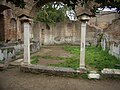
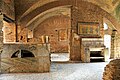
Public baths adjacent to Ostia's forum that are dated to the third century CE
Excavations at Ostia Antica have brought to light 26 bath complexes in the town. These range from large public baths, such as the Forum Baths, to smaller, often private ones, such as the small baths (Regio I, XIX, 5).
Baths in Ostia, like elsewhere in the Roman world, would have served both a hygienic and a social function. Bath construction increased after an aqueduct was built to Ostia in the early Julio-Claudian Period.
Many of the baths follow simple linear arrangements, with one room following the next, due to the density of buildings in Ostia. Only a few, like the Forum Baths or the Baths of the Swimmers, had the space to include a palaestra. Archaeologists name the bathhouses from features preserved, for example the inscription of Buticoso in building I, XIV, 8 leads to the name Bath of Buticosus or the mosaic of Neptune in building II, IV, 2 leads to the Baths of Neptune. The baths in Ostia follow the standard numbering convention, which divides the town into five regions, numbered I to V, and then identifies the individual blocks and buildings as follows: (region) I, (block) I, (building) 1.
The Forum Baths (I, XII, 6) are located of the Via della Forica south of the Forum. The complex is also called the Thermae Gavii Maximi, named after Marcus Gavius Maximus, the praetorian prefect who sponsored their construction. The baths were intended for public use and covered c. 3,200 m2. Statues of Hygieia, Aesculapius, and Fortuna were some of the many statues recovered from the bath that most likely belonged to the Forum Bath's decorative program. Additionally, cipollino columns were used to decorate the bathhouse.
There were several phases of construction for the baths. The Forum Baths were initially built during the reigns of Emperor Antoninus Pius c. 160 with subsequent additions during the Severan Dynasty (193-225), reign of Maxentius and Constantine (306-337), and finally during the reign of Theodosius (379-395). The Baths were constructed in the city centre and were the largest of all Ostia baths with a large palaestra south of the main building. The Forum Baths are characteristic of the experimental mode of planning during Hadrianic-Antonine period. The structure may have reached 15–17 m tall, although not as high the remains are still impressive. Along the southern face of the building are the warm rooms of the bathhouse, placed to take advantage of the sun's passive heating. Here a modern visitor can see the octagonal sun-bathing room (heliocaminus), an elliptical sweating room (laconicum) two tepidaria and a caldarium with three pools. The palaestra was surrounded on three sides by porticos which shaded the entrance to shops. Many hairpins were recovered during excavations proving that the baths were used by women. It is assumed that this would be at a separate time of day from men, but no clear evidence exists. …
This modest bathhouse (II, II, 3) is found close to the Porta Romana and Via Ostiensis. It has been speculated that it was the guild headquarters for the Cisiarii (Latin for Coachmen) however there is no direct evidence for this besides the subject of the mosaics. The structure was built during the Hadrianic era and refurbished during the 3rd Century CE. Notable is the large black-and-white mosaic in the frigidarium which depicts two sets of walls, possibly referring to Rome and Ostia, four figures of Atlas and a set of two-wheeled wagons (in Latin cisia) drawn by mules with silly names like Pudes (Prudish), Podagrosus (Gouty), Potiscus (Thirsty?), and Barosus (Effeminate). It is this mosaic that gives the name to the bathhouse. In recent excavations, a noria (wooden water wheel) was discovered in the rooms south of the frigidarium. Enslaved people would have walked in the wheel to draw up and distribute the water needed.
East of the theater is another large square bath complex covering c. 4,400 square meters (67 meters x 67 meters) and is known as the Baths of Neptune (II, IV, 2). The structure, built late during the reign of the emperor Hadrian, was dedicated early (~139 C.E.) in the reign of Antonius Pius. At the end of the second century C.E it was restored by Gamala Iunior. The bath continued to be renovated until the 4th century C.E. The bath house is surrounded on four sides by streets and has entrances on each street. The overall design of the bathhouse was similar to those found in Pompeii, such as the Central Baths and therefore represents the next aspect of development. …
These baths (III, I, 2-3) were constructed during the reign of Trajan and restored sometime during the early third century C.E. It is unclear if they are related to their namesake, the neighboring Christian Basilica (III, I, 4).
These baths (III, VIII, 2) were given the wrong name by early excavators at Ostia. Originally believed to be the Thermae Marittime in CIL XIV, 137 which has since been connected to the Porta Marina Baths. These baths were started around 130 C.E., destroying a part of the Republican city walls in their construction. They underwent two more sets of renovations around 210 C.E. and in the mid-4th century C.E. The bathhouse contains several mosaics with oceanic themes. One of them shows the head of Oceanus surrounding by four smaller tritons, done to emphasise the importance of the central figure. Beyond the typical bathhouse rooms, it also contains a set of terraces that led to the sea.
This bath complex (III, X, 2) creates a city block with houses to the north and the south (House of the Charioteers and House of Serapis) from the late Hadrianic/early Antonine period. It is possible this bathhouse was only intended for the residents of the two adjoining insulae. The bath is named after a satirical painting of seven Greek philosophers found in a room that was formerly a tavern and later used as the apodyterium, the philosophers are identified by their names and city of origin written in Greek and a humorous and ironic Latin inscription referring to latrine activities. The central hall contains a mosaic with 5 concentric rings depicting hunting scenes. The room adjacent to the natatio is a fresco of Venus Anadyomene.
These baths (III, XVI, 7) which were built at the same time as the Serapeum, were constructed during the reign of Hadrian. They were named after a mosaic found in the corridor south of the frigidarium which shows a female head with a triskeles, or three legs, behind her. The suspensurae, or raised floor, was restored during the reign of Commodus. In one of the heated rooms is a mosaic that potentially advertised where one could find prostitutes in the bathhouse. Although others suggest that it was a nickname for an unofficial youth organization. …
The Baths of the Lighthouse (IV, II, 1) have a long history of use, originally started during the late Trajanic/Early Hadrianic Period with renovations during the late Antonine/early Marcus Aurelian period, again during the reign of Caracalla, during the last quarter of the 3rd century C.E., and during the 5th century C.E. Flanking the entrance are shops and a thermopolium. The frigidarium contains 3rd-century frescoes of Europa and the Bull and Venus carried by Tritons and a Nereid. The namesake mosaic can be found in the floor of the frigidarium where fish and sea monsters surround a lighthouse (pharos). The lighthouse and a marine goat are the main compositional figures and they are surrounded by smaller marine creatures and black lines that represent water. Stamps on the fistulae is used as evidence that the ownership of the baths changed three times, between some Roman Senators and either Cornificia or Cornificia Minor.
These small baths were built behind a commercial building during the Antonine period. It is poorly preserved and on the edge of the excavated area.
It is unclear why these baths (IV, IV, 8) were give this name. They are evidence of the Late Antique inhabitation of Ostia being built between 390 and 425 C.E. They were constructed in a perisytlium of the House of Jupiter the Thunderer. There are many geometric mosaics found throughout the rooms here, additional the bathhouse has 10 apses, which could be the inspiration for its modern name.
This bathhouse (IV, V, 10-11), named for the six columns found in its courtyard, was along the western half of the Decumanus. It has several phases of construction, from the first half of the 2nd century C.E. through the Severan period. A cache of republican period coins in a bronze vessel was in its foundation. Like many of the smaller bathhouses, this one was set into the existing urban fabric with bars, shops, and apartments surrounding it. There are several reservoirs underneath that supply water to the bathhouse.
Text from Wikipedia, the free encyclopedia, under CC BY-SA 4.0. Full article: «Forum Baths, Ostia».
Distances are as the crow flies, not walking or driving.


Forum Baths, Ostia is in Rome, in the province of Roma (Lazio), Italy. GPS coordinates: 41.75398, 12.28944.
Nearby you’ll find: Caseggiato della Cisterna (0 m away), Foro della Statua Eroica (0 m away), Caseggiato dei Triclini (0 m away).
Text. Wikipedia, the free encyclopedia (CC BY-SA 4.0).
Data. Wikidata (CC0); opening hours and contacts OpenStreetMap (ODbL).
Photos. Wikimedia Commons, author and licence on every image.
Updated 28 October 2026. All sources and licences