


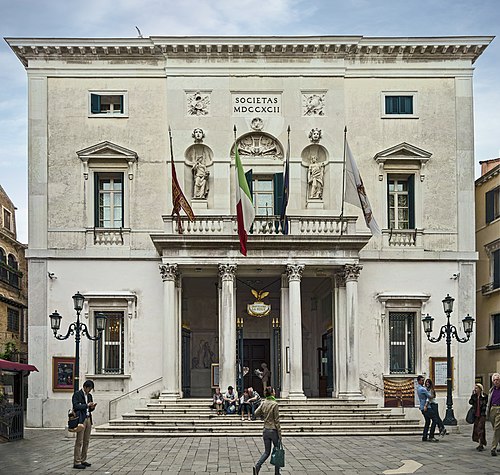
Photo: Secchi Smith, ©Teatro San Cassiano Ltd, CC BY-SA 4.0 · Wikimedia Commons
Historic theatre
Teatro San Cassiano
Opera house in Venice, Italy
- Within the UNESCO World Heritage Site “Venice and its Lagoon”
At a glance
- Type
- Historic theatre
- Coordinates
- 45°26′19″ N, 12°19′49″ E
History and description
The Teatro San Cassiano (or Teatro di San Cassiano and other variants) was the world's first public opera house, inaugurated as such in 1637 in Venice. The first mention of its construction dates back to 1581. The name with which it is best known comes from the parish in which it was located, San Cassiano (Saint Cassian), in the Santa Croce district (‘sestiere’) not far from the Rialto.
The theatre was owned by the Venetian Tron family and was the first ‘public’ opera house in the sense that it was the first to open to a paying audience. Until then, public theatres (i.e., those operating on a commercial basis) had staged only recited theatrical performances (commedie) while opera had remained a private spectacle, reserved for the aristocracy and the courts. The Teatro San Cassiano was, therefore, the first public theatre to stage opera and in so doing opened opera for wider public consumption.
Sixteenth century
The first information relating to a theatre on this site dates back to 1581. The Tron family theatre for commedie is referenced both in a letter sent by Ettore Tron to Duke Alfonso II d’Este, dated 4 January 1580 more veneto (i.e., 1581), and in Francesco Sansovino’s, Venetia città nobilissima et singolare, in which two theatres in the parish of San Cassiano are mentioned: according to some historians, and based on the roughly rectangular shape of the plot of land on which it stood, the Tron theatre would appear to have been the “egg-shaped” one, with the Michiel in turn being the “round” one. In the cited letter, Tron writes of “expenditure of great significance for the recitation of comedies”, but he also hints at the popularity of his venture:
Other than suggesting that the theatre was well received, this also confirms that theatre-boxes, which would later constitute one of the key architectural elements of the théâtre à l'italienne (an Italianate opera house), were already present in this first incarnation of the venue. This too is confirmed in a letter from Venice by Paolo Mori (agent of the Duke of Mantua), dated 7 October 1581, which mentions the “boxes of those two purpose-built venues”. Additionally, in Antonio Persio's Trattato de’ Portamenti (1607), within a passage referring to the years preceding 1593—and in reference seemingly to either the Tron theatre or the Michiel theatre—the author writes that the nobles “had rented almost all the boxes”. …
Seventeenth century
Archive documents refer with some continuity to the use of the Teatro San Cassiano for theatrical performances throughout the 1610s. In 1629 and 1633, two fires destroyed the theatre. No known archival documents mention the theatre in the two years 1634–1635.
In 1636, the Tron brothers (Ettore and Francesco, of the ‘branch’ of the San Benetto family) appear to have communicated to the authorities their intention to open a “Theatre for music”, thus clarifying from the outset its function as an opera house. This, in itself, marks a critical turning point in the history of opera: a theatre built specifically to stage music.
This is revealed in a document dated 2 May 1636, reportedly uncovered by Remo Giazotto in the late 1960s but no longer traceable since at least the mid-1970s:
With reference to the information given to these Illustrious Magistrates by the Noblemen Tron of San Benetto regarding the intention of opening a Theatre for music, as practiced in some places for the delight of distinguished audiences [...]
No image of the theatre of 1637 is extant today: neither of the outside nor of the inside. What is well known is that the Teatro San Cassiano was inaugurated in 1637 with the performance of L’Andromeda by Francesco Manelli (music) and Benedetto Ferrari (libretto). The dedication, dated 6 May 1637, specifies that the opera “had been reborn on stage two months ago”.
The historical significance of this event is incalculable, as is the commercial practice established of purchasing of an entrance ticket by each spectator; a concept destined for global diffusion, but which occurs here as public opera for the first time. Indeed, the Teatro San Cassiano can, therefore, be seen as the economic-architectonic prototype of the Italian opera house destined to enjoy enormous fortune over the following centuries. …
Eighteenth century
There is no evidence relating to structural works having occurred during the first half of the eighteenth century.
On the other hand, opera production continued with some consistency at least until the middle of the century, thanks in particular to the long-lasting collaboration with Tomaso Albinoni; other noted composers who staged their operas at the Teatro San Cassiano in this era were Antonio Pollarolo, Francesco Gasparini, Carlo Francesco Pollarolo, Antonio Lotti, Gaetano Latilla, Baldassare Galuppi.
As previously noted, prior to 1765, Francesco Bognolo—the architect in charge of the design of the ‘new’ Teatro San Cassiano—took measurements of “all the theatres in Venice, as well as the one in Padua”. Among these, the precise measurements relating to the ‘old’ Teatro San Cassiano appear. This theatre was characterised by reduced dimensions: the proscenium, for example, was a little wider than 8 metres, while the stage had an average depth of 6.5 metres. The boxes were extremely limited in size, at least by comparison to those of the nineteenth century to which we are now accustomed, and their widths ranged from about 95 centimetres to c. 120 centimetres in the ‘pergoletto di mezzo’ (central box). The recorded height of the boxes of the ‘primo ordine’ (second tier) was slightly less than 2.10 metres, while for those of the ‘terzo ordine’ (thus, the fourth tier) were just over 1.80 metres. As for the ‘new’ Teatro San Cassiano, inaugurated with La morte di Dimone (1763), music by Antonio Tozzi and libretto by Johann Joseph Felix von Kurz and Giovanni Bertati, the main difference was with regard the deeper stage, achieved by the extending the length of the theatre by demolishing two small houses which, with reference to the ‘old’ Teatro San Cassiano, stood against its end wall located a few metres from the outer curve of the boxes. In the ‘new’ Teatro San Cassiano, the average depth of the stage was slightly less than 9.5 metres, therefore approximately 3 metres more than its predecessor; the boxes were also a little wider than that of the late-seventeenth-century Teatro San Cassiano: suffice to compare the width the proscenium boxes of the ‘old’ theatre at 104 centimetres against 139 centimetres in the ‘new’ theatre. …
The reimagination and reconstruction project
The ongoing project to reconstruct the Teatro San Cassiano of 1637 in Venice has been conceived, directed and financed by Paul Atkin, founder and CEO of the Teatro San Cassiano Group Ltd. The project was first devised by Atkin in 1999, but research into the feasibility of rebuilding the original theatre of 1637 in Venice began in earnest in April 2015. This led to the incorporation of the Teatro San Cassiano Group in early May 2017 (near the anniversary of the libretto of L’Andromeda, whose dedication is dated 6 May 1637) and the official launch of the project in June 2019 through an international conference, an exhibition and a concluding concert held in Venice: ‘Teatro San Cassiano: need, solution, opportunity’. The project has received the formal support of the Comune of Venice. The Teatro San Cassiano Group has announced that a preferred site has been identified and that the appropriate technical-architectural studies are in process.
Text from Wikipedia, the free encyclopedia, under CC BY-SA 4.0. Full article: «Teatro San Cassiano».
Timeline
- 1637Opened
Events and people from Wikidata (CC0).
Photos
Getting there
Venezia Santa LuciaTrain, nearest
800 m as the crow flies
Teatro San Cassiano
San Silvestro300 m
Aeroporto Marco Polo di Venezia7.4 km
Distances are as the crow flies, not walking or driving.
Loading map…
Nearby
See on the mapMore historic theatres in Veneto


Frequently asked questions
Where is Teatro San Cassiano?
Teatro San Cassiano is in Venice, in the province of Venezia (Veneto), Italy. GPS coordinates: 45.43851, 12.33037.
What else is there to see near Teatro San Cassiano?
Nearby you’ll find: Palazzo Albrizzi (0 m away), Palazzo Soranzo (100 m away), Palazzo Muti Baglioni (100 m away).
Sources and licences
Text. Wikipedia, the free encyclopedia (CC BY-SA 4.0).
Data. Wikidata (CC0); opening hours and contacts OpenStreetMap (ODbL).
Photos. Wikimedia Commons, author and licence on every image.
Credits for the 3 photos
- Teatro San Cassiano reimagined — Secchi Smith, ©Teatro San Cassiano Ltd, CC BY-SA 4.0
- Teatro San Cassiano (1637) wooden model — Amodels Ltd, © Teatro San Cassiano Ltd, CC BY-SA 4.0
- Teatro San Cassiano (1763) — Venice State Archives, CC BY-SA 4.0
Updated 28 October 2026. All sources and licences