


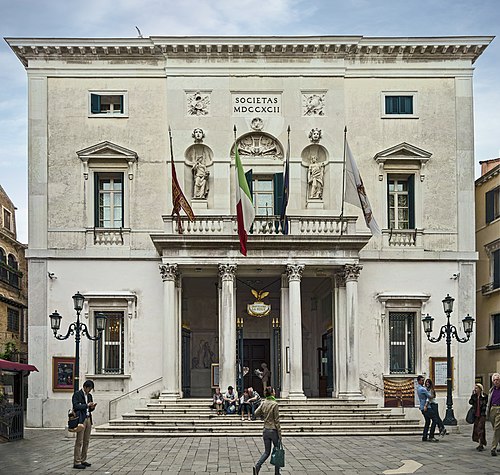
Photo: Photo: Andreas Praefcke, CC BY 3.0 · Wikimedia Commons
Historic theatre
Teatro Malibran
Theatre in Venice, Italy
- Within the UNESCO World Heritage Site “Venice and its Lagoon”
At a glance
- Type
- Historic theatre
- Architect
- Thomas Bezzi
- Coordinates
- 45°26′20″ N, 12°20′17″ E
History and description
The Teatro Malibran, known over its lifetime by a variety of names, beginning with the Teatro San Giovanni Grisostomo (or Crisostomo) after the nearby church, is an opera house in Venice which was inaugurated in 1678 with a production of the premiere of Carlo Pallavicino's opera Vespasiano. By 1683, it had quickly become known as "the biggest, most beautiful and richest theatre in the city" and its operatic importance throughout the 17th and 18th centuries led to an even grander description by 1730:
A true kingdom of marvels....that with the vastness of its magnificent dimension can be rightly compared to the splendours of ancient Rome and that with the grandeur of its more than regal dramatic performances has now conquered the applause and esteem of the whole world.
Richly decorated, the theatre consisted of five levels of thirty boxes and a large stalls area. However, as an opera house, its success was short-lived and from 1751 to 1800, opera was rarely performed there. Taken over by the municipality in 1797, it became the Teatro Civico until purchased by a partnership and restored in 1819. It re-opened again, this time in private hands, with Rossini's La gazza ladra.
As the Teatro San Giovanni Grisostomo
The theatre was built on the site of the former residence of the traveller Marco Polo and designed by Thomas Bezzi for the Grimani family. It became a venue for opera in Venice featuring high quality singers such as Margherita Durastanti who served as prima donna between 1709 and 1712. Alessandro Scarlatti's opera Mitridate Eupatore received its premiere there on 5 January 1707, while Georg Friedrich Händel's Agrippina premiered on 26 December 1709. The theatre also presented work by Carlo Francesco Pollarolo.
During the 1730s, the San Giovanni Grisostomo began a slow and inexorable decline, although managing to keep its position at the head of Venetian theatres until the middle of the eighteenth century. In 1737, when Carlo Goldoni was placed in charge of the Venetian stage, prose works began to be performed (many of these his own comedies). Subsequently, because of its considerable size, the Grimani family decided to open a smaller theater in 1755, the San Benedetto. The opening of this new stage led to the end of the dominance of the San Giovanni, which saw a slow decrease in performance.
Following the fall of the Republic of Venice and the French occupation, the theatre was among the few not to be closed.
As the Teatro Malibran
In 1819 it was sold to Gallo, who restored it in 1834; in 1837 he changed the name to Teatro Malibran, in honor of the famous singer Spanish mezzo-soprano Maria Malibran. In 1849 the return of the Austrians to Venice provoked the closure of all the major theatres of Venice as protest, but the Malibran was the exception.
Gallo's son took over in 1852; it was auctioned in 1886 then radically redecorated in the Egyptian style; it was closed for six years after a single operatic season in 1913 due to security problems, but it re-opened to present Verdi's Otello in December 1919 plus much of the popular Italian repertory after that. The Malibran was active in the presentation of operas, operettas, and even showed films for the first half of the 20th century.
In 1992 the municipality of Venice purchased the theatre, and the action which they took—especially that following the
destruction of the Teatro La Fenice in January 1996—is recounted on the Commune de Venezia's website:
When the Venice City Council bought the Malibran, it marked a new phase for the theatre: the restoration of the roof was meant to be the starting point of an extremely detailed project by Antonio Foscari to completely restore the building and modify the structures, in particular to extend the gallery and boxes. When the Fenice was destroyed in a fire in January 1996, the Malibran was placed in the limelight because it had become even more indispensable. Thus, the decision was taken to respect the entire original architectural structure rather than radically change the installations and increase the set machinery so that the project would be approved more rapidly and with innovative procedures. During restoration the orchestra pit was also enlarged and an enormous underground basin was made to collect the water from Venice's occasional flooding that could have filled the entire theatre with water. …
Text from Wikipedia, the free encyclopedia, under CC BY-SA 4.0. Full article: «Teatro Malibran».
Timeline
- 1678Opened
People
Events and people from Wikidata (CC0).
Photos
Getting there
Venezia Santa LuciaTrain, nearest
1.4 km as the crow flies
Teatro Malibran
Rialto Mercato200 m
Aeroporto Marco Polo di Venezia7.3 km
Distances are as the crow flies, not walking or driving.
Loading map…
Nearby
See on the mapMore historic theatres in Veneto


Frequently asked questions
Where is Teatro Malibran?
Teatro Malibran is in Venice, in the province of Venezia (Veneto), Italy. GPS coordinates: 45.43899, 12.33816.
What else is there to see near Teatro Malibran?
Nearby you’ll find: Palazzo Civran (100 m away), Casa Perducci (100 m away), Palazzo Ruzzini (100 m away).
Sources and licences
Text. Wikipedia, the free encyclopedia (CC BY-SA 4.0).
Data. Wikidata (CC0); opening hours and contacts OpenStreetMap (ODbL).
Photos. Wikimedia Commons, author and licence on every image.
Credits for the 8 photos
- Teatro Malibran — Photo: Andreas Praefcke, CC BY 3.0
- Teatro Malibran (7296483638) — Tony Hisgett from Birmingham, UK, CC BY 2.0
- Teatro Malibran di notte Venezia 2 — This Photo was taken by Wolfgang Moroder. Feel free to use my photos, but please mention me as the author and send me a message. This image is not in the public domain. Please respect the copyright…, CC BY-SA 3.0
- Teatro malibran venice — Abxbay, CC BY-SA 3.0
- Venezia Teatro Malibran facade — Photo: Andreas Praefcke, CC BY 3.0
- Theatre Malibran (Intérieur) — Van Der Meulen Christofle, CC0
- Theatre Malibran (Venice) — Van Der Meulen Christofle, CC0
- Paolo Monti - Servizio fotografico - BEIC 6363511 — Paolo Monti, CC BY-SA 4.0
Updated 28 October 2026. All sources and licences