


- Most beautiful villages
Photo: No machine-readable author provided. Pippo-b assumed (based on copyright claims)., Public domain · Wikimedia Commons
Historic village
Italian comune
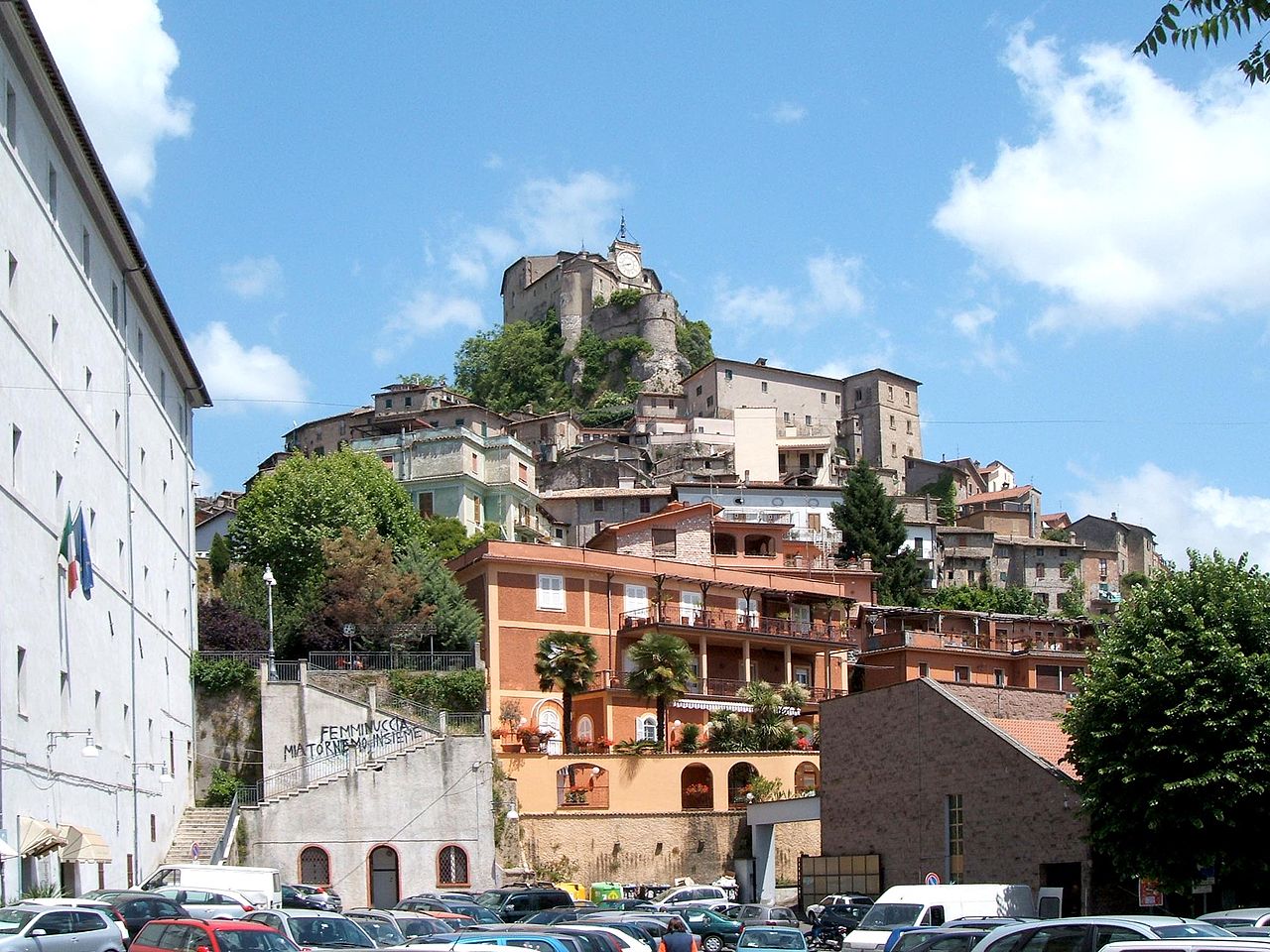
Subiaco is a comune (municipality) in the Metropolitan City of Rome Capital, in the Italian region of Latium, 40 kilometres (25 mi) from Tivoli alongside the River Aniene. It is a tourist and religious resort because of its sacred grotto (Sacro Speco), in the medieval St. Benedict's Abbey, and its Abbey of Santa Scolastica. It is one of I Borghi più belli d'Italia ("The most beautiful villages of Italy"). The first books to be printed in Italy were produced here in the late 15th century.
Among the first ancient settlers in the area were the Aequi, an Italic people. In 304 BC they were conquered by the Romans, who introduced their civilization and took advantage of the waters of the River Aniene. The present name of the city comes from the artificial lakes of the luxurious villa that Roman Emperor Nero had built: in Latin Sublaqueum means "under the lake". The name was applied to the town that developed nearby. The biggest of the three Subiaco Dams was then the highest dam in the world until its destruction in 1305. After the fall of the Roman Empire, the villa and the town were abandoned, becoming almost forgotten ruins.
When St. Benedict, at the age of fourteen (c. 494), retired from the world and lived for three years in a cave above the River Aniene, he was supplied with the necessaries of life by a monk, St. Roman. From this grotto, St. Benedict developed the concepts and organization of the Benedictine Order. He built twelve monasteries, including one at the grotto, and placed twelve monks in each. In 854 a record noted its renovation. In this year, Pope Leo IV is said to have consecrated an altar to Sts. Benedict and Scholastica, who was St Benedict's sister, and another to St. Sylvester.
Another renovation took place in 1053 under Abbot Humbert of the Abbey of St. Scholastica. Abbot John V, created cardinal by Pope Gregory VII, made the grotto the terminus of a yearly procession, built a new road, and had the altars reconsecrated. By 1200 there was a community of twelve monks, on which Innocent III conferred the title of priory; John XXII in 1312 appointed a special abbot for the monks. A new road was built by the city in 1688. …
In addition to the two abbeys, including Abbey of Santa Scolastica, also noteworthy are:
Nero's villa
Rocca Abbaziale ("Abbot's castle"), a massive medieval edifice largely rebuilt in the 16th and 17th centuries
Church of Saint Francis (1327), holds notable paintings from the 15th and 16th centuries.
Text from Wikipedia, the free encyclopedia, under CC BY-SA 4.0. Full article: «Subiaco».
Distances are as the crow flies, not walking or driving.


Subiaco is in Subiaco, in the province of Roma (Lazio), Italy. GPS coordinates: 41.93333, 13.10000.
Nearby you’ll find: Museo delle Attività Cartarie e della Stampa (900 m away), Rocca abbaziale (900 m away), Monastery of Saint Scholastica (1 km away).
Text. Wikipedia, the free encyclopedia (CC BY-SA 4.0).
Data. Wikidata (CC0); opening hours and contacts OpenStreetMap (ODbL).
Photos. Wikimedia Commons, author and licence on every image.
Updated 28 October 2026. All sources and licences