


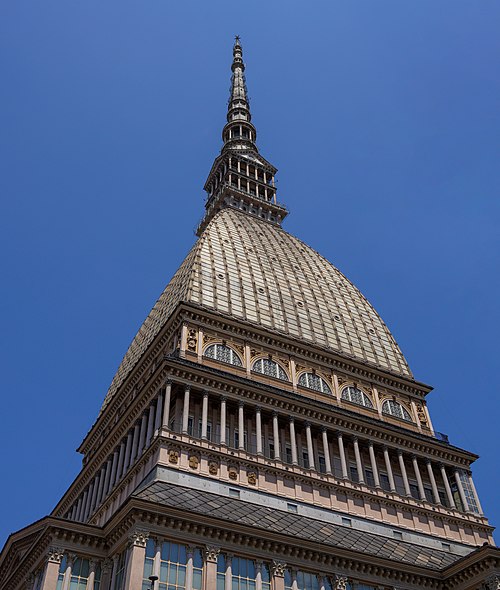
Photo: Livioandronico2013, CC BY-SA 3.0 · Wikimedia Commons
At a glance
- Type
- Fortress / Tower
- Coordinates
- 45°04′30″ N, 7°41′05″ E
History and description
The Palatine Gate (Italian: Porta Palatina; Piedmontese: Pòrta Palatin-a) is a Roman Age city gate located in Turin, Italy. The gate provided access through the city walls of Julia Augusta Taurinorum (modern Turin) from the North side and, as a result, it constituted the Porta Principalis Dextra of the old town.
The Palatine Gate represents the primary archaeological evidence of the city's Roman phase. It is one of the world's best-preserved 1st-century AD Roman gateways. Together with the ancient theatre's remains, located a short distance away, it is part of the so-called Archaeological Park, which opened in 2006.
Features
The Porta Principalis Dextra served as an access to the cardo maximus, currently identified in Via Porta Palatina and Via San Tommaso. Its impressive remains are currently visible at the center of an open area, today's Piazza Cesare Augusto.
Quite similar to the ancient Porta Decumana, built into the medieval structure of the present-day Palazzo Madama, the Palatine Gate represents an example of a typical Roman gate facing a cavaedium (quadrangular courtyard on the inside of the city walls), the remains of which are placed in front of the gate. Erected on a square base, the two angular towers are more than thirty metres high and feature a sixteen-sided structure. The central body, namely the interturrio, is about twenty metres long and is characterized by two orders of windows, the lower one composed of arch windows and the upper one made up of jack arch windows. The underlying portion features four entryways: the central ones are larger and taller and are vehicle accessible, while the two entryways to the sides are narrower and shorter and serve as pedestrian passageways. The grooves along the entryways' inner walls suggest the original presence of the so-called cateractae, an alleged system of gate gratings operated from the upper floor.
On the ground near the gate is still part of the guardhouse added in the Roman period, on which one can see the furrows on the stones caused by the transit of wagons.
The pair of bronze statues depicting Augustus Caesar and Julius Caesar are not the original statues but copies from the last, radical restoration of 1934. However, they are objects of discussion as they were incorrectly placed in the internal area occupied by the statio and not outside the gate, where they would possibly have more relevance.
History
Built in the 1st century during the Augustan Age or the Flavian Age, the Porta Principalis Dextra may predate the construction of the city walls and was perhaps built on the location of an earlier Republican Age gate.
This facility served as a city gate for a long time and was turned into a castrum in the 11th century, although it lost the internal structure of the cavaedium over the centuries. In 1404, after centuries of incursions and partial decay, the western tower was rebuilt, and both towers were completed with battlements for defensive purposes.
The Palatine Gate was supposed to be torn down in the early 18th century, pursuant to the urban renewal process started by Vittorio Amedeo II. However, the dismantling was not implemented thanks to the intervention of the architect and engineer Antonio Bertola, who convinced the duke to preserve the ancient architectural work.
In 2006, the City of Turin started a restoration of the archaeological area, with the intent to improve the park, make the towers accessible to the public, and build an underground parking for the carts of the nearby Porta Palazzo open market.
Text from Wikipedia, the free encyclopedia, under CC BY-SA 4.0. Full article: «Palatine Towers».
Photos
Getting there
Torino Porta SusaTrain, nearest
1.5 km as the crow flies
Palatine Towers
Aeroporto di Torino14.2 km
Distances are as the crow flies, not walking or driving.
Loading map…
Nearby
See on the mapMore fortresses and towers in Piedmont


Frequently asked questions
Where is Palatine Towers?
Palatine Towers is in Turin, in the province of Torino (Piedmont), Italy. GPS coordinates: 45.07500, 7.68470.
What else is there to see near Palatine Towers?
Nearby you’ll find: Casa del Pingone (100 m away), Palazzo dei Cavalieri (100 m away), Palazzi Juvarriani in Piazza della Repubblica (100 m away).
Sources and licences
Text. Wikipedia, the free encyclopedia (CC BY-SA 4.0).
Data. Wikidata (CC0); opening hours and contacts OpenStreetMap (ODbL).
Photos. Wikimedia Commons, author and licence on every image.
Credits for the 4 photos
- Porta Palatina Torino — Livioandronico2013, CC BY-SA 3.0
- Porta palatina, statue — Anassagora, CC BY 3.0
- PortaPalatina basolato — Enryonthecloud, Public domain
- PortaPalatina scalanatura — Enryonthecloud, Public domain
Updated 28 October 2026. All sources and licences