


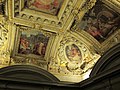


Photo: Francesco Bini, CC BY-SA 4.0 · Wikimedia Commons
Historic villa / palace, 1299
Palazzo Vecchio
Palace in Florence, Italy
- Within the UNESCO World Heritage Site “Historic Centre of Florence”
At a glance
- Period
- Middle Ages, 1299
- Styles
- Romanesque art, Gothic architecture
- Architect
- Arnolfo di Cambio
- Protection
- Italian national heritage
- Coordinates
- 43°46′10″ N, 11°15′22″ E
- Address
- Piazza della Signoria 1
History and description
The Palazzo Vecchio is the town hall of Florence, Italy. It overlooks the Piazza della Signoria, which holds a copy of Michelangelo's David statue, and the gallery of statues in the adjacent Loggia dei Lanzi.
Originally called the Palazzo della Signoria, after the Signoria of Florence, the ruling body of the Republic of Florence, this building was also known by several other names: Palazzo del Popolo, Palazzo dei Priori, and Palazzo Ducale, in accordance with the varying use of the palace during its long history. The building acquired its current name when the Medici duke's residence was moved across the Arno River to the Palazzo Pitti.
History
In 1299, the commune and people of Florence decided to build a palace that would be worthy of the city's importance, and that would be more secure and defensible in times of turbulence for the magistrates of the commune. Arnolfo di Cambio, the architect of the Duomo and the Santa Croce church, began construction upon the ruins of Palazzo dei Fanti and Palazzo dell'Esecutore di Giustizia, once owned by the Uberti family. Giovanni Villani (1276–1348) wrote in his Nuova Cronica that the Uberti were "rebels of Florence and Ghibellines", stating that the palazzo was built to ensure that the Uberti family homes would never be rebuilt on the same location.
The cubical building is made of solid rusticated stonework, with two rows of two-lighted Gothic windows, each with a trefoil arch. In the 15th century, Michelozzo added decorative bas-reliefs of the cross and the Florentine lily in the spandrels between the trefoils. The building is crowned with projecting crenellated battlements, supported by small arches and corbels. Under the arches are a repeated series of nine painted coats of arms of the Florentine republic. Some of these arches can be used as embrasures (spiombati) for dropping heated liquids or rocks on invaders.
The solid, massive building is enhanced by the simple tower with its clock. Giovanni Villani wrote that Arnolfo di Cambio incorporated the ancient tower of the Foraboschi family (the tower then known as "La Vacca" or "The Cow") into the new tower's facade as its substructure; this is why the rectangular tower (height 94 m) is not directly centered in the building. This tower contains two small cells, that, at different times, imprisoned Cosimo de' Medici (the Elder) (1435) and Girolamo Savonarola (1498). The tower is named Torre d'Arnolfo after its designer. The tower's large, one-handed clock was originally constructed in 1353 by the Florentine Nicolò Bernardo, but was replaced in 1667 with a replica made by Georg Lederle from the German town of Augsburg (Italians refer to him as Giorgio Lederle of Augusta) and installed by Vincenzo Viviani. …
Entrance
Above the front entrance door, there is a notable ornamental marble frontispiece, dating from 1528. In the middle, flanked by two gilded lions, is the Jesuit symbol, surrounded by a glory, above the text (in Latin): "Rex Regum et Dominus Dominantium" (translation: "King of Kings and Lord of Lords"). This text dates from 1851 and does not replace an earlier text by Savonarola as mentioned in guidebooks. Between 1529 and 1851 they were concealed behind a large shield with the grand-ducal coat of arms.
Michelangelo's David also stood at the entrance from its completion in 1504 to 1873, when it was moved to the accademia Gallery. A replica erected in 1910 now stands in its place, flanked by Baccio Bandinelli's Hercules and Cacus. The statuary present at the entrance of the Palazzo Vecchio is a testament to the fluctuating political atmosphere in Florence from 1504 to 1534, when Michelangelo's David and Bandinelli's Hercules and Cacus were created, respectively. The statuary in front of this political building was commissioned under two different rulers in Florence, David under Piero Soderini and Hercules and Cacus under the Medici. These statues, thus engage in a fierce dialogue with each other as well as the Florentine public about the socio-political state of Florence under each of the rulers. The statues at the entrance were installed next to each other to perpetuate different political agendas depending on their patron and demonstrate superiority from one regime to the next.
Courtyards
The first courtyard was designed in 1453 by Michelozzo. In the lunettes, high around the courtyard, are crests of the church and city guilds. In the center, the porphyry fountain is by Battista del Tadda. The Putto with Dolphin on top of the basin is a copy of the original by Andrea del Verrocchio (1476), now on display on the second floor of the palace. This small statue was originally placed in the garden of the Villa Medici at Careggi. The water, flowing through the nose of the dolphin, is brought here by pipes from the Boboli Gardens.
In the niche, in front of the fountain, stands Samson and Philistine by Pierino da Vinci.
The frescoes on the walls are vedute of the cities of the Austrian Habsburg monarchy, painted in 1565 by Giorgio Vasari for the wedding celebration of Francesco I de' Medici, the eldest son of Cosimo I de' Medici, to Archduchess Johanna of Austria, sister of the Emperor Maximilian II. Amongst the cities depicted are Graz, Innsbruck, Linz, Vienna, Bratislava (Pozsony), Prague, Hall in Tirol, Freiburg im Breisgau and Konstanz. Some were damaged over the course of time.
The harmoniously proportioned columns, at one time smooth, and untouched, were at the same time richly decorated with gilt stuccoes.
The barrel vaults are furnished with grotesque decorations.
The second courtyard, also called "The Customs", contains the massive pillars built in 1494 by Il Cronaca (1457–1508) that sustains the great "Salone dei Cinquecento" on the second floor.
The third courtyard was used mainly for offices of the city. Between the first and second courtyard the massive and monumental stairs by Vasari lead up to the "Salone dei Cinquecento".
Salone dei Cinquecento
The Salone dei Cinquecento (Hall of the Five Hundred) is the largest and most imposing chamber in the Palazzo Vecchio. It measures approximately 52 meters (170 feet) in length, 23 meters (75 feet) in width, and 18 meters (59 feet) in height. However, another source reports slightly different dimensions, with a width of 22.15 meters and lengths of 51.61 meters along the east wall and 53.47 meters along the west wall.
The Salone dei Cinquecento was built in 1494 by Simone del Pollaiolo, on commission of Savonarola who, replacing the Medici after their exile as the spiritual leader of the Republic, wanted it as a seat of the Grand Council (Consiglio Maggiore) consisting of 500 members.
Later, the hall was enlarged by Giorgio Vasari so that Grand Duke Cosimo I could hold his court in this chamber. During this transformation, famous (but unfinished) works were lost, including the Battle of Cascina by Michelangelo, and the Battle of Anghiari by Leonardo da Vinci. Leonardo was commissioned in 1503 to paint one long wall with a battle scene celebrating a famous Florentine victory. He was always trying new methods and materials and decided to mix wax into his pigments. Da Vinci had finished painting part of the wall, but it was not drying fast enough, so he brought in braziers stoked with hot coals to try to hurry the process. A legend exists that Giorgio Vasari, wanting to preserve Da Vinci's work, had a false wall built over the top of The Battle of Anghiari before painting his fresco. Attempts to find Da Vinci's original work behind the Vasari fresco have so far been inconclusive.
Michelangelo never proceeded beyond the preparatory drawings for the fresco he was commissioned to paint on the opposite wall. Pope Julius II called him to Rome to paint the Sistine Chapel, and the master's sketches were destroyed by eager young artists who came to study them and took away scraps.Missing Ref. The surviving decorations in this hall were made between 1555 and 1572 by Giorgio Vasari and his helpers, among them Livio Agresti from Forlì. They mark the culmination of mannerism and make this hall the showpiece of the palace. …
Text from Wikipedia, the free encyclopedia, under CC BY-SA 4.0. Full article: «Palazzo Vecchio».
Timeline
- 1299Built
Events and people from Wikidata (CC0).
Photos
Getting there
Firenze Santa Maria NovellaTrain, nearest
1.1 km as the crow flies
Palazzo VecchioPiazza della Signoria 1
Aeroporto Firenze Amerigo Vespucci6.2 km
Distances are as the crow flies, not walking or driving.
Loading map…
Nearby
See on the mapMore historic villas and palaces in Tuscany

- Free 1st Sunday

- UNESCO
- Free 1st Sunday

- UNESCO
- Free 1st Sunday

- Free 1st Sunday

Frequently asked questions
Where is Palazzo Vecchio?
Palazzo Vecchio is in Florence, in the province of Firenze (Tuscany), Italy. Address: Piazza della Signoria 1. GPS coordinates: 43.76944, 11.25611.
How old is Palazzo Vecchio?
Wikidata dates it to 1299.
What else is there to see near Palazzo Vecchio?
Nearby you’ll find: Vasari Corridor (100 m away), Gabinetto dei disegni e delle stampe (100 m away), Studiolo of Francesco I (100 m away).
Sources and licences
Text. Wikipedia, the free encyclopedia (CC BY-SA 4.0).
Data. Wikidata (CC0); opening hours and contacts OpenStreetMap (ODbL).
Photos. Wikimedia Commons, author and licence on every image.
Credits for the 9 photos
- Piazza della signoria, palazzo vecchio, veduta 01 — Francesco Bini, CC BY-SA 4.0
- Escuts a la façana del Palazzo Vecchio, Florència — Joanbanjo, CC BY-SA 3.0
- Firenze Palazzo Vecchio 06 — Andrzej Otrębski, CC BY-SA 4.0
- Inside of the Palazzo Vecchio, Florence (5771653804) — Michal Osmenda from Brussels, Belgium, CC BY-SA 2.0
- Palazzo vecchio (retro) — Sailko, CC BY 2.5
- Palazzo Vecchio by nigth — Petar Milošević, CC BY-SA 4.0
- Palazzo Vecchio Cortile interno — Lorenzo Testa, CC BY-SA 4.0
- Palazzo vecchio, cortile della dogana 02 — sailko, CC BY 2.5
- Palazzo vecchio, porta di tramontana — sailko, CC BY 2.5
Updated 28 October 2026. All sources and licences