


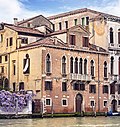


Photo: Abxbay, CC BY-SA 3.0 · Wikimedia Commons
Historic villa / palace
Palazzo Priuli Stazio, Venice
Building in Venice, Italy
- Within the UNESCO World Heritage Site “Venice and its Lagoon”
At a glance
- Coordinates
- 45°26′28″ N, 12°19′43″ E
History and description
The Palazzo Priuli Stazio is a Baroque architecture palace located near San Giacomo dell'Orio in the sestiere of Santa Croce in Venice, Italy.
History
Previously, the place had been property of the Suriàn family, admitted to Venetian aristocracy in 1648. The family originally had moved from Rimini in the 15th century, and included the physician Giacomo; Grand Chancellor Andrea; Bernardo, archbishop of Corfu in 1482; and an Antonio, patriarch of Venice in 1504. The aristocratic branch was soon extinguished by 1679.
In 1534, the Suriàn family sold this palace to Marcantonio Prezzato, a rich merchant from Bergamo, who moved to Venice around 1537. Agostino, the son of Marcantonio commissioned reconstruction using designs of Jacopo Sansovino. In 1636, a son of Agostino, also named Marcantonio, in turn sold the palace to Lorenzo and Bernardo Stazio; in 1659, the Stazio family joined the aristocracy. In 1701, by virtue of Elisabetta Stazio's marriage to Michiele Priuli-Renier, the palace was ultimately inherited in the 19th century, by two sisters: Elisabetta Labia Priuli and Orsola Priuli Maccarani, both living in Rome. In 1859, the palace was deeded to the Comune of Venice to serve as quarters of the Municipal Guards.
The interior decoration has since been dispersed. In the 18th century, the ground floor had, in the style of Alessandro Vittoria, a bust of a bearded man; likely a portrait of someone from the Priuli family. There were also once four oil canvases located in the piano nobile depicting illustrious members of the Priuli Family:
Silvestro Priuli, son of Michele, and grandnephew of King Taksony of Hungary, who during the crusades was one of the first to scale the walls of Ascalon in 1098.
Zilia, daughter of Marco Dandolo, and wife of Doge Lorenzo Priuli, crowned dogaressa 1557.
Pietro Priuli, son of Benedetto, elevated among other commissions to Provveditore to the Crown. 1593.
Francesco Priuli, son of Michele, once ambassador to Charles Emmanuel I, Duke of Savoy, and then in Valladolid to King Philip III of Spain, defending the Republic of Venice from the calumnies by its enemies in 1606.
Text from Wikipedia, the free encyclopedia, under CC BY-SA 4.0. Full article: «Palazzo Priuli Stazio, Venice».
Getting there
Venezia Santa LuciaTrain, nearest
600 m as the crow flies
Palazzo Priuli Stazio, Venice
San Marcuola "A"100 m
Aeroporto Marco Polo di Venezia7.1 km
Distances are as the crow flies, not walking or driving.
Loading map…
Nearby
See on the mapMore historic villas and palaces in Veneto

- Free 1st Sunday


- UNESCO

- UNESCO
- Free 1st Sunday
- UNESCO
Frequently asked questions
Where is Palazzo Priuli Stazio, Venice?
Palazzo Priuli Stazio, Venice is in Venice, in the province of Venezia (Veneto), Italy. GPS coordinates: 45.44120, 12.32870.
What else is there to see near Palazzo Priuli Stazio, Venice?
Nearby you’ll find: Galleria internazionale d'arte moderna (100 m away), Fondaco dei Turchi (100 m away), Museo di Storia Naturale di Venezia (100 m away).
Sources and licences
Text. Wikipedia, the free encyclopedia (CC BY-SA 4.0).
Data. Wikidata (CC0); opening hours and contacts OpenStreetMap (ODbL).
Photos. Wikimedia Commons, author and licence on every image.
Credits for the 1 photos
- Pal priuli stazio 1777 — Abxbay, CC BY-SA 3.0
Updated 28 October 2026. All sources and licences