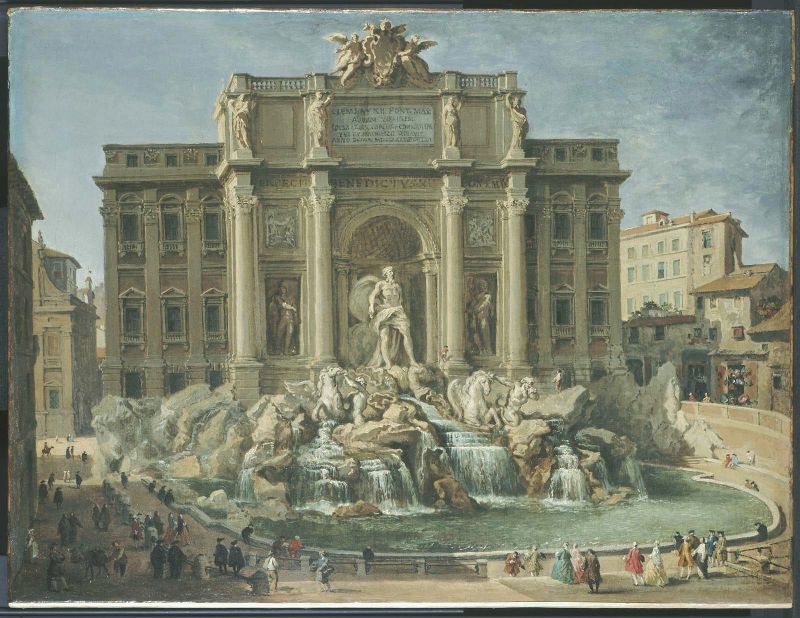


Photo: Giovanni Paolo Panini, Public domain · Wikimedia Commons
Historic villa / palace
Palazzo Poli
Building in Rome, Italy
- Within the UNESCO World Heritage Site “Historic Centre of Rome, the Properties of the Holy See in that City Enjoying Extraterritorial Rights and San Paolo Fuori le Mura”
At a glance
- Architect
- Martino Longhi il vecchio
- Coordinates
- 41°54′04″ N, 12°28′59″ E
History and description
The Palazzo Poli is a palace in Rome, Italy, that was altered in the 18th century to form the backdrop to the Trevi Fountain.
History
In 1566, Lelio dell'Anguillara, Duke of Ceri, purchased the Palazzo Del Monte. He commissioned the Palazzo Ceri, in honor of himself, and hired the architect Martino Longhi the Elder. In 1591, Martino Longhi the Elder died and the architect Ottaviano Nonni was hired to finish the original project.
The House of Borromeo inherited Palazzo Ceri and completed multiple renovations and extensions. Eventually, in 1678, the palace was for sale. Purchased by Lucrezia Colonna, who was married to the Duke of Poli, Giuseppe Lotario Conti. Here, the palace changed names again to how it is known today, Palazzo Conti di Poli, or Palazzo Poli. The Conti family was responsible for many more extensions, including purchasing and incorporating of many adjacent buildings which formed the Piazza di Trevi. The son of Giuseppe Lotario, Duke Stefano Conti, completed these renovations, including demolishing the central portion of the building, before 1730 to allow for the building of the Trevi Fountain.
The new Baroque style south facade of the building was commissioned by Nicola Salvi in 1731. He hired the architect, Luigi Vanvitelli. As a setting for the fountain, Vanvitelli gave the building a new monumental façade that contains the giant order of Corinthian pilasters linking the two main storeys of the palace.
Museum
Maria Cristina Misiti, director of the National Institute of Graphics, had the idea to turn the building into a museum to help visitors learn more about the history of Rome and its inhabitants. The Palazzo Poli houses the institute's collection of copper engraving plates dated from the sixteenth century to the present.
Text from Wikipedia, the free encyclopedia, under CC BY-SA 4.0. Full article: «Palazzo Poli».
People
Events and people from Wikidata (CC0).
Photos
Getting there
FlaminioTrain, nearest
1.4 km as the crow flies
Palazzo Poli
Aeroporto di Roma-Ciampino14.5 km
Distances are as the crow flies, not walking or driving.
Loading map…
Nearby
See on the mapMore historic villas and palaces in Lazio

- Free 1st Sunday


Frequently asked questions
Where is Palazzo Poli?
Palazzo Poli is in Rome, in the province of Roma (Lazio), Italy. GPS coordinates: 41.90114, 12.48318.
What else is there to see near Palazzo Poli?
Nearby you’ll find: Istituto nazionale per la grafica (0 m away), Istituto centrale per la grafica (100 m away), Accademia di San Luca (100 m away).
Sources and licences
Text. Wikipedia, the free encyclopedia (CC BY-SA 4.0).
Data. Wikidata (CC0); opening hours and contacts OpenStreetMap (ODbL).
Photos. Wikimedia Commons, author and licence on every image.
Credits for the 7 photos
- Pannini, Giovanni Paolo - Fountain of Trevi, Rome - 18th c — Giovanni Paolo Panini, Public domain
- Façade van Palazzo Poli te Rome, RP-P-1957-653-26-1 — Rijksmuseum, CC0
- Roma - Palazzo Poli - 2025-10-12 001 — C_messier, CC BY-SA 4.0
- 20090802 Panorama, Trevi Fountain, Rome, Italy — Fod, CC BY 2.5 dk
- 2011 Fontana di Trevi — Miguel Hermoso Cuesta, CC BY-SA 4.0
- Façade van het paleis van de hertog van Ceri te Rome, RP-P-2016-709-35 — Rijksmuseum, CC0
- Fontana de Trevi (5047663584) — Andrés Nieto Porras from Palma de Mallorca, España, CC BY-SA 2.0
Updated 28 October 2026. All sources and licences