





Photo: Sailko, CC BY 3.0 · Wikimedia Commons
Historic villa / palace
Palazzo delle Poste
Building in Grosseto, Italy
At a glance
- Style
- Rationalism
- Architect
- Angiolo Mazzoni
- Coordinates
- 42°45′50″ N, 11°06′43″ E
History and description
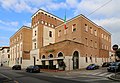
The Palazzo delle Poste (transl. Post Office Building) is an administrative building which serves as the Poste Italiane headquarters in Grosseto, Tuscany. It was designed by architect Angiolo Mazzoni and completed in 1932. The building features an exterior in a monumental style, typical of the Fascist architecture, while the interior is characterized by a closer alignment with the modern principles of Italian rationalism. It also houses sculptures by Napoleone Martinuzzi and Domenico Ponzi.
Location
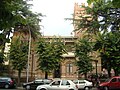
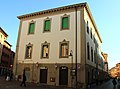
The building is situated in the suburb of Porta Nuova, outside the city walls, and is bordered by Via Roma and Viale Giacomo Matteotti, overlooking Piazza Fratelli Rosselli, formerly Piazza Umberto I, and commonly known as Piazza della Vasca. It serves as a key visual landmark aligned with Via Fallaci, leading into the historic center. The square features significant architecture from different periods and styles: the neo-classical Palazzo del Governo; Ludovico Quaroni's modern multi-purpose building from the 1970s; the Villino Panichi with its Renaissance Revival and Art Nouveau-style elements; and the austere former Royal Normal School (now "Giovanni Pascoli" middle school).
History
As part of Benito Mussolini's plan to tackle unemployment, Decree No. 10102 on 8 July 1930, authorized the construction of the Post and Telegraph Building in Grosseto, designed by architect Angiolo Mazzoni. Mazzoni selected a site in a circular square named after Umberto I, outside the city walls in the suburb of Porta Nuova. After initial design revisions, the final project was completed by June 1930. Expropriations began in April, and demolition of existing buildings, including the recently built Art Nouveau-style Palazzo Barth, started in September.
The masonry contract was awarded to Milan's Rusconi Carlo company in September 1930, with a significant discount on the estimated cost. The work, which began on 4 February 1931, and involved around 120 workers daily, was completed by 20 October 1932. Marble, travertine, and granite were supplied by Società Marmifera Nord Carrara of Montecatini group. The building was inaugurated on 13 November 1932, in the presence of King Victor Emmanuel III. Additional completion works were approved in August 1939.
Post-war modifications included raising the central body of the building in 1953 (completed in 1955), constructing a new single-story section for mail carriers in 1963, and expanding the public hall and director's apartment in 1975. A request was made in 1983 to raise the eastern wing on Via Roma.
Description
The building is a city landmark with a monumental and rhetorical style. It has a trapezoidal plan due to the plot's shape, leading to an unconventional layout along the bisector of the angle formed by the adjacent streets. The main section, facing Piazza Rosselli, is clad in Rapolano travertine and features entrance arches. This section is connected to two nearly symmetrical wings along Via Roma and Viale Matteotti, with central spaces linking them and overlooking a rear service courtyard.
The main facade, about 20 meters high, is divided into three parts, highlighted by a monumental portal with a lintel supported by Ionic columns and topped by the marble group of Maremma Domata ("Tamed Maremma") by Napoleone Martinuzzi. A prominent elliptical tower, containing the main staircase, serves as a visual and functional hinge between the wings. The tower's verticality is accentuated by a central window illuminating the staircase and directing attention to small clock openings below the windowed loggia at the top.
The facade's slight concavity follows the square's circular shape, balanced by a convex granite staircase leading to a paved plaza in Rapolano travertine. This plaza features a circular fountain with a Portasanta marble basin and a central diorite sphere. Smaller portals, framed by Portasanta marble fasces, lead to elegant rooms with high-quality materials, including yellow marble from Mori and green Alpi marble benches.
Original glass and brass lights are found by the entrances to the public hall, which has wooden paneling with integrated neon lighting. The right-side room, missing a marble bench, features a bronze statue of Saint Christopher by Martinuzzi. …
Critical reception
The post office palace was initially seen as "a bold attempt at fascist-era art, blending classical elements with a well-understood modernity" and celebrated for its use of fine marbles. In the context of a broader reevaluation of Angiolo Mazzoni's architectural work over the past years, the building is recognized as an example of "heavy yet evocative monumentalism", possessing "a vaguely sinister metaphysical allure".
According to Quattrocchi (2006), the building "redeems itself from the heavy monumentalism of the exterior through the beautiful and functional interiors, which find a remarkable and evocative spatial wisdom in the episode of the helical staircase occupying the tower", adding that this differentiation between exterior and interior takes on "the sense of a transition from a casual yet predictable historicism to a more streamlined and internationally 'modern' language".
Text from Wikipedia, the free encyclopedia, under CC BY-SA 4.0. Full article: «Palazzo delle Poste».
Timeline
- 1932Opened
Events and people from Wikidata (CC0).
Photos
Getting there
GrossetoTrain, nearest
600 m as the crow flies
Palazzo delle Poste
Aeroporto di Grosseto3.1 km
Distances are as the crow flies, not walking or driving.
Loading map…
Nearby
See on the mapMore historic villas and palaces in Tuscany

- Free 1st Sunday

- UNESCO
- Free 1st Sunday

- UNESCO
- Free 1st Sunday

- Free 1st Sunday

Frequently asked questions
Where is Palazzo delle Poste?
Palazzo delle Poste is in Grosseto, in the province of Grosseto (Tuscany), Italy. GPS coordinates: 42.76395, 11.11186.
What else is there to see near Palazzo delle Poste?
Nearby you’ll find: Palazzo del Governo (0 m away), Consorzio Agrario Provinciale (100 m away), Villino Panichi (100 m away).
Sources and licences
Text. Wikipedia, the free encyclopedia (CC BY-SA 4.0).
Data. Wikidata (CC0); opening hours and contacts OpenStreetMap (ODbL).
Photos. Wikimedia Commons, author and licence on every image.
Credits for the 9 photos
- Grosseto, Palazzo delle Poste, 1931-32, esterno 03 — Sailko, CC BY 3.0
- Grosseto, Palazzo delle Poste, 1931-32, esterno 01 — Sailko, CC BY 3.0
- Grosseto, Palazzo delle Poste, 1931-32, esterno 06 bande, già fasci littori — Sailko, CC BY 3.0
- Grosseto, Palazzo delle Poste, 1931-32, esterno 07 capitello — Sailko, CC BY 3.0
- Grosseto, Palazzo delle Poste, 1931-32, esterno, accesso laterale dx 01 — Sailko, CC BY 3.0
- Grosseto, Palazzo delle Poste, 1931-32, esterno, accesso laterale dx 02 velario — Sailko, CC BY 3.0
- Grosseto, piazza della vasca col palazzo delle poste — Francesco Bini, CC BY-SA 4.0
- Palazzo delle Poste Grosseto 2 — Alienautic, Public domain
- Palazzo delle Poste, Grosseto, Tuscany, Italy - panoramio — trolvag, CC BY-SA 3.0
Updated 28 October 2026. All sources and licences