




Photo: Gino il Pio, Public domain · Wikimedia Commons
At a glance
- Style
- Mannerism
- Architect
- Antonio da Sangallo il Giovane
- Commissioned by
- House of Colonna
- Protection
- Italian national heritage
- Coordinates
- 41°46′11″ N, 12°39′31″ E
History and description
Palazzo Colonna is a historic building in the center of Marino, in the Roman Castles area of the Metropolitan City of Rome, Italy. Currently, it houses the municipal headquarters of the municipality of Marino.
The palace was built between the 1630s and the 1720s at the behest of various members of the Colonna family, exploiting the pre-existing structures of a fortification that probably already existed around the 11th century. The original design was entrusted to the architect Antonio da Sangallo the Younger, but the current appearance of the building – still unfinished on two fronts – is due to later interventions by other designers, including Girolamo Rainaldi.
The palace remained the personal property of the Colonna family until 1916, when it was given in perpetual emphyteusis to the City of Marino, which installed the municipal headquarters there. During World War II, the palace was almost completely destroyed by Anglo-American aerial bombardment on February 2, 1944; it had been rebuilt by 1958.
History
During the Roman period, the territory of the historic center of Marino was occupied by the municipium of Castrimoenium, located, according to some scholars, either at the locality of Castel de' Paolis or at the present-day Castelletto ward, that is, in the oldest inhabited area of Marino.
The area to date occupied by the palace is located just outside, in a southerly direction, the perimeter of Castelletto, right along the line of expansion of the built-up area during the late Middle Ages, which would lead to the populating of the Coste and Santa Lucia districts. For these reasons, some scholars have been tempted to hypothesize that the Counts of Tusculum -whose lordship is attested in the area of the Alban Hills since the 10th century, and who probably also ruled Marino during the 12th century- had already built a tower or fortified building at this point on the hill.
In any case, when the castle came into the possession of the Orsini family they provided for the rearrangement of the entire perimeter of the castle walls, which in just a century suffered three sieges: in 1267 by the Romans led by Arrigo of Castile, in 1347 by the tribune Cola di Rienzo, and in 1379-after the battle of Marino-by the papal army obedient to Pope Urban VI. Thus, one can well understand the military importance of the fief, which was endowed with a new gate - Porta Giordana, probably dedicated to the feudal lord Giordano Orsini -, a new urban addition -the so-called Camere Nuove- and the defensive complex at the foot of the castle, along the valley of the marana delle Pietrare. This probably includes the construction-or modernization-of what was called the Orsini fortress, which occupied substantially the same area as the present 16th-century palace. …
Description
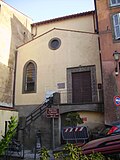
The eastern front, facing Largo Lepanto, may have been intended to be the main front of the palace, at least in an early plan. It is also conceivable that this front is the one that was to serve as the backdrop to Via Paolo Mercuri. Certainly, it is possible to trace in the style of this front a reference to the facade of Palazzo Farnese in Rome, currently the seat of the French embassy in Italy, designed by Antonio da Sangallo the Younger.
The similarity lies mainly in the ashlar doorway, as well as in the flight of windows, which, however, in Marino do not have the alternating gable. Moreover, the portal of Marino's palace, with ashlars of alternating sizes, is not perfectly centered but off-center to the right.
In front of this facade, until the Anglo-American bombing of February 2, 1944, was located the 17th-century fountain of the Four Moors: it was the collapse of this part of the palace onto the fountain that caused its ruin. In late 2008, it appears that some original peperino parts of the palace were found by digging underground in the square.
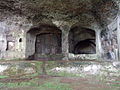
Since 1987, the premises of the palace facing Largo Palazzo Colonna have housed the Pro Loco association with its archives and the "Girolamo Torquati" library of local interest. From the premises in question, it is possible to access the palace's cave complex, which houses two exhibition itineraries: "In vita vitis," on the subject of viticulture, and "Memories of War," which collects memorabilia of evacuees in the caves during World War II. A temporary exhibition of nativity scenes is also organized there during the Christmas season.
Its facade with peperino pillars supporting partially bulging pillow-like lintels presents a heavy and melancholic ensemble.
The northern front, at present the main front of the palace, faces Piazza della Repubblica and is directed toward the 16th-century rectilinear road of Via Roma, the main thoroughfare into the city coming from Rome. Probably, the arrangement of Via Roma -until 1931 still called Strada Nuova- must be linked to the visit of Emperor Charles V of Habsburg to Rome in 1532, and was therefore taken care of by Ascanio I Colonna to be later taken over by Marcantonio II Colonna between 1562 and 1577 and by Cardinal Ascanio Colonna around 1584. …
Text from Wikipedia, the free encyclopedia, under CC BY-SA 4.0. Full article: «Palazzo Colonna».
People
Events and people from Wikidata (CC0).
Photos
Getting there
Marino LazialeTrain, nearest
200 m as the crow flies
Palazzo Colonna
Aeroporto di Roma-Ciampino6.4 km
Distances are as the crow flies, not walking or driving.
Loading map…
Nearby
See on the mapMore historic villas and palaces in Lazio

- Free 1st Sunday


Frequently asked questions
Where is Palazzo Colonna?
Palazzo Colonna is in Marino, in the province of Roma (Lazio), Italy. GPS coordinates: 41.76977, 12.65851.
What else is there to see near Palazzo Colonna?
Nearby you’ll find: Museo civico Umberto Mastroianni (0 m away), Marino Mithraeum (300 m away), Villa Desideri (600 m away).
Sources and licences
Text. Wikipedia, the free encyclopedia (CC BY-SA 4.0).
Data. Wikidata (CC0); opening hours and contacts OpenStreetMap (ODbL).
Photos. Wikimedia Commons, author and licence on every image.
Credits for the 9 photos
- Palazzo Colonna Marino 02 — Gino il Pio, Public domain
- Bastione Palazzo Colonna — Gino il Pio, Public domain
- Colonna Palazzo Colonna Marino — Gino il Pio, Public domain
- Facciata Orientale Palazzo Colonna — Gino il Pio, Public domain
- Interno-Palazzo-Colonna anniventi — N.D., Public domain
- Marino Palazzo Colonna 1 — Edoardo Scialis, CC BY-SA 4.0
- Palazzo Colonna fianco west Marino — Gino il Pio, Public domain
- Palazzo Colonna notturno - 1 — Gigi er Gigliola, CC0
- Palazzo-Colonna-Marino anniventi — N.D., Copyrighted free use
Updated 28 October 2026. All sources and licences