





Photo: Didier Descouens, CC BY-SA 3.0 · Wikimedia Commons
Historic villa / palace
Ca Cappello
Building in Venice, Italy
- Within the UNESCO World Heritage Site “Venice and its Lagoon”
At a glance
- Style
- Renaissance
- Coordinates
- 45°26′10″ N, 12°19′48″ E
- Address
- ramo Dolfin, 2035, San Polo
History and description
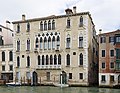
The Palazzo or Ca' Cappello Layard is a palace situated in the sestiere of San Polo of Venice, Italy, overlooking the Grand Canal at the confluence between this and the smaller Rio di San Polo and Rio delle Erbe. On the Grand canal, it is located between Palazzo Barbarigo della Terrazza and Palazzo Grimani Marcello. It is particularly noteworthy for having been the residence of Austen Henry Layard, discoverer of Nineveh.
Description
Located on the confluence of three canals, it is thus an unusual structure in that it presents three facades rather than the customary one.
Façade on the Grand Canal. It is the widest of the facades, it is characterized by a sober aspect and a large number of lancet windows. The first piano nobile is enriched by a large rectangular three-mullioned window that opens onto a terrace next to Palazzo Grimani Marcello
Façade on the Rio delle Erbe. The least impressive of the facades
Façade on the Rio di San Polo. It is enriched by two balconied three-mullioned windows, with elaborate capitels, flanked by an elegant couple of lancet windows. Nineteenth-century stone-carved patera of romanesque taste enrich the façade.
Origins and lost fresco cycle by Veronese and Zelotti
Ca' Cappello is a grand palace of Gothic origin, but substantially restructured during the course of the sixteenth century under the direction of its owner, the procurator of Saint Mark Antonio Cappello, who had supervised some of the most important projects of construction and renovation in sixteenth-century Venice, in particular the commencement of work on Rialto bridge, the edification of the Biblioteca Nazionale Marciana and the supervision of the construction of the Golden staircase at Ducal Palace or the redecoration of the room of the Council of Ten within the palace.
For these important works Antonio had frequently commissioned painters Paolo Veronese and Giovanni Battista Zelotti, to who he had ties through common friend Michele Sanmicheli. Veronese and Zelotti were thus commissioned to decorate with frescoes the renovated Renaissance palace. The fresco cycle was noted by Giorgio Vasari as one of Veronese’s notable works “who painted with the same [Zelotti] the façade of the palace of M. Antonio Cappello that is in Venice overlooking the Grand Canal”. The frescoes were more extensively described by erudite Carlo Ridolfi in his 1648 Le Meraviglie dell’arte, “over the Grand Canal in the house of the Cappelli Veronese coloured some figures of Cerere, Pomona, Pallas and other deities. The figures above were painted by his friend Zelotti”. The cycle did not survive long. In his 1674 Miniere della Pittura Veneziana the erudite Marco Boschini noted surviving but damaged work by Zelotti, and wrote that much had already been lost in a fire. The deities painted by Zelotti were however still visible in 1760 when Anton Maria Zanetti printed his Varie Pitture a Fresco de principali maestri Veneziani, and reproduced in engravings the four surviving figures. It is not certain when these remaining and worn out frescoes were finally lost, but by the nineteenth century they were certainly no longer visible.
Ca Cappello and the salon of the Layards
Ca Cappello was purchased, at a date given variously as 1874 and 1878 by sources, by the English archeologist, diplomat and politician Austen Henry Layard, with the help of the doyen of the British community in Venice, the historian Rawdon Brown. Layard, who had shipped his great collection of Italian Renaissance paintings to Venice in 1875, inhabited the palazzo stably following his withdrawal from the diplomatic career after political debacle in Istanbul and deep disagreement with Gladstone until his death by cancer, on the occasion of a rare visit to London, in 1894. The frescoes by Zelotti and Veronese were no longer visible, but Layard managed significant renovation works in the palace. Red, yellow and green felt covered the walls inside, and Spanish silks festooned outside of balconies and windows gave the palazzo an unmistakable appearance. Assyrian reliefs from Nineveh and a Hellenistic funerary piece from Samos were installed into the staircase wall, though these were in 1892 donated to the Museo Civico Correr, and replaced with floral paintings by Neapolitan artist Francesco Lavagna.
More significant was the collection of paintings assembled by the Layards in a gallery in the palazzo, with the most significant work being the Portrait of Mehmet II by Gentile Bellini. …
Later History and controversial swap
The death of Lady Layard in 1912 and the outbreak of the war saw an end to Ca Cappello’s role as a leading literary and social salon in Venice. It was later acquired by the Carnelutti family, before passing in 1967 into the possession of the University of Venice Ca’ Foscari.
It is currently the object of a controversial swap operation that would see it transferred, together with sixteenth-century palace Ca Bembo and the modern Palazzo Cosulich, two other university properties, to a property investment fund in exchange for a 1957 former state electricity company edifice. The swap has aroused considerable criticism and investigative weekly L'Espresso has noted the absence of a public auction and problems connected with an apparent violation - only supposed - with Italian heritage law, that forbids the swap of listed property. The chancellor Carlo Carraro has defended the operation on budget grounds, arguing it will help stave off large cuts to scholarships and research funding.
Text from Wikipedia, the free encyclopedia, under CC BY-SA 4.0. Full article: «Ca Cappello».
Photos
Getting there
Venezia Santa LuciaTrain, nearest
900 m as the crow flies
Ca Cappelloramo Dolfin, 2035, San Polo
Sant'Angelo100 m
Aeroporto Marco Polo di Venezia7.7 km
Distances are as the crow flies, not walking or driving.
Loading map…
Nearby
See on the mapMore historic villas and palaces in Veneto

- Free 1st Sunday


- UNESCO

- UNESCO
- Free 1st Sunday

- UNESCO
Frequently asked questions
Where is Ca Cappello?
Ca Cappello is in Venice, in the province of Venezia (Veneto), Italy. Address: ramo Dolfin, 2035, San Polo. GPS coordinates: 45.43623, 12.33007.
What else is there to see near Ca Cappello?
Nearby you’ll find: Palazzo Grimani Marcello (0 m away), Palazzo Querini Dubois (0 m away), Palazzo Barbarigo della Terrazza (0 m away).
Sources and licences
Text. Wikipedia, the free encyclopedia (CC BY-SA 4.0).
Data. Wikidata (CC0); opening hours and contacts OpenStreetMap (ODbL).
Photos. Wikimedia Commons, author and licence on every image.
Credits for the 9 photos
- Ca' Cappello Layard Carnelutti (Venice) — Didier Descouens, CC BY-SA 3.0
- Ca' Cappello Layard & Palazzo Grimani Marcello, Venice (37100850823) — Dimitris Kamaras from Athens, Greece, CC BY 2.0
- Palazzo Barbarigo della Terrazza Rio San Polo Ca' Cappello Layard Carnelutti Venezia — This Photo was taken by Wolfgang Moroder. Feel free to use my photos, but please mention me as the author and send me a message. This image is not in the public domain. Please respect the copyright…, CC BY-SA 3.0
- Ca cappello layard gran canal — Abxbay, CC BY-SA 3.0
- Ca cappello layard — Abxbay, CC BY-SA 3.0
- Ca' Cappello Layard Carnelutti gran canal san polo — Abxbay, CC BY-SA 3.0
- Ca' Cappello Layard, Venice (37061711714) — Dimitris Kamaras from Athens, Greece, CC BY 2.0
- Palazzi Ca' Cappello Layard Carnelutti e Grimani Marcello Canal Grande Venezia — This Photo was taken by Wolfgang Moroder. Feel free to use my photos, but please mention me as the author and send me a message. This image is not in the public domain. Please respect the copyright…, CC BY-SA 3.0
- Ca' Cappello — Tahmaspkhan, CC BY-SA 3.0
Updated 28 October 2026. All sources and licences