




- Most beautiful villages
Photo: Hagai Agmon-Snir حچاي اچمون-سنير חגי אגמון-שניר, CC BY-SA 4.0 · Wikimedia Commons
Historic village
Italian commune
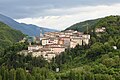
Norcia, traditionally known in English by its Latin name of Nursia ( NUR-see-ə, NUR-sh(ee-)ə), is a town and comune (municipality) in the province of Perugia in southeastern Umbria, Italy.
Unlike many ancient towns, it is located in a wide plain abutting the Monti Sibillini, a subrange of the Apennines with some of its highest peaks, near the Sordo River, a small stream that eventually flows into the Nera. The town is popularly associated with the Valnerina (the valley of the Nera). It is a member of I Borghi più belli d'Italia ("The most beautiful villages of Italy").
The area is known for its air and scenery, and is a base for mountaineering and hiking. It is also widely known for hunting, especially of the wild boar, and for sausages and ham made from wild boar and pork. In Italian, such products have been named after Norcia, and are known as norcineria.
Norcia, ancient Nursia, was a city of the Sabines, although situated very close to the territory of the Umbrians, as attested by classical writers including Livy, Plutarch, Dionysius, Pliny, Silius Italicus, and Ptolemy.
In early times several Sabine settlements or pagi arose in the territory of Norcia. Their existence is attested by numerous tomb discoveries containing funerary objects of distinctly Italic type.
Particularly notable were the discoveries of a necropolis at Ancarano (a frazione of Norcia), where one such settlement stood. Traces of a temple built of roughly squared stones were found there, together with Etruscan and Campanian terracottas and remains of an ancient defensive wall composed of irregular natural stones laid without mortar. Among the most remarkable finds were bronze objects including Italic swords, shield disks worked in relief and decorated with studs and bosses, fibulae, rings, and other items dating to the 7th century BC.
Another necropolis existed near the town itself, in the plain known as Santa Scolastica.
According to the historian Giacomo Lauro, Norcia was a powerful Sabine city when the Sabine territory was divided for a long time into four prefectures: Norcia itself, Rieti, Cures, and Nomentum. Under King Songo it was regarded as the capital of Sabina. Homer and Virgil recount that many centuries before the founding of Rome the warriors of Norcia took part in the siege of Troy and later received Roman citizenship.
In later times the town was placed within Picenum. Like the other Sabines, the inhabitants of Norcia became Roman citizens toward the end of the 5th century of Rome (mid-3rd century BC); however, they did not obtain the full rights of citizenship until after the Social War, and only later did Nursia attain the status of a municipium.
The earliest historical mention occurs during the Second Punic War in 205 BC, when Norcia was among the cities that voluntarily supplied soldiers for the army of Scipio. On that occasion only three Sabine cities were named: Norcia, Rieti, and Amiternum. Later the citizens of Norcia were punished by Octavian for providing assistance to Lucius Antonius during the Perusine War. …
Text from Wikipedia, the free encyclopedia, under CC BY-SA 4.0. Full article: «Norcia».
Our data shows no stations, stops or car parks nearby. Check how to get there before you set out.


Norcia is in Norcia, in the province of Perugia (Umbria), Italy. GPS coordinates: 42.79260, 13.09318.
Nearby you’ll find: La Castellina (100 m away), Forca d'Ancarano (3.6 km away), Sant'Eutizio (9 km away).
Text. Wikipedia, the free encyclopedia (CC BY-SA 4.0).
Data. Wikidata (CC0); opening hours and contacts OpenStreetMap (ODbL).
Photos. Wikimedia Commons, author and licence on every image.
Updated 28 October 2026. All sources and licences