

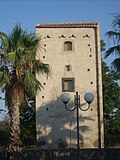


- UNESCO
Photo: Alun Salt from Derby and Leicester, UK, CC BY-SA 2.0 · Wikimedia Commons
Naxos or Naxus (Ancient Greek: Νάξος) was an ancient Greek city of Magna Graecia, presently situated in modern Giardini Naxos near Taormina on the east coast of Sicily.
Much of the site has never been built on and parts have been excavated in recent years.
Its remains are open to the public and an on-site museum contains many finds.
Ancient writers agree that Naxos was the most ancient of all the Greek colonies in Sicily; it was founded in 734/5 BC, a year before Syracusae, by colonists from Naxos in Greece and Chalcis in Euboea, with whom were mingled, according to Ephorus, a number of Ionians. He also named Theocles, or Thucles as leader of the colony and founder of the city and as an Athenian by birth; but Thucydides takes no notice of this, and describes the city as a purely Chalcidic colony; and it seems certain that in later times it was generally so regarded. The memory of Naxos as the earliest of all the Greek settlements in Sicily was preserved by the dedication of an altar outside the town to Apollo Archegetes, the divine patron under whose authority the colony had sailed; and it was a custom (still retained long after the destruction of Naxos itself) that all Theori or envoys proceeding on sacred missions to Greece, or returning from thence to Sicily, should offer sacrifice on this altar.
The new colony must have been speedily joined by fresh settlers from Greece, as within six years after its first establishment the Chalcidians at Naxos were able to send out a fresh colony, which founded the city of Leontini (modern Lentini) in 730 BC; and this was speedily followed by that of Catana. Theocles himself became the Oekist, or recognised founder, of the former and Euarchus, probably a Chalcidic citizen, of the latter. Strabo and Scymnus of Chios both represent Zancle (modern Messina) also as a colony from Naxos, but no allusion to this is found in Thucydides. But, as it was certainly a Chalcidic colony, it is probable that some settlers from Naxos joined those from the parent country. Callipolis was a colony of Naxos and also ceased to exist at an early period. Notwithstanding this evidence of its early prosperity, there is very little information as to the early history of Naxos. Archaeology shows that the city walls were built in the mid 6th c. BC. …
The city walls are visible on the south of the site and were built in the mid 6th c. BC using the Cyclopean polygonal technique. They were up to 8 m high with the first 2 m of stone and the higher layer of mud bricks.
The city was completely rebuilt in about 470 BC probably by Hieron I of Syracuse with a new Hippodamian orthogonal street plan on a different orientation from the first city. The original city was razed and lies below the later one. Only the sacred precincts, some temples and the shipyard were left intact on a different orientation. The city plan represents one of the best preserved western examples of its type. Square bases, perhaps altars, mark each crossroads on its south east corner.
The seafront façade of the shipyard complex indicates that the present sandy beachfront is circa 180–190 m further out from the 5th century BC the coastline and that the sea level was about 2 m higher than at present.
Text from Wikipedia, the free encyclopedia, under CC BY-SA 4.0. Full article: «Naxos».
Distances are as the crow flies, not walking or driving.


Naxos is in Giardini Naxos, in the province of Messina (Sicily), Italy. Address: Parco Via Lungomare Schiso', 98035 Giardini-Naxos. GPS coordinates: 37.82399, 15.27398.
Nearby you’ll find: Schisò Castle (200 m away), Vignazza Tower (600 m away), Palazzo Duchi di Santo Stefano (3.1 km away).
Text. Wikipedia, the free encyclopedia (CC BY-SA 4.0).
Data. Wikidata (CC0); opening hours and contacts OpenStreetMap (ODbL).
Photos. Wikimedia Commons, author and licence on every image.
Updated 28 October 2026. All sources and licences