


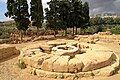


Photo: Ludvig14, CC BY-SA 4.0 · Wikimedia Commons
Archaeological site
Valley of the Temples
Archaeological site in Sicily, Italy
At a glance
- Type
- Archaeological site
- Protection
- World Heritage Site
- UNESCO World Heritage
- Archaeological Area of Agrigento
- Coordinates
- 37°17′23″ N, 13°35′24″ E
- Address
- Via Strada Panoramica Dei Templi Ex Casa Sanfilippo, 92100 Agrigento
History and description
The Valle dei Templi, or Valley of the Temples, is an archaeological site in Agrigento (ancient Greek: Ακράγας, Akragas), Sicily. It is one of the most outstanding examples of ancient Greek art and architecture of Magna Graecia, and is one of the main attractions of Sicily. The term "valley" is a misnomer, the site being located on a ridge outside the town of Agrigento.
Since 1997, the entire area has been included in the UNESCO World Heritage List. The archaeological and landscape park of the Valle dei Templi, with its 1300 hectares, is the largest archaeological park in Europe and the Mediterranean basin.
Overview
The Valley includes remains of seven temples, all in Doric style. The ascription of the names, apart from that of the Olympeion, is a mere tradition established in Renaissance times. The temples are:
Temple of Concordia, whose name comes from a Latin inscription found nearby, and which was built in the 5th century BC. Turned into a church in the 6th century AD, it is now one of the best preserved in the Valley.
Temple of "Hera", also built in the 5th century BC. It was burnt in 406 BC by the Carthaginians.
Temple of Heracles, who was one of the most venerated deities in the ancient Akragas. It is the most ancient in the Valley: destroyed by an earthquake, it consists today of only eight columns.
Temple of Olympian Zeus, built in 480 BC to celebrate the city-state's victory over Carthage. The use of large-scale atlases characterizes it.
Temple of Castor and Pollux. Despite its remains including only four columns, it is now the symbol of modern Agrigento.
Temple of Hephaestus (Vulcan), also dating from the 5th century BC. It is thought to have been one of the most imposing constructions in the valley; it is now, however, one of the most eroded.
Temple of Asclepius, located far from the ancient town's walls; it was the goal of pilgrims seeking cures for illness.
The Valley is also home to the so-called Tomb of Theron, a large tuff monument of pyramidal shape; scholars suppose it was built to commemorate the Romans killed in the Second Punic War.
Temple of Concordia
Due to its good state of preservation, the Temple of Concordia is ranked amongst the most notable edifices of the Greek civilization existing today. Notably, the UNESCO symbol alludes to this temple's six-column facade. It has a peristasis of 6 × 13 columns built over a basement of 39.44 × 16.91 m; each Doric column has twenty grooves and a slight entasis, and is surmounted by an architrave with triglyphs and metopes; also perfectly preserved are the tympani. The cella, preceded by a pronaos, is accessed by a single step; also existing are the pylons with the stairs that allow reaching the roof and, over the cella's walls and in the blocks of the peristasis entablature, the holes for the wooden beam of the ceiling. The exterior and the interior of the temple were covered by polychrome stucco. The upper frame had gutters with lion-like protomes, while marble tiles covered the roof.
When the temple was turned into a church, the entrance was moved to the rear, and the rear wall of the cella was destroyed. The spaces between the columns were closed, while 12 arched openings were created in the cella, in order to obtain a structure with one nave and two aisles. The pagan altar was destroyed, and sacristies were carved out in the eastern corners. The sepultures visible inside and outside the temple date to the High Middle Ages.
Temple of "Hera"
This temple lies at the easternmost end of the ridge and is built on a huge artificial terrace. It dates to c. 450 BC, measuring 38.15 × 16.9 m: it is in Doric style, peripteros six columns wide by thirteen long, preceded by a pronaos and opisthodomos. The base has four steps.
Current remains (including anastylosis from the 18th century onwards) consist of the front colonnade with parts of the architrave and of the frieze. Only fragments of the other three sides survive, with few elements of the cella. The building was damaged in the fire of 406 BC and restored in Roman times, with the substitution of marble tiles with ones of clay, and the addition of a steep rise in the area where today can be seen the remains of the altar.
Nearby are arcosolia and other sepultures from Byzantine times, belonging to the late 6th century AD renovation of the Temple of Concordia into a Christian church.
Temple of Asclepius
The Temple of Asclepius is located in the middle of the San Gregorio plain. Its identification is based on a mention by Polybius (I, 18, 2), who states that the temple was "in front of the city", one mile away. However, as the actual distance does not correspond and the size of the building is relatively small, scholars remain dubious about this attribution.
The small temple, probably dating to the late 5th century BC and measuring 21.7 × 10.7 m, rises over a basement with three steps. Its peculiarity is the fake opysthodomus with two semi-columns on the external side of the rear cella. Also extant are parts of the entablature, with lion-like protomes, a frieze, and a geison pediment.
The sanctuary housed a bronze statue of Apollo by Myron, a gift to the city by Scipio, which was stolen by Verres.
Text from Wikipedia, the free encyclopedia, under CC BY-SA 4.0. Full article: «Valley of the Temples».
Photos
Getting there
Tempio di VulcanoTrain, nearest
1.0 km as the crow flies
Valley of the TemplesVia Strada Panoramica Dei Templi Ex Casa Sanfilippo, 92100 Agrigento
Porto Empedocle5.3 km
Distances are as the crow flies, not walking or driving.
Loading map…
Nearby
See on the mapMore archaeological sites in Sicily


- UNESCO

- UNESCO
Frequently asked questions
Where is Valley of the Temples?
Valley of the Temples is in Agrigento, in the province of Agrigento (Sicily), Italy. Address: Via Strada Panoramica Dei Templi Ex Casa Sanfilippo, 92100 Agrigento. GPS coordinates: 37.28972, 13.59000.
What are the opening hours of Valley of the Temples?
According to OpenStreetMap the opening hours are: Every day: 8:30–20:00. Always check the official website before your visit.
Is Valley of the Temples wheelchair accessible?
According to OpenStreetMap data, the site is wheelchair accessible.
What else is there to see near Valley of the Temples?
Nearby you’ll find: Temple of Concordia (200 m away), Temple of Heracles (300 m away), Temple of the Olympian Zeus (500 m away).
Sources and licences
Text. Wikipedia, the free encyclopedia (CC BY-SA 4.0).
Data. Wikidata (CC0); opening hours and contacts OpenStreetMap (ODbL).
Photos. Wikimedia Commons, author and licence on every image.
Credits for the 9 photos
- Agrigento TemplesValley 0066 — Ludvig14, CC BY-SA 4.0
- 01 Panorama (foto del 1979) — Luciano Tronati, CC BY-SA 4.0
- 02 Panorama (foto del 1979) — Luciano Tronati, CC BY-SA 4.0
- 03 Panorama (foto del 1979) — Luciano Tronati, CC BY-SA 4.0
- Agrigento - Comune di Agrigento - 2023-09-01 17-28-32 001 — Giacomo Palermo, CC BY-SA 4.0
- Agrigento - Comune di Agrigento - 2023-09-25 12-37-59 001 — Lorenzo Gaudenzi, CC BY-SA 4.0
- Ingresso V porta — Davide Mauro, CC BY-SA 4.0
- Ruins Valley of the Temples Agrigento — Valleyofthetemples, CC BY-SA 4.0
- Statua romana, valle dei templi 1 — Davide Mauro, CC BY-SA 4.0
Updated 28 October 2026. All sources and licences