
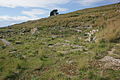


- UNESCO
Photo: Allie_Caulfield from Germany, CC BY 2.0 · Wikimedia Commons
Soluntum or Solus was an ancient city on the Tyrrhenian coast of Sicily, near present-day Porticello in the comune of Santa Flavia, Italy. The site is a major tourist attraction. The city was founded by the Phoenicians in the sixth century BC and was one of the three chief Phoenician settlements in Sicily in the archaic and classical periods. It was destroyed at the beginning of the fourth century BC and re-founded on its present site atop Monte Catalfano. At the end of the fourth century BC, Greek soldiers were settled there and in the 3rd century BC the city came under the control of the Roman Republic. Excavations took place in the 19th century and in the mid-20th century. Around half of the urban area has been uncovered and it is relatively well preserved. The remains provide a good example of an ancient city in which Greek, Roman and Punic traditions mixed.
The Phoenicians founded the city in the 8th or 7th century BC, according to Thucydides. They had established several other trading emporia in the west of Sicily, including Motya and Panormus (modern Palermo). In 539 BC, the Phoenicians in the eastern Mediterranean were conquered by the Persian empire. The Phoenicians of the western Mediterranean (known to the Romans as Punics) became independent and Carthage in particular developed into a major city, which brought the Phoenician settlements in Sicily under its control at an uncertain point in time. Increasingly the Phoenicians and Greeks in Sicily came into conflict with one another.
The location of the archaic city has long been uncertain. No archaic remains have been found in the excavations at Soluntum, so it is clear that it was not located on the same site as the later city. Recent excavations revealed a Punic necropolis at Capo Solanto to the south of the city, with remains from the sixth and fifth centuries BC, and this is now believed to have been the location of the archaic city.
In 409 BC, the Carthaginians invaded Sicily and conquered many Greek cities, including Selinus, Agrigentum, and Gela. After a short piece, the Carthaginians besieged Syracuse in 398 BC, whose tyrant Dionysius I managed to fend them off, recapture most of the lost territory. Soluntum remained loyal to Carthage even in 397 BC, when Dionysius invaded the Punic part of the island and destroyed Motya, causing most of Carthage's allies to defect. Dionysius ravaged its territory without success, but in 396 BC it was betrayed to Dionysius and destroyed. The city was rebuilt in the middle of the fourth century, in its present location, atop Monte Catalfano. In 307 BC the Carthaginians gave the city to the soldiers and mercenaries of Agathocles, who had made peace with the Carthaginians after their leader abandoned them in Africa. …
Excavations have brought to light considerable remains of the ancient Roman town, and a good deal still remains unexplored. The site was identified using ancient literary sources by Tommaso Fazello in his 1558 history of Sicily. The first excavations were carried out in 1825 by Domenico Lo Faso Pietrasanta and published in his Le antichità della Sicilia. Vol 5: Antichità di Catana — Palermo. 1842, pp. 57–67. He unearthed a sanctuary and discovered several statues. Francesco Saverio Cavallari carried out systematic excavations from 1856, following his appointment as the first professor of archaeology at the University of Palermo. The first plan of the city was published in 1875.
Cavalleri's excavations were continued by Antonino Salinas, who published the first detailed reports. Minor excavations by Ettore Gabrici in 1920 only revealed a few rooms inside the city. Vincenzo Tusa began excavations in 1951. He found the "House of Leda" in 1953, the theatre in 1963, and the "House of Harpocrates" around 1970. One reason for the intensification of excavations was the potential seen for the ruins to become a tourist attraction. No final publication of Tusa's excavations has ever been published. Some of the artefacts recovered (especially the coins) are now kept in the Antonino Salinas Regional Archaeological Museum in Palermo; the rest is on display in the museum at the site.
Starting in 1964, the city was excavated by the German Archaeological Institute of Rome. Under Helmut Schläger, the architecture of the agora was investigated, but Schlager's early death prevented publication of the results. From 1988, Armin Wiegand investigated the theatre, eventually publishing a study of the building Markus Wolf has worked on the agora and the houses of the city, with a special focus on the gymnasium. In 2014, Alberto Sposito published an architectural study, presenting all excavated buildings and the current state oft heir remains. …
Text from Wikipedia, the free encyclopedia, under CC BY-SA 4.0. Full article: «Soluntum».
Distances are as the crow flies, not walking or driving.


Soluntum is in Santa Flavia, in the province of Palermo (Sicily), Italy. Address: Via Collegio Romano, SNC - Santa Flavia. GPS coordinates: 38.09306, 13.53139.
According to OpenStreetMap the opening hours are: Monday to Saturday: 9:00–17:30; Sunday: 9:00–14:00. Always check the official website before your visit.
There is an admission charge. Up-to-date prices are on the official website.
Nearby you’ll find: Theatre of Soluntum (100 m away), Torre Sant'Elia (700 m away), Villa Filangeri (1.4 km away).
Text. Wikipedia, the free encyclopedia (CC BY-SA 4.0).
Data. Wikidata (CC0); opening hours and contacts OpenStreetMap (ODbL).
Photos. Wikimedia Commons, author and licence on every image.
Updated 28 October 2026. All sources and licences