



- Free 1st Sunday
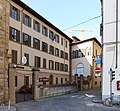
Photo: Ebonaiuti, CC BY-SA 4.0 · Wikimedia Commons
Museum, 1930
Italian museum for the history of science
Museo Galileo (formerly Istituto e Museo di Storia della Scienza; Institute and Museum of the History of Science) is located in Florence, Italy, in Piazza dei Giudici, along the River Arno and close to the Uffizi Gallery. The museum, dedicated to astronomer and scientist Galileo Galilei, is housed in Palazzo Castellani, an 11th-century building which was then known as the Castello d'Altafronte.
Museo Galileo owns one of the world's major collection of scientific instruments, which bears evidence of the role that the Medici and Lorraine Grand Dukes attached to science and scientists.
The Museo di Storia della Scienza re-opened to the public with the new name Museo Galileo in June 2010, after a two-year closure due to redesigning and renovation work. Its name change celebrates the 400-year anniversary of Galileo's Sidereus Nuncius (The Starry Messenger), first published in March of 1610.
The museum features the valuable scientific instruments from the Medici Collections which were first displayed in the Stanzino delle Matematiche (Mathematics Room) in the Uffizi Gallery. They were later moved to the Museo di Fisica e Storia Naturale (Museum of Physics and Natural History) founded by Grand Duke Peter Leopold in 1775. During the reign of the Lorraine Grand Dukes, new instruments were added to the scientific collections. In 1929, the First Italian Exhibition of the History of Science in Florence highlighted the importance of scientific collections within Italy's cultural heritage. As a consequence, in 1930 the University of Florence formed the Istituto di Storia della Scienza con annesso Museo (Institute of the History of Science and attached Museum). The institute was housed in Palazzo Castellani and was entrusted with the instrument collections of the Medici and Lorraine dynasties. The permanent exhibition is arranged by chronological and thematic paths.
The first floor's nine rooms are devoted to the Medici Collections, dating from the 15th century through the 18th century. The permanent exhibition includes all of Galileo's unique artifacts, among which are his only two extant telescopes and the framed objective lens from the telescope with which he discovered the Galilean moons of Jupiter; thermometers used by members of the Accademia del Cimento; and an extraordinary collection of terrestrial and celestial globes, including Santucci's Armillary Sphere, a giant armillary sphere designed and built by Antonio Santucci.
The nine rooms on the second floor house instruments and experimental apparatus collected by the Lorraine dynasty (18th-19th century), which bear witness to the remarkable contribution of Tuscany and Italy to the progress of electricity, electromagnetism and chemistry. The exhibits include obstetrical wax models from the Santa Maria Nuova Hospital, Grand Duke Peter Leopold’s chemistry cabinet and the beautiful machines made in the workshop of the Museo di Fisica e Storia Naturale to illustrate the fundamental physical laws.
Text from Wikipedia, the free encyclopedia, under CC BY-SA 4.0. Full article: «Museo Galileo».
Events and people from Wikidata (CC0).
Distances are as the crow flies, not walking or driving.


Museo Galileo is in Florence, in the province of Firenze (Tuscany), Italy. Address: Piazza dei Giudici, 1, 50122 Firenze. GPS coordinates: 43.76768, 11.25602.
According to OpenStreetMap the opening hours are: Mo,We-Su 09:30-18:00; Tu 09:30-13:00; Jan 01,06,easter,May 01,Jun 24,Aug 15,Nov 01,Dec 08,25-26 off. Always check the official website before your visit.
There is an admission charge. Up-to-date prices are on the official website.
According to OpenStreetMap data, the site is wheelchair accessible.
Wikidata dates it to 1930.
Nearby you’ll find: Altafronte Castle (0 m away), Palazzo dei Veliti (0 m away), Teatrino della Baldracca (0 m away).
Text. Wikipedia, the free encyclopedia (CC BY-SA 4.0).
Data. Wikidata (CC0); opening hours and contacts OpenStreetMap (ODbL).
Photos. Wikimedia Commons, author and licence on every image.
Updated 28 October 2026. All sources and licences