




- Free 1st Sunday
Photo: Jastrow, Public domain · Wikimedia Commons
Museum, 1998
Art museum
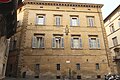
Santa Maria della Scala (also referred to as the Hospital, Ospedale, and Spedale) is located in Siena, Italy. Now a museum, it was once an important civic hospital dedicated to caring for abandoned children, the poor, the sick, and pilgrims. Revenues were earned partially from bequests and donations from the citizens of Siena, particularly the wealthy. The head of the hospital was the rector who managed the lay brothers responsible for its operation.
Santa Maria della Scala was one of Europe's first hospitals and is one of the oldest hospitals still surviving in the world. It played a major cultural role and is considered one of Siena's 3 main artistic hubs.
The Hospital partially gets its name from its position. Located across the Piazza del Duomo from Siena Cathedral, Santa Maria della Scala refers to its position across from the steps that lead into the Cathedral. The Hospital is made up of a complex of buildings. Those buildings have been enlarged and improved upon over the years, yet the Hospital's properties also once included much of the Via del Capitano and land outside the city walls as well as other, smaller hospitals. Around the 13th and 14th centuries, the Hospital organized its land into large agricultural estates. This is said to have "represented the largest concentration of land of the Sienese state". This agricultural land helped to financially support the Hospital's works.
Particular sections of note include the Church of the Santissima Annuziata, which was built at the end of the 13th century but then completely renovated towards the end of the 15th century, and the Pellegrinaio. The Pellegrinaio (or "Pilgrim's Hall") is the main hall where pilgrims were lodged. It also served as a location for public festivities. This hall, along with another specifically to house women was built around 1325. The church of the Santissima Annuziata, built during the 13th century, was enlarged during the second part of the 15th century, along with the "vertical expansion" of the Palazzo del Rettore.
Santa Maria della Scala was dedicated to its services. From at least as far back as 1193 up to the 18th century, the Hospital took on many philanthropic endeavors:
Abandoned babies often found their way to the Hospital. Meticulous records were kept of the details relating to each child, in order that the original parents may later be able to find them. The procedure for the children's care was implemented according to age: As infants, they were given to wet nurses then later weaned and educated. At age 8, they were taught a trade and any profits they made were kept for them. When they reached 18, the children had the option of leaving. Those that chose to leave were given all their saved earnings, plus 100 soldi, a set of clothing, and furnishings for a house. Girls were given an additional 50 lire as a dowry.
Meals were served for the poor three times a week. The sick were also given free meals and treatment. The Hospital's treatment of the sick was unusual for the time: their policy was to have one bed for each sick patient, and the sheets were kept clean. Also, in what has been suggested as "one of the earliest examples of such a therapeutic objective," patients were treated in order to be cured. The Hospital employed one normal doctor and one surgeon. In the 16th century, it added an additional surgeon. As the Hospital became a training ground for doctors, there was, for the 17th and 18th centuries, a unique emphasis on using a more hands-on learning approach.
Another service implemented by the Hospital was to care for pilgrims. They were offered free room and board in the pilgrimage halls, which were segregated by sex. When they left, pilgrims received vouchers for food and drink in Sienese territory as they continued their travels.
Siena lies on the Via Francigena, the main pilgrimage road to Rome, and the Hospital was probably founded to accommodate the pilgrims and other travelers who passed through by the canons of the Duomo. According to legend, the Hospital was founded in 898 by a cobbler named Sorore. However, the first known document mentioning it is a "deed of gift" from March 29, 1090. The first rector, Beringerio, was said to be appointed in 1200.
To settle infighting between the clergy and laypeople over who held more authority, Pope Celestine III issued a papal bull in 1193 that declared the Hospital a lay organization independent of the Cathedral.
In 1359, the Hospital acquired several new relics, including part of the Virgin Mary's girdle and her veil, possibly to stimulate pilgrim travel. More relics were acquired under the Rector Giovanni Buzzichelli. Other relics owned by the Hospital included those of Sts Augustinus and Marcellinus, and a nail from the cross of Christ.
At the end of the 13th century, the Hospital sped up its physical expansion and internally began splitting up according to the different functions it held (such as headquarters for confraternities, caring for the sick, sheltering pilgrims, etc.).
In 1404 the Council of Siena took control of the rector nomination process and made it a city office.
In the 1430s, the confraternity devoted to Saint Jerome moved into the rooms in the lower levels of the Hospital, which were directly accessible from the streets. Other confraternities active at this time include an older confraternity dedicated to Mary Most Holy, the brotherhood of Saint Michael the Archangel, later renamed the brotherhood of Saint Catherine of the Night, and a confraternity founded by Andrea Gallerani that was "active in good works" at the Hospital.
During the 18th century, the Hospital became part of the university.
In 1995, the Hospital opened up to the public as a museum. At first, only the areas considered the most significant were shown. As more areas were restored, access increased. It is still being restored.
The museum is open almost every day of the year. An entrance fee is required with reduced prices for large groups, students, seniors, and soldiers. Residents, children under 11 and invalids receive free entrance.
Through the museum, it is possible to view over half of the complex. There are nearly 12,000 square meters of paths covering the renovated parts of the Hospital. Some of the places of interest a museum-goer today can explore are the Pellegrinaio, the Cappella del Manto (Chapel of the Mantle), the Sagrestia Vecchia (Old Sacristy), the Cappella della Madonna (Chapel of the Virgin Mary), and the Oratories of the Compagnia di Santa Caterina della Notte and of Santa Maria sotto le colte. The ravaged sculptures by Jacopo della Quercia from the Fonte Gaia are displayed here, as well as drawings and models for the 1858 restoration. A video animation charts the various states of the fountain through the centuries. Also included are an Archaeological Museum with a vast display of Etruscan cinerary urns and other material, a Children's Art Museum, the Giuliano Briganti Library and Photo Library of Art, and other temporary installation and convention spaces.
Text from Wikipedia, the free encyclopedia, under CC BY-SA 4.0. Full article: «Santa Maria della Scala».
Events and people from Wikidata (CC0).
Distances are as the crow flies, not walking or driving.


Santa Maria della Scala is in Siena, in the province of Siena (Tuscany), Italy. Address: Piazza Duomo, 1, 53100 Siena. GPS coordinates: 43.31694, 11.32889.
According to OpenStreetMap the opening hours are: December to January · every day: 10:00–19:00; February to March, October to November · Monday, Wednesday to Friday: 10:00–17:00; February to March, October to November · Saturday and Sunday: 10:00–19:00; April to September · every day: 10:00–19:00; December to January · public holidays: Closed; February to March, October to November · Tuesday: Closed. Always check the official website before your visit.
There is an admission charge. Up-to-date prices are on the official website.
According to OpenStreetMap data, the site is wheelchair accessible.
Wikidata dates it to 1998.
Nearby you’ll find: Palazzo del Capitano del Popolo (0 m away), Palazzo Reale (0 m away), Museo archeologico nazionale di Siena (100 m away).
Text. Wikipedia, the free encyclopedia (CC BY-SA 4.0).
Data. Wikidata (CC0); opening hours and contacts OpenStreetMap (ODbL).
Photos. Wikimedia Commons, author and licence on every image.
Updated 28 October 2026. All sources and licences