




- Most beautiful villages
Photo: Hagai Agmon-Snir حچاي اچمون-سنير חגי אגמון-שניר, CC BY-SA 4.0 · Wikimedia Commons
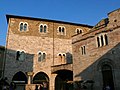
Montefalco is a historic small hill town in Umbria, Italy. It is one of I Borghi più belli d'Italia ("The most beautiful villages of Italy").
Montefalco DOC is a regulated geographical area due to its red grape wine production, including the highly localized Sagrantino grape variety. The town's museum is in a former church, which has a fresco cycle on the life of St. Francis by the Florentine artist Benozzo Gozzoli (1450–1452).
Adone Palmieri states that Montefalco was formerly called Falisco Umbro, or Falliene, and that it was a Roman municipium. He adds that it was destroyed in Sulla's civil war and later rebuilt, being known as Curcurione or Coccorano until 1249; after that it took the name Montefalco. He places the earlier settlement about 1 mile (1.6 km) from the present town.
Palmieri also links a phase of castle-building to the time of the emperor Otto I, writing that a German baron named Enzio Gordiano, attracted by the beauty and fertility of the territory, built a castle that was later destroyed by the Saracens, after which the present Montefalco arose from its ruins.
Montefalco first appears in records in 1180, when its castle was submitted to the municipality of Spoleto. Shortly before this, in 1177, Frederick Barbarossa added Montefalco to the county of Foligno. In 1185 Barbarossa stayed in Montefalco and presented the counts of Antignano with a hunting falcon; this falcon was later adopted as the town's emblem.
By 1240 the community had acknowledged imperial authority. Institutional structures associated with communal government are documented from the early 13th century, when the office of podestà was already in place. In 1270 the people's palace was built.
In the struggles between Guelphs and Ghibellines, Montefalco sided with the Guelph party and, during the period of the Avignon Papacy, it more than once sent its own militia to strengthen the arms of the Church. The Ghibelline side was led by a figure named Biagio de’ Rizzo and prevailed until Guelph exiles, guided and joined by the Guelphs of Ugolino Trinci, lord of Foligno, broke the walls by night, regained Montefalco and restored their faction to power.
Trinci then dominated Montefalco as vicar general of the Church and held its lordship for a long time. Under Corrado Trinci, however, the people rose up, appealed to the pontiff, and joined the army sent by Pope Eugene IV to depose him; Corrado was eventually defeated. After this, the pope sent the Count della Facciola to govern the town. The fortress near the town gate was demolished. …
Text from Wikipedia, the free encyclopedia, under CC BY-SA 4.0. Full article: «Montefalco».
Distances are as the crow flies, not walking or driving.


Montefalco is in Montefalco, in the province of Perugia (Umbria), Italy. GPS coordinates: 42.89376, 12.65238.
Nearby you’ll find: Museum Complex of San Francesco (Montefalco) (100 m away), Palazzo dei Consoli (5.6 km away), Museo Civico, Bevagna (5.7 km away).
Text. Wikipedia, the free encyclopedia (CC BY-SA 4.0).
Data. Wikidata (CC0); opening hours and contacts OpenStreetMap (ODbL).
Photos. Wikimedia Commons, author and licence on every image.
Updated 28 October 2026. All sources and licences