




- UNESCO
- Free 1st Sunday
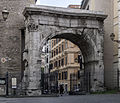
Photo: Rodolfo Lanciani, Public domain · Wikimedia Commons
Archaeological site
Famed formal garden of the early Roman Empire
The Gardens of Maecenas, or Horti Maecenatis, constituted the luxurious ancient Roman estate of Gaius Maecenas, an Augustan-era imperial advisor and patron of the arts. The property was among the first in Italy to emulate the style of Persian gardens. The walled villa, buildings, and gardens were located on the Esquiline Hill, atop the agger of the Servian Wall and its adjoining necropolis, as well as near the Horti Lamiani.
Lucullus started the fashion of building luxurious garden-palaces in the 1st century BC with the construction of his gardens on the Pincian Hill, soon followed by Sallust's gardens between the Quirinal, Viminal and Campus Martius, which were the largest and richest in the Roman world. In the 3rd century AD the total number of gardens (horti) occupied about a tenth of Rome and formed a green belt around the centre. The horti were a place of pleasure, almost a small palace, and offered the rich owner and his court the possibility of living in isolation, away from the hectic life of the city but close to it. A fundamental feature of the horti was the large quantity of water necessary for the rich vegetation and for the functioning of the numerous fountains and nymphaea. The area was particularly suitable for these residences as eight of the eleven large aqueducts of the city reached the Esquiline.
In the Roman Republican era the eastern Esquiline outside of the Servian Walls was a cemetery with open pits (puticuli) for the poor. The Esquiline gate was where criminals were executed and their bodies left for scavengers. Around 40 BC reform of public cemeteries was promoted by Maecenas, the friend and later minister of Augustus, and begun under his reign. In 38 BC, the Roman Senate banned open-air corpse cremation within a 2 mile radius of the city. The original phase of the garden was constructed by the conclusion of the 30s BC (the use of opus reticulatum brickwork is the basis for this dating). This was achieved by burying the whole district alongside the Agger of Servius Tullius under 6–8 m of earth and creating luxurious gardens on top. The results were celebrated in a song by Maecenas' friend, Horace:
Many of the burial pits of the ancient necropolis, attested to predate the gardens, have been found near the north-west corner of the Piazza Vittorio Emanuele, that is, outside the porta Esquilina and the Servian Wall and north of the via Tiburtina vetus. Probably the horti extended north from that gate and road on both sides of the agger. …
The Latin all-encompassing term for gardens, horti, is an effective misnomer, as in antiquity it referred generally to luxury villas on the outskirts of Rome, so-named for especially prominent vegetation and urban removal. The rustic yet holistic complex seems to have featured libraries, pavilions, riding grounds, baths, and an aviary. Each part of the gardens was visually and physically accessible by successive terraces and porticos.
The Aqua Marcia, an essential aqueduct for the city, delivered high-quality water directly past Maecenas's property on the Esquiline, making the grounds uniquely poised to be maintained as one of the first private, landmark Roman gardens. This was crucial to another purported logistical feat of the gardens; Maecenas is said to be the first Roman to build a hot water swimming pool.
Maecenas's sponsored retinue of influential Latin poets recorded some direct observations of his Esquiline gardens. Propertius mentions that Maecenas “preferred a shady oak and falling waters and a few reliable acres of fruitful soil." In his ode to Maecenas, his close associate Horace emphasizes the sweeping elevation of the garden estate over the expanse of Rome, ultimately symbolic of his friend's detached yet esteemed semi-retirement, spent closely advising Augustus.
The Late Republican-era room preserved on the grounds of the horti, termed the "auditorium of Maecenas" in modernity, was most likely a triclinium, functioning as a private banqueting hall attached to residential quarters. The structure was built directly into the Servian Wall, as the city had long outgrown the defensive fortifications, and on top of the agger. Verse of Horace attests to the domestic architectural takeover of the Servian Wall in Esquiline garden estates, as when he writes of a "stroll on the sunny rampart."
The long rectangular hall was bisected by a channel of water. The room terminated with seven monumentalized, marble-clad steps in a semicircular apse. Drill-holes, accommodative of pipes, indicate this to be the cascade fixture of a fountain. The inside of the room was doubly secluded, with an ancient ramp leading visitors to a subterranean level. …
Text from Wikipedia, the free encyclopedia, under CC BY-SA 4.0. Full article: «Gardens of Maecenas».
Distances are as the crow flies, not walking or driving.


Gardens of Maecenas is in Rome, in the province of Roma (Lazio), Italy. GPS coordinates: 41.89389, 12.50139.
Nearby you’ll find: Auditorium of Maecenas (0 m away), Beat '72 (100 m away), Teatro Brancaccio (100 m away).
Text. Wikipedia, the free encyclopedia (CC BY-SA 4.0).
Data. Wikidata (CC0); opening hours and contacts OpenStreetMap (ODbL).
Photos. Wikimedia Commons, author and licence on every image.
Updated 28 October 2026. All sources and licences