




Photo: MM, Public domain · Wikimedia Commons
Archaeological site
Heraion at the Mouth of the Sele
Building in Capaccio, Italy
Capaccio Paestum (SA), Campania
At a glance
- Type
- Archaeological site
- Dedicated to
- Hera
- Coordinates
- 40°29′19″ N, 14°58′11″ E
- Address
- Via Magna Grecia, 919
History and description
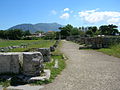
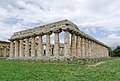
The Heraion at Foce del Sele (English "Heraion at the mouth of the River Sele") is an archaeological site consisting of an Ancient Greek sanctuary complex dedicated to the goddess Hera in what was Magna Graecia. When built, the complex was located at the mouth of the Sele, approximately 8 km (5.0 mi) north of the Greek city of Poseidonia that was famous for its three standing Greek temples. Due to the deposition of alluvial sediment by the river, the site now is approximately 2.3 km (1.4 mi) from the modern coast.
The site is in the modern Italian comune of Capaccio-Paestum, some 40 km (25 mi) south of Salerno.
Construction at the complex is dated from the sixth to at least the third centuries BC. The sanctuary included a Greek temple and other buildings. It was located in the countryside rather than in an urban development and may have included buildings to accommodate pilgrims.
During the Middle Ages most of the stones were scavenged for use elsewhere as building materials or for other purposes.
Ancient references
Although the existence of the sanctuary is reported by ancient historical sources, for a long time its location was not corroborated by other evidence. Differing ancient references made the rediscovery of the remains difficult. Strabo, attributed the foundation of the complex to Jason during the expedition of the Argonauts and he described the location of the Sanctuary of Argive Hera at the northern border of Lucania, on the left bank of the river Sele, about fifty stades from the city of Paestum. Pliny the Elder, however, described the location of the sanctuary as being on the opposite bank of the river. The path of the river changed with time as well. Finally, the site was discovered and confirmed the ancient reports of its existence.
History
The ancient sanctuary was founded at the beginning of the sixth century BC by the Greek colony at Paestum who originally were from further south at Sybaris. They dedicated the sanctuary to Argive Hera, the Greek goddess of women and marriage, as well as of navigation. At that time, the Sele River represented a boundary between Greek and Etruscan areas of influence.
Initially cult activities must have been performed in the open, in a sacred area equipped with an altar and bounded by porticos for hosting pilgrims. At the end of the sixth century, a grand temple was built, which probably was octastyle (with a facade of eight columns) and peripteral. At the same time, two other buildings were built some distance in front of the temple.
After the takeover of Paestum and the area by the local Lucanian people at the end of the fifth century BC, the sanctuary reached its highest cultural peak, with the reuse of more ancient materials for the construction of new buildings: a new portico and then a meeting house. At a certain distance, a square building was built, in which many loom weights have been found. Based upon the known cultural traditions of the time and these, it is theorised that in this building during each year, women about to be married would weave a new peplos dress that was offered to the cult statue of the goddess at an annual procession. Among the artefacts found at the sanctuary is a marble statue of Hera, seated on a throne with a pomegranate in her hand.
In 273 BC, the area was absorbed by the Roman Republic, who turned Paestum into a colonia. The weaving building was destroyed and a wall was built around the sacred area. The sanctuary survived in a slow decline until the second century AD. The area silted up and eventually memory of the site was lost beyond the local area.
The cult of Hera survived through all of these changes in a Christianised form as the Madonna del Granato (Madonna of the Pomegranate), whose cult in the vicinity of the sanctuary recalls the depiction of Hera with the pomegranate.
The sanctuary was brought to light by the excavations of the archaeologists Umberto Zanotti Bianco and Paola Zancani Montuoro between 1934 and 1940.
Metopes
Approximately seventy metope reliefs carved in local sandstone have been recovered during excavations. They had been broken up, often into small fragments, and had to be pieced back together like a jigsaw puzzle. Thirty-eight of these belong to a more ancient group (second half of the sixth century) and must have decorated buildings that cannot now be reconstructed. They would have decorated a much earlier building that was lost to renovations at the site. Once it was thought that these early metopes came from a rectangular building presumed to be a treasury, but excavations demonstrated that the treasury was built much too late for the style of the reliefs. The metopes of this early group depict episodes from the Twelve Labours of Heracles, the Trojan War, and the lives of Jason and Orestes.
Most of the early group of metopes were carved in sections, consisting of a triglyph on the left and a relief panel with figures on the right, all on a single piece of stone. The more recent group of approximately thirty metopes from the main or second temple, depict young maidens dancing in bas-relief, reflecting the emphasis of the sanctuary cult on marriage. These date from around 510 BC. In the second group each figure panel was a separate piece of stone. Some panels from both groups are very badly worn.
The local stone is coarse and not suitable for carving detail. If only for this reason the figures in the reliefs are lightly modelled and relatively flat, but around their outlines the stone has been deeply cut back. Some have only the outline deeply carved, with the figures blank and flat. These may have been unfinished, or intended only to be painted. It is likely that all the reliefs were painted in bright colours. The muscularity of the figures is comparable to the style of sculptures from Sybaris, from which the members of the founding colony had migrated.
Although the three main Greek temples at Paestum are still standing, none of them had sculpted reliefs resembling these; perhaps painted scenes, now lost, substituted for them. …
Votive gifts
Artefacts found during excavations of the sanctuary have included a large number of buried votive offerings (mostly terracotta statuettes of the goddess) that were buried some time after being left at the shrine. A large portion of these votives are on display at the site of the sanctuary in the Museo Narrante del Santuario di Hera alla Foce del Sele, located in a reconstructed farm house (the masseria Procuriali).
A first deposit was found near the temple and was made up of five ditches lined by stone slabs and covered with stone as well. These artefacts were deposited between the sixth and second centuries BC. Some evidence of burning relates to the sacrifices offered at the times of the burials.
A second deposit consisting of one large ditch also was discovered. It contained approximately six thousand artefacts, including terracotta statues and small bronze objects, dating from burials between the fourth and second centuries BC. Some coins from the second century AD that were deposited in a flood were also found there.
Text from Wikipedia, the free encyclopedia, under CC BY-SA 4.0. Full article: «Heraion at the Mouth of the Sele».
People
Events and people from Wikidata (CC0).
Photos
Getting there
Capaccio-RoccadaspideTrain, nearest
5.2 km as the crow flies
Heraion at the Mouth of the SeleVia Magna Grecia, 919
Aeroporto di Salerno - Costa d'Amalfi15.3 km
Distances are as the crow flies, not walking or driving.
Loading map…
Nearby
See on the mapMore archaeological sites in Campania

- UNESCO
- Free 1st Sunday

- UNESCO

- UNESCO

- UNESCO
- Free 1st Sunday

- Free 1st Sunday
Frequently asked questions
Where is Heraion at the Mouth of the Sele?
Heraion at the Mouth of the Sele is in Capaccio Paestum, in the province of Salerno (Campania), Italy. Address: Via Magna Grecia, 919. GPS coordinates: 40.48850, 14.96970.
What else is there to see near Heraion at the Mouth of the Sele?
Nearby you’ll find: Temple of Athena (7.7 km away), National Archaeological Museum of Paestum (7.9 km away), Archaeological site of Paestum (7.9 km away).
Sources and licences
Text. Wikipedia, the free encyclopedia (CC BY-SA 4.0).
Data. Wikidata (CC0); opening hours and contacts OpenStreetMap (ODbL).
Photos. Wikimedia Commons, author and licence on every image.
Credits for the 4 photos
- ItaliaPaestumHeraionFoceSeleResti — MM, Public domain
- ItaliaPaestumMuseoHeraionFoceSele — MM, Public domain
- Museo archeologico di Paestum WLM 012 — Mentnafunangann, CC BY-SA 3.0
- Paestum Museum (6120216419) — Dave & Margie Hill / Kleerup from Centennial, CO, USA, CC BY-SA 2.0
Updated 28 October 2026. All sources and licences