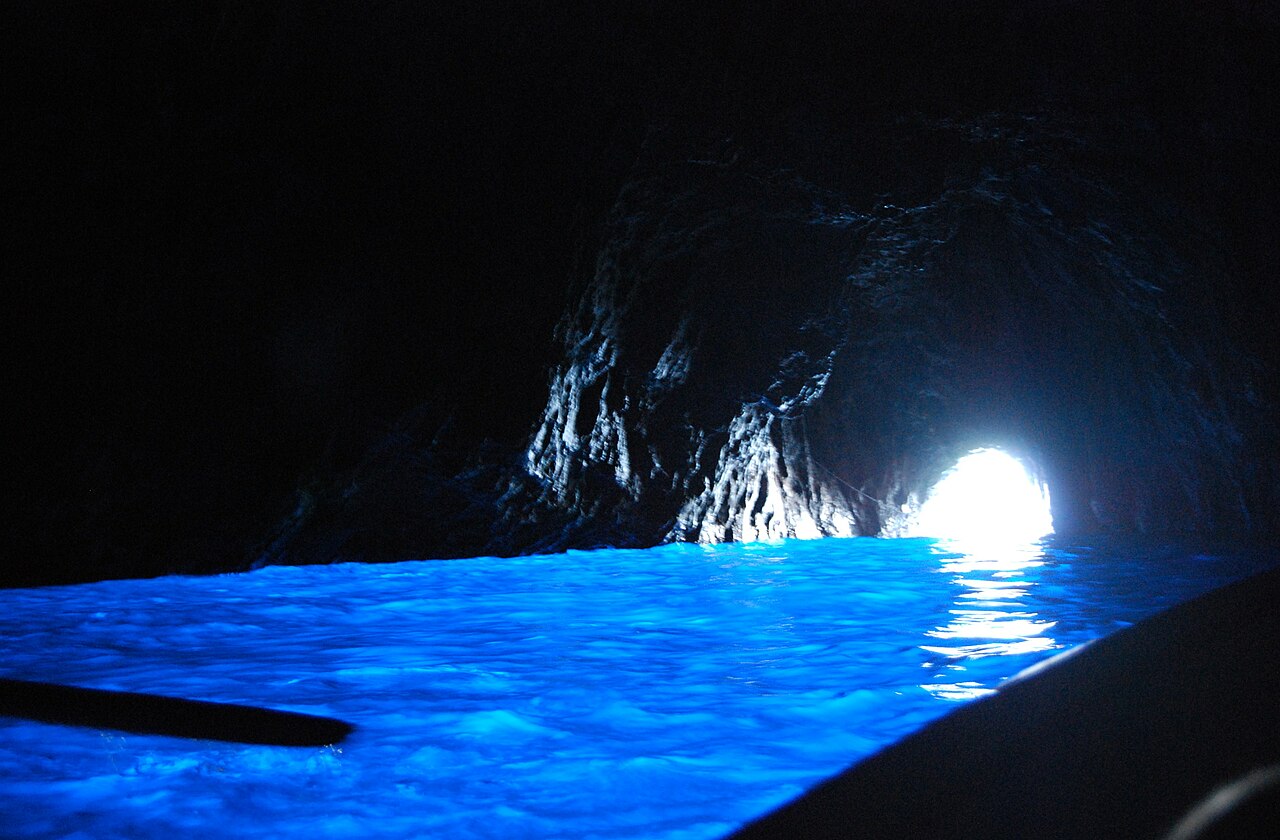


Photo: Elenagm, CC BY-SA 4.0 · Wikimedia Commons
Archaeological site
Blue Grotto
Sea cave on the coast of Capri, Italy
At a glance
- Type
- Archaeological site
- Protection
- Italian national heritage
- Coordinates
- 40°33′40″ N, 14°12′20″ E
- Address
- via grotta Azzurra - Anacapri
History and description
The Blue Grotto (Italian: Grotta Azzurra) is a sea cave on the coast of the island of Capri, southern Italy. Sunlight shining through an underwater cavity is reflected back upward through the seawater below the cavern, giving the water a blue glow that illuminates the cavern. The cave extends some 50 metres (160 ft) into the cliff at the surface, and is approximately 150 metres (490 ft) deep, with a sandy bottom.
Access
The cave is 60 metres (200 ft) long and 25 metres (82 ft) wide. The entry is 2 metres (6 ft 7 in) wide and roughly 1 metre (3 ft 3 in) high at low tides, making safe access possible only when tides are low and the sea is calm. To enter the grotto, visitors must lie flat on the bottom of a small four-person rowboat. The oarsman then uses a metal chain attached to the cave walls to guide the boat inside the grotto.
In 2011, a visitor suffered a life-altering injury when his neck was broken while entering the cave. The Cooperativa Battellieri Grotta Azzurra initially denied liability, but settled a damages claim. It was concluded that the boatmen had continued entering the cave when the sea conditions were too dangerous. Swimming in the grotto is forbidden.
Colour
The Blue Grotto is one of several sea caves worldwide that is flooded with a brilliant blue or emerald light. The quality and nature of the colour in each is determined by its unique combination of depth, breadth, water clarity, and light source.
In the case of the Blue Grotto, the light comes from two sources: the narrow arched entranceway, and a large hole somewhere below the above water entrance, separated by a band of rock between one and two meters tall. Since it is farther from the surface, much less light passes through the lower opening, but its depth and size allow it to be the grotto water's primary source of illumination.
As light passes through the water into the cave, red reflections are filtered out and only blue light enters the cave. Objects placed in the water of the grotto famously appear silver. This is caused by tiny bubbles, which cover the outside of the object when they are placed underwater. The bubbles cause the light to refract differently than it does from the surrounding water and gives off the silver effect.
In part because of the dazzling effect of the light from the above-water opening, it is impossible for a visitor who is in one of the rowboats to identify the shape of the larger hole, the outline of the bar that separates the two holes, or the nature of the light source. Visitors only have a general awareness of the light coming up from underneath as well as the water in the cave being more light-filled than the air. A visitor who places a hand in the water can see it "glow" eerily in this light.
The island of Capri gives its name to the colour Capri because of the colour's resemblance to the bright blue colour of the waters of the Blue Grotto.
History
During Roman times, the grotto was used as the personal swimming hole of Emperor Tiberius as well as a marine temple. Tiberius moved from the Roman capital to the island of Capri in 27 AD. During Tiberius' reign, the grotto was decorated with several statues as well as resting areas around the edge of the cave. Three statues of the Roman sea gods Neptune and Triton were recovered from the floor of the grotto in 1964 and are now on display at a museum in Anacapri. Seven bases of statues were also recovered from the grotto floor in 2009. This suggests that there are at least four more statues lying on the cave's bottom. The cave was described by the Roman historian Pliny the Elder as being populated with Triton "playing on a shell". The now-missing arms on the recovered Triton statue—usually depicted with a conch shell—suggest that the statues recovered in 1964 are the same statues Pliny the Elder saw in the 1st century AD. According to a reconstruction of how the Blue Grotto might have looked in Roman times, a swarm of Triton statues headed by a Neptune statue may have stood in the walls of the cave. The Marevivo association aims to construct this by placing statues in the grotto. This project is being carried out in collaboration with the archaeological superintendence of Pompeii.
At the back of the main cave of the Blue Grotto, three connecting passageways lead to the Sala dei Nomi, or "Room of Names", named for the graffiti signatures left by visitors over the centuries. Two more passages lead deeper into the cliffs on the side of island. It was thought that these passages were ancient stairways which led to Emperor Tiberius' palace. However, the passages are natural ones that narrow and then end further along.
During the 18th century, the grotto was known to the locals as Gradola, after the nearby landing place of Gradola. It was avoided by sailors and islanders because it was said to be inhabited by witches and monsters. The grotto was then "rediscovered" by the public in 1826, with the visit of German writer August Kopisch and his friend Ernst Fries, who were taken to the grotto by local fisherman Angelo Ferraro.
The legend of the Blue Grotto
The cave as in every medieval history was said to be a refuge for devils and monsters. Two priests determined to drive them away entered the cave swimming, and after a few minutes spent inside it, they ran away in panic as if they had seen the face of the devil. From that moment on, the two began to rant. Named the cursed cave, it has numerous legends.
Text from Wikipedia, the free encyclopedia, under CC BY-SA 4.0. Full article: «Blue Grotto».
Photos
Getting there
Address
via grotta Azzurra - Anacapri
Port3.0 km
Aeroporto di Napoli Capodichino36.6 km
Distances are as the crow flies, not walking or driving.
Loading map…
Nearby
See on the mapMore archaeological sites in Campania

- UNESCO
- Free 1st Sunday

- UNESCO

- UNESCO

- UNESCO
- Free 1st Sunday

- Free 1st Sunday
Frequently asked questions
Where is Blue Grotto?
Blue Grotto is in Anacapri, in the province of Napoli (Campania), Italy. Address: via grotta Azzurra - Anacapri. GPS coordinates: 40.56102, 14.20542.
Can I visit Blue Grotto for free?
Yes: entry is free on the first Sunday of every month, under the Italian “Domenica al museo” scheme.
What else is there to see near Blue Grotto?
Nearby you’ll find: Villa Damecuta (1.2 km away), Torre Materita (1.7 km away), Villa San Michele (1.7 km away).
Sources and licences
Text. Wikipedia, the free encyclopedia (CC BY-SA 4.0).
Data. Wikidata (CC0); opening hours and contacts OpenStreetMap (ODbL).
Photos. Wikimedia Commons, author and licence on every image.
Credits for the 9 photos
- Grotta azzurra.capri — Elenagm, CC BY-SA 4.0
- 1958 Capri Blue Grotto vessels 02 Maurice Luyten — Maurice Luyten, CC BY 4.0
- Blue Grotto , Capri , Naples , Campania , Italy - panoramio — Kaz Ish, CC BY-SA 3.0
- Blue Grotto Capri Inside — Arnaud Gaillard, CC BY-SA 1.0
- Blue Grotto IMG 0203 — Deror_avi, CC BY-SA 4.0
- Blue grotto in capri arp — Adrian Pingstone ( Arpingstone ), Public domain
- Blue Grotto view from inside — Towinn, CC BY-SA 3.0
- Blue Grotto 藍洞 - panoramio — lienyuan lee, CC BY 3.0
- Blue Grotto, Capri, IT — Glen Scarborough, CC BY-SA 2.0
Updated 28 October 2026. All sources and licences