


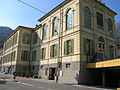


Photo: Hagai Agmon-Snir حچاي اچمون-سنير חגי אגמון-שניר, CC BY-SA 4.0 · Wikimedia Commons
Castle, 1830
Fort Bard
Fortified complex in the Aosta Valley, Italy
At a glance
- Type
- Castle
- Period
- Modern era, 1830
- Architect
- Antonio Francesco Olivero
- Protection
- Italian national heritage
- Coordinates
- 45°36′29″ N, 7°44′40″ E
- Address
- Via Vittorio Emanuele II, 89, 11020 Bard
History and description
Fort Bard, also known as Bard Fort, is a fortified complex built in the 19th century by the House of Savoy on a rocky prominence above Bard, a town and comune in the Aosta Valley region of northwestern Italy. Fort Bard has been completely restored after many years of neglect. In 2006 it reopened to tourists as the Museum of the Alps, it has additional art exhibitions and galleries. In the summer, the main courtyard is used to host musical and theatrical performances.
History
The fort, which is at the entrance to the Aosta Valley, is located in a narrow gorge above the Dora Baltea river. It has been used for millennia to control the historic route between Italy and France. The current fortifications were built by Charles Albert of Savoy between 1830 and 1838. It replaced a 10th-century castle that had, itself, been built on an earlier structure founded by Theodoric I in the 5th century. The castle was under the control of the powerful local lords of Bard until the middle of the 13th century when ownership passed to the House of Savoy. Under their control, the defences were strengthened and improved.
On May 14, 1800, a 40,000-strong French army was stopped by 400 Austro-Piedmontese soldiers at Fort Bard. They held the pass for two weeks, completely ruining Napoleon Bonaparte's plan of making a surprise attack on the Po Valley and Turin. When he heard the news, he named the fort vilain castel de Bard. Bonaparte then ordered the fort to be razed to the ground. It was not until 1830 that Charles Albert of Savoy, fearing new attacks from the French, ordered that the fort be rebuilt. The task was entrusted to the famed Italian military engineer, Francesco Antonio Olivero.
The work, which took eight years to complete, created a fort with two distinct levels. The upper part had conventional battlements whereas the lower part had 50 gun ports in autonomous casemates that were designed to offer mutual protection if attacked. A total of 416 soldiers could now be billeted in the 283-room fort. The upper level had a courtyard which contained the arsenals and barracks. The fort had enough ammunition and food supplies for three months. By the end of the 19th century, the fort had lost its military value and fell into disuse. However, the Italian Army did continue to use the fort as a powder magazine. When it closed in 1975, ownership passed to the government of the Autonomous Region of Valle d'Aosta. In the 1980s the fort opened as a tourist attraction despite many buildings needing urgent repair.
Present day
In the late 1990s the fort was closed. It then underwent major restoration work. In 2006 Fort Bard reopened as the Museum of the Alps. Fort Bard and its town were used as the fictional Eastern European country of Sokovia in the 2015 film Avengers: Age of Ultron directed by Joss Whedon.
Text from Wikipedia, the free encyclopedia, under CC BY-SA 4.0. Full article: «Fort Bard».
Timeline
- 1830Built
Events and people from Wikidata (CC0).
Photos
Getting there
Hône-BardTrain, nearest
700 m as the crow flies
Fort BardVia Vittorio Emanuele II, 89, 11020 Bard
Aeroporto regionale della Valle d'Aosta / Aéroport régional de la Vallée d'Aoste32.6 km
Distances are as the crow flies, not walking or driving.
Loading map…
Nearby
See on the mapMore castles in Aosta Valley


Frequently asked questions
Where is Fort Bard?
Fort Bard is in Bard, Aosta Valley (Aosta Valley), Italy. Address: Via Vittorio Emanuele II, 89, 11020 Bard. GPS coordinates: 45.60817, 7.74458.
How old is Fort Bard?
Wikidata dates it to 1830.
What else is there to see near Fort Bard?
Nearby you’ll find: Museum of the Alps (0 m away), Archéoparc (300 m away), Marelli Palace (1 km away).
Sources and licences
Text. Wikipedia, the free encyclopedia (CC BY-SA 4.0).
Data. Wikidata (CC0); opening hours and contacts OpenStreetMap (ODbL).
Photos. Wikimedia Commons, author and licence on every image.
Credits for the 9 photos
- ForteDiBardHoneAug052023 02 — Hagai Agmon-Snir حچاي اچمون-سنير חגי אגמון-שניר, CC BY-SA 4.0
- Aosta, Forte di Bard — epanto, CC BY-SA 2.0
- Bard - Forte di Bard - 2023-09-07 10-11-27 001 — Dottorgonzi, CC BY-SA 4.0
- Bard - Forte di Bard - 2024-09-08 13-42-35 001 — Chiara Vallarino 1, CC BY-SA 4.0
- Bard AO Vista dal Forte — Laurom, CC BY-SA 3.0
- Bard Il forte che prevale — Rosario Lepore, CC BY-SA 3.0
- Bard Il forte003 — Rosario Lepore, CC BY-SA 3.0
- Bard-forte di Bard1-2010 — Davide Papalini, CC BY-SA 3.0
- Bard-forte di Bard2-2010 — Davide Papalini, CC BY-SA 3.0
Updated 28 October 2026. All sources and licences