

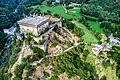


Photo: Hagai Agmon-Snir حچاي اچمون-سنير חגי אגמון-שניר, CC BY-SA 4.0 · Wikimedia Commons
At a glance
- Type
- Castle
- Style
- International Gothic
- Protection
- Italian national heritage
- Coordinates
- 45°39′16″ N, 7°41′08″ E
- Address
- Strada Regionale 4 Issogne, 11020
History and description
Issogne Castle is a castle in Issogne, in lower Aosta Valley, in northwestern Italy. It is one of the most famous manors of the region, and is located on the right bank of the Dora Baltea at the centre of the inhabited area of Issogne. As a seigniorial residence of the Renaissance, the Castle has quite a different look from that of the austere Verrès Castle, which is located in Verrès, on the opposite bank of the river.
Issogne Castle is most noteworthy for its fountain in the form of pomegranate tree and its highly decorated portico, a rare example of medieval Alpine painting, with its frescoed cycle of scenes of daily life from the late Middle Ages.
History
The earliest mention of the castle of Issogne is in a papal bull issued by Pope Eugene III in 1151, which refers to a fortified building at Issogne, the property of the Bishop of Aosta. Some walling discovered in the cellars of the current castle may be evidence of a Roman villa, dating from the 1st century BC, on the site.
Tensions between the Bishop of Aosta and the De Verrecio family, lords of the nearby town of Verrès, reached boiling point around 1333, when the castle of Issogne, the episcopal seat, was attacked and damaged by fire. Issogne remained the seat of the bishop until 1379, when the bishop of Aosta submitted to the jurisdiction of the then lord of Verrès, Yblet of Challant. Ibleto transformed the episcopal stronghold into an elegant princely residence in Gothic style, with a series of towers and buildings enclosed by an encircling wall.
When Yblet died in 1409, the feud and castle of Issogne passed to his son Francis of Challant (French: François de Challant), who in 1424 received the title of Count of Challant from the Duke of Savoy. Francesco died in 1442, leaving no male heir. A long succession struggle between Francesco's daughter Catherine of Challant and her cousin James of Challant-Aymavilles (French: Jacques de Challant-Aymavilles) was won by James, who thus became the second Count of Challant and the new lord of Issogne.
From about 1480, further alterations were made to the Castle by James's son Luigi di Challant, and continued after his death in 1487 by his cousin, the prior George of Challant-Varey (French: Georges de Challant-Varey), to whom James's wife Marguerite de la Chambre had granted custody of his sons Philibert and Charles. George had new wings erected to connect the already existing buildings, unifying the complex into a single horseshoe shape surrounding a central courtyard. The decorations of the portico and the celebrated pomegranate fountain date to this period. The Castle hosted many illustrious guests, including the future emperor Sigismund of Luxemburg as he returned to Germany in 1414, and King Charles VIII of France in 1494. …
Interior of the Castle
From the exterior, the Castle looks like a fortified residence of fairly unprepossessing appearance, without any particular decoration, with angular turrets a little higher than the rest of the building. The Castle is situated at the centre of the inhabited area of Issogne.
The Castle was built to a quadrangular plan, three sides of which are occupied by the building and the fourth, oriented towards the south, comprises an Italian Garden, enclosed within a surrounding wall.
The internal courtyard, enclosed within the three sides of the building, and the garden form one of the most interesting spaces of the Castle. At one time, one reached this space by passing from the countryside through principal gate and under a portico. Today, for practical reasons, the secondary entrance on the west side is used. This entrance faces an expansive field.
On the facades that face the courtyard, one finds the so-called "Miroir pour les infants de Challant", a series of frescoed heraldic arms that show the diverse branches of the Challant family and the principal matrimonial alliances of the house. The "miroir" was created in order to preserve a record of the family history and to transmit it to future generations. The surrounding wall of the garden, on the other hand, was decorated with monochromatic images of legends and heroes of antiquity, now unfortunately almost entirely obliterated.
At the centre of the courtyard, one finds the celebrated 'pomegranate fountain'. From the octagonal stone bowl of the fountain emerges a pomegranate tree made of wrought iron from which jets of water are sprayed. Strangely, although the fruit of the tree is clearly to be understood as that of the pomegranate the leaves, perhaps for symbolic reasons intended by the artist, are those of another tree - the oak. George of Challant probably had the fountain constructed as a wedding gift for the wedding of his favourite, Philibert of Challant, when Philibert married Louise d'Aarberg in 1502. It appears that the tree is to be read symbolically as the expression of the desire to unite the fertility and unity of the family represented by the pomegranate, with its seed-filled fruit, with the strength and antiquity signified by the oak. Amongst the branches of the pomegranate-oak, and somewhat difficult to discern, tiny dragons have been inserted. …
Text from Wikipedia, the free encyclopedia, under CC BY-SA 4.0. Full article: «Issogne Castle».
Photos
Getting there
VerrèsTrain, nearest
700 m as the crow flies
Issogne CastleStrada Regionale 4 Issogne, 11020
Aeroporto regionale della Valle d'Aosta / Aéroport régional de la Vallée d'Aoste26.3 km
Distances are as the crow flies, not walking or driving.
Loading map…
Nearby
See on the mapMore castles in Aosta Valley


Frequently asked questions
Where is Issogne Castle?
Issogne Castle is in Issogne (Aosta Valley), Italy. Address: Strada Regionale 4 Issogne, 11020. GPS coordinates: 45.65442, 7.68549.
What are the opening hours of Issogne Castle?
According to OpenStreetMap the opening hours are: Oct-Mar Tu-Su 10:00-13:00, 14:00-17:00; Apr-Sep Tu-Su 09:00-19:00; Dec 25 off; Jan 01 off || Jul-Aug Mo 09:00-19:00 "aperto i lunedì di luglio e agosto". Always check the official website before your visit.
What else is there to see near Issogne Castle?
Nearby you’ll find: Prevostura di Saint-Gilles (1.7 km away), Verrès Castle (1.9 km away), Ville fortified house and tower (3.5 km away).
Sources and licences
Text. Wikipedia, the free encyclopedia (CC BY-SA 4.0).
Data. Wikidata (CC0); opening hours and contacts OpenStreetMap (ODbL).
Photos. Wikimedia Commons, author and licence on every image.
Credits for the 9 photos
- IssogneJuly292023 01 — Hagai Agmon-Snir حچاي اچمون-سنير חגי אגמון-שניר, CC BY-SA 4.0
- Castello d'Issogne — Luigi Ippolito, CC BY-SA 3.0
- Castello di Issogne 006 — Rosario Lepore, CC BY-SA 3.0
- Castello di Issogne 20160815 132317 (48) — Frasqua74, CC BY-SA 4.0
- Castello di Issogne Stitch — Rosario Lepore, CC BY-SA 3.0
- Il parco del Castello di Issogne — Pat.vvf, CC BY-SA 3.0
- Issogne Blick vom Castello d'Issogne — Zairon, CC BY-SA 4.0
- Issogne Castello d'Issogne 1 — Zairon, CC BY-SA 4.0
- Issogne Castello d'Issogne Garten 1 — Zairon, CC BY-SA 4.0
Updated 28 October 2026. All sources and licences