



- UNESCO
- Free 1st Sunday
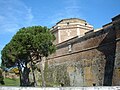
Photo: Croberto68, CC BY-SA 3.0 · Wikimedia Commons
Archaeological site
Archaeological site in the province of Viterbo, Italy
Fabrica di Roma (VT), Lazio
Falerii is a village in the municipality of Fabrica di Roma in the Province of Viterbo, Italy. Its name is better known for two nearby ancient cities, Falerii Veteres (old Falerii) and Falerii Novi (new Falerii).
Falerii Veteres, now Civita Castellana, was one of the chief cities of the duodecim populi of ancient Etruria. The site is about 2 km west of the course of the Via Flaminia, some 50 km north of Rome.
It was the main city of the Falisci, a people whose language was Faliscan and was part of the Latino-Faliscan language group. The Ager Faliscus (Faliscan Country), which included the towns of Capena, Nepet, and Sutrium, was close to the Monti Cimini.
The site of the original Falerii is a plateau, about 1100 × 400 m, not higher than the surrounding country (140 m) but separated from it by gorges over 60 m in depth, and only connected with it on the western side, which was strongly fortified with a mound and ditch. The rest of the city was defended by walls constructed of rectangular blocks of tuff of which some remains still exist.
According to legend, Falerii Veteres was of Argive origin. Strabo's assertion that the population, the Falisci, were of a different race from the Etruscans is supported by the evidence of the inscriptions which have been found here. They were written in a Latin dialect. Most of the surviving inscriptions date back to the second half of the fourth century BC and the first half of the third century BC. The Faliscan language survived "the domination of the [surrounding] Etruscan culture, as well as, for a long time, the expansion of the Romans".
Falerii was relatively close to Rome, and the Faliscans viewed the Romans as a threat to their security. For this reason, they supported the Etruscan cities of Veii and Fidenae (which was near Veii, on the other bank of the river) in their conflicts with Rome in the fifth century. Livy noted that: "As these two States [Falerii and the nearby Capena] were nearest in point of distance, they believed that if Veii fell they would be the next on whom Rome would make war". There had been a history of on-and-off conflicts between Rome and Veii, which often involved Fidenae. The Romans had placed a colony at Fidenae to garrison the city. In 437 BC Fidenae revolted, attacked the Roman settlers and sided with Veii. Roman envoys who were sent to Fidenae were killed on the order of the king of Veii. The Romans advanced on Fidenae. The Faliscans sent troops in support. The Veientes and Fidenates (the inhabitants of Veii and Fidenae) wanted to prolong the war, but the Faliscans wanted a pitched battle. The Romans routed the combined enemy forces. In 436 BC the Romans raided the territory of Veii and Falerii, but did not attack the two cities. In 435 BC the Fidenates crossed into Roman territory to raid it and called in the army of Veii. Falerii did not want to renew the war. In 434 the Romans seized Fidenae. This alarmed Veii and Falerii. They sent envoys to the Etruscan League (a council of the twelve major Etruscan cities) for assistance, but the league refused to help Veii. …
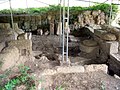
Remains of a temple were found at Lo Scasato, at the highest point of the ancient town, in 1888, and others have been excavated in the outskirts. The attribution of one of these to Juno Quiritis is uncertain. These buildings were of wood, with fine decorations of coloured terracotta. Numerous tombs hewn in the rock are visible on all sides of the town, and important discoveries have been made in them; many objects, both from the temples and from the tombs, are in the Museo di Villa Giulia at Rome. Similar finds have also been made at Calcata, ten km to the south, and Corchiano, around ten km north-west.
Text from Wikipedia, the free encyclopedia, under CC BY-SA 4.0. Full article: «Falerii Novi».
Distances are as the crow flies, not walking or driving.


Falerii Novi is in Fabrica di Roma, in the province of Viterbo (Lazio), Italy. GPS coordinates: 42.30000, 12.35737.
Nearby you’ll find: Fort Sangallo (4.4 km away), Museo Archeologico dell'Agro Falisco (4.4 km away), Narce (4.8 km away).
Text. Wikipedia, the free encyclopedia (CC BY-SA 4.0).
Data. Wikidata (CC0); opening hours and contacts OpenStreetMap (ODbL).
Photos. Wikimedia Commons, author and licence on every image.
Updated 28 October 2026. All sources and licences