




- UNESCO
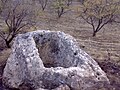
Photo: José Luiz, CC BY-SA 4.0 · Wikimedia Commons
Heraclea Minoa (Ancient Greek: Ἡράκλεια Μινῴα, Hērákleia Minṓia; Italian: Eraclea Minoa) was an ancient Greek city of Magna Graecia situated on the southern coast of Sicily near the mouth of the river Halycus (modern Platani), 25 km west of Agrigentum (Acragas, modern Agrigento). It is located near the modern town of the same name in the comune Cattolica Eraclea in Italy.
Excavations have revealed several parts of the city which are now open to the public.
Archaeology has shown that the city was founded in the middle of the 6th century BC as an outpost of the Greek colony of Selinus (modern Selinunte) and was finally abandoned around the beginning of the 1st century AD.
The city is situated a few hundred metres southeast of the mouth of the river Platani (the ancient Halycus) in a defendable position atop the conspicuous promontory now called Capo Bianco with gently sloping sides down to the Platani valley to the north and sheer white cliffs to the ocean on the south side. The Heraclean promontory is mentioned by Strabo in his description of the coasts of Sicily, and which he correctly gives as 20 miles distant from the port of Agrigentum.
Its two names were connected with separate myths regarding its origin. The first of these was that Heracles, having vanquished the local hero Eryx in a wrestling match, obtained thereby the right to the whole western portion of Sicily, which he expressly reserved for his descendants.
The other was that somewhat later, Minos, king of Crete, having come to Sicily in pursuit of Daedalus, landed at the mouth of the river Halycus, and founded there a city, to which he gave the name of Minoa; or, according to another version of the story, the city was first established by his followers, after the death of Minos himself. Heraclides Ponticus adds that there was previously a native city on the spot, the name of which was Macara. No intimation is given by Diodorus of the names relating to the same spot.
Archaeological finds from the necropolis show the city was founded in the mid-6th century BC. The first written mention of the city is of a small town and a colony of the Greek settlement of Selinus (itself founded about 650 BC), bearing the name of Minoa. From its founding Minoa was in contention between Selinus (as its eastern outpost) and Akragas which wanted control of the Platani valley.
In c. 510 BC Dorieus the Spartan (brother of Cleomenes I) came to Sicily with the intent of reclaiming the territory which he believed had belonged to his ancestor Heracles. But in fighting the Carthaginians and Segestans, he was defeated and slain and almost all his leading companions also perished. Euryleon, the only one of the chiefs who escaped, made himself master of Minoa which now, in all probability, obtained for the first time the name of Heraclea.
From the time of this new settlement it seems to have borne the name of Heraclea, though coupled with that of Minoa for the sake of distinction.
The city was only briefly under the control of the Spartans and during the whole of the 5th c. BC it was under Akragan control and became very prosperous. …
The location of Heraclea Minoa was first identified by the 16th century historian Tommaso Fazello; the foundations of the walls could be distinctly traced and, though no ruins remained standing, the whole site abounded with remains of pottery and brickwork. According to Fazello an aqueduct was then also still visible between the city and the mouth of the river but its remains have since disappeared, though the height difference makes this unlikely to be practible.
In the early 20th century, a mid-6th-early 5th century BC necropolis was discovered. A large-scale excavation by Professor Ernesto de Miro from 1950 uncovered late 4th–late 1st century BC dwellings and the late 4th century BC theatre. The absence of Arretine ware at the site strongly suggests that the city was abandoned by the beginning of the 1st century AD. Many cemeteries and tombs have been excavated in the nearby countryside and many of their grave goods are on display in the on-site museum.
The theatre was built in the 4th-3rd c. BC into the hollow of a small hill with, unusually, the cavea facing south against the advice of Vitruvius. The side of the theatre is built onto the city walls. The sides of the auditorium are prolonged like a few other Greek theatres (e.g. Segeste, Athens).
It did not have a real stage as in the orchestra the fixings for cables of a mobile wooden podium were found.
The theatre was abandoned in the 2nd-1st c. BC when other buildings used the walls of the staircases.
The soft building stone, as used throughout the city, has mandated a modern roof to protect the theatre from further erosion.
The oldest IV-III c. BC settlement is visible at present through two completely excavated houses: A and B.
House A had a courtyard (atrium) equipped with a large cistern into which water from the compluvium pitched roofs drained. North of the courtyard was a domestic shrine (lararium) of which the quadrangular altar leaning against the northwest corner and the shrine for the lares in the east wall are preserved. The floor of the room is in cocciopesto decorated with white pieces while the walls retain remnants of the stucco decoration (Pompeian 1st style). …
Text from Wikipedia, the free encyclopedia, under CC BY-SA 4.0. Full article: «Heraclea Minoa».
Distances are as the crow flies, not walking or driving.


Heraclea Minoa is in Montallegro, in the province of Agrigento (Sicily), Italy. GPS coordinates: 37.39404, 13.28090.
Nearby you’ll find: Theatre of Herakleia Minoa (0 m away), Anguilla necropolis (9 km away), Castello di Poggiodiana (13.3 km away).
Text. Wikipedia, the free encyclopedia (CC BY-SA 4.0).
Data. Wikidata (CC0); opening hours and contacts OpenStreetMap (ODbL).
Photos. Wikimedia Commons, author and licence on every image.
Updated 28 October 2026. All sources and licences