

- UNESCO
- Free 1st Sunday
Photo: Cassius Ahenobarbus, CC BY-SA 3.0 · Wikimedia Commons
Archaeological site
Imperial Roman palace in ancient Rome, located on the northwest corner of the Palatine Hill
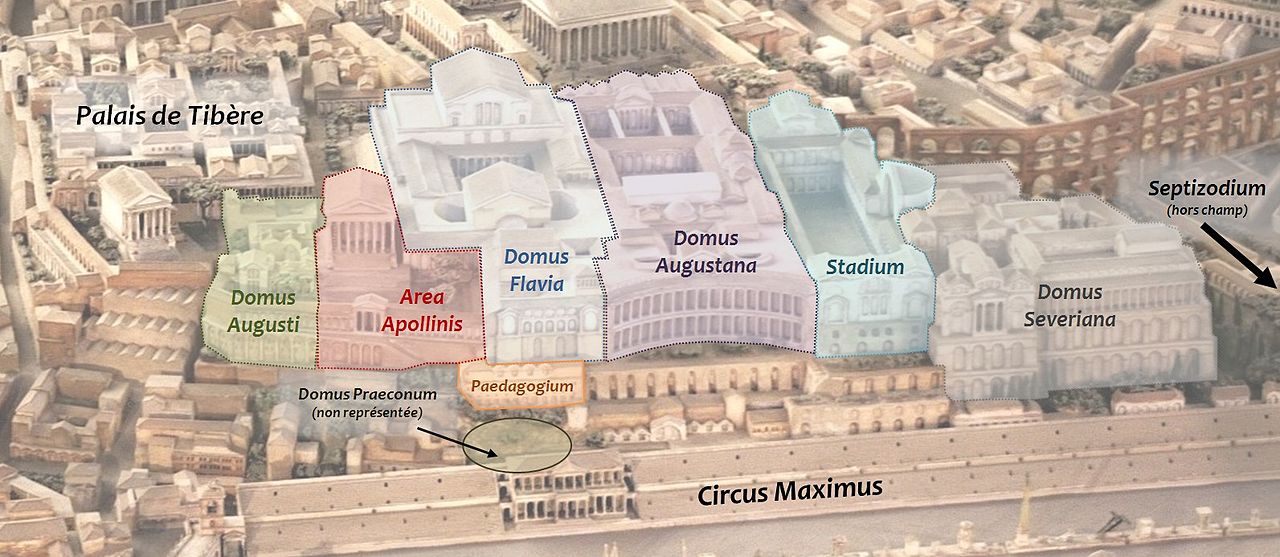
The Domus Tiberiana was an Imperial Roman palace in ancient Rome, located on the northwest corner of the Palatine Hill. It probably takes its name from a house built by the Emperor Tiberius, who is known to have lived on the Palatine, though no sources mention his having built a residence. It was enlarged by the successors to Tiberius, and would have been the principal Roman residence of Tiberius, Caligula, Claudius, and Nero during the early part of his reign. Relatively little is known of the structure archaeologically, since the Farnese Gardens have occupied the site of the main level since the 16th century, making excavation difficult.
The remains of the Domus Tiberiana lie on the northwest corner of the Palatine, facing the Velabrum and the Roman Forum below, with the Capitoline hill beyond. The site comprises an area of approximately 150 metres by 120 metres (492 x 394 feet), and is occupied by the platform of the Farnese Gardens, which were constructed in 1550 by Cardinal Alessandro Farnese. The visible remains are those of the imposing arcaded support structures on the northern slope of the hill, built under Domitian, Trajan and Hadrian. On the level of the Forum the ruins of a vestibule complex, begun by Domitian and completed by Hadrian, lie behind the Temple of Castor and Pollux. From here there was an access ramp which led up the slope of the hill to the Domus Tiberiana on the summit.
The core of the Tiberiana was oriented around a large peristyle with arcades surrounding it on four sides. A double block of rooms separated by a broad corridor was built south of this peristyle, and another block of rooms stood to the north. Along the east side of the Tiberiana is a 130 meter (427 foot) long cryptoporticus from the time of Nero, with mosaic floors and poorly preserved frescoes. This cryptoporticus was connected to the Flavian Palace when it was built. In the southeast corner of the palace, close to the Domus Livia, are the remains of an elliptical basin probably used as a fish pond. On the southwest front is a portico fronting a series of rooms, which are believed to have housed the Praetorian Guard based on the graffiti found in them.
Scholarly consensus holds that Tiberius built a splendid house as princeps, which would form the base structure for a complex of buildings developed by his successors Caligula, Claudius and Nero. It's possible that Tiberius built his house on the site of his father's (Tiberius Claudius Nero) house, and the place of his birth, since excavations have revealed an earlier Republican-era house built on a high podium beneath the western end of the Tiberiana.
The name Domus Tiberiana first appears in the Histories of Tacitus in connection with the assassination of Galba in 69 AD. However, earlier references to the houses of Caligula, Claudius and Nero on the Palatine by authors like Suetonius and Plutarch accord with the location of the Domus Tiberiana, making it likely these were one and the same house. Anthony Barrett suggested that the name "may have been coined to define the original structure, to draw a distinction with the later period when the general term palatium became associated specifically with the huge palace complex built over the area by Domitian."
Suetonius mentions that Caligula expanded the palace out into the Forum, where he converted the Temple of Castor and Pollux into an entry vestibule. Although only scant traces have been left of this extension, the remains of masonry and a large rectangular pool measuring 9m x 26m (30 feet x 85 feet) lying within a court can be discerned behind the Temple of Castor and Pollux. …
Various sculptures and architectural ornaments have been discovered in 2008 on or near the site of the Domus Tiberiana. These include a pair of white marble wings that would have belonged to a large Nike statue, and a statue of Aphrodite. A high quality panel of opus sectile flooring, composed of several types of marble inlaid in a geometric pattern, was found during the excavations (1865–67) by Pietro Rosa and is on display in the Palatine Museum, along with the statues discovered at the site. Significant finds have been made within the Hadrianic arcades which covered the old Clivus Victoriae, including altars to Minerva and Lucina. Several fragments of high-quality terracotta statues were also found within these arcades; they are believed to have been working models for making copies of Greek statues for Roman clients in the time of Caesar and Augustus.
Text from Wikipedia, the free encyclopedia, under CC BY-SA 4.0. Full article: «Domus Tiberiana».
Distances are as the crow flies, not walking or driving.


Domus Tiberiana is in Rome, in the province of Roma (Lazio), Italy. GPS coordinates: 41.89024, 12.48623.
Nearby you’ll find: Farnese Gardens (0 m away), House of Livia (100 m away), Horrea Agrippiana (100 m away).
Text. Wikipedia, the free encyclopedia (CC BY-SA 4.0).
Data. Wikidata (CC0); opening hours and contacts OpenStreetMap (ODbL).
Photos. Wikimedia Commons, author and licence on every image.
Updated 28 October 2026. All sources and licences