
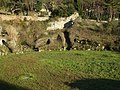


Photo: Deblu68, CC BY-SA 3.0 · Wikimedia Commons
Abbey / Monastery, 1739
Convento di Santa Maria ad Nives di Palazzolo
Building in Rocca di Papa, Italy
Rocca di Papa (RM), Lazio
At a glance
- Type
- Abbey / Monastery
- Period
- Early modern period, 1739
- Style
- Gothic architecture
- Coordinates
- 41°44′36″ N, 12°41′25″ E
History and description
The church of Santa Maria ad Nives of Palazzolo (also called of Palazzola) is a Catholic place of worship located in the municipality of Rocca di Papa, in the province of Rome, in the suburbicarian diocese of Frascati. Next to the church stands the former convent of the Friars Minor Observant.
The convent, which already existed in the 11th century, stands in a picturesque place overlooking Lake Albano: amidst alternate events it reached its period of maximum splendor around the middle of the 18th century, with the architectural interventions promoted by Bishop José Maria Ribeiro da Fonseca de Évora. The convent was a protectorate of the Kingdom of Portugal from 1870 to 1910, until it was handed over to private individuals in 1915. Since 1920 it has hosted a summer stay for seminarians from the Venerable English College.
History
The Alban Hills were subject between about 600,000 and 20,000 years ago to the volcanic activity of the Latian Volcano, which generated the present environmental setting in which the convent is located: at the foot of Monte Cavo (949 m a.s.l.), an ancient secondary volcanic crater of the Latian Volcano, overlooks Lake Albano, a volcanic lake that fills what was also a volcanic crater.
Most likely this was the site of the legendary city of Alba Longa, which according to the account of Dionysius of Halicarnassus was founded by Aeneas's son Ascanius thirty years after the founding of Lavinium, "near a mountain and a lake, occupying the space between the two." This description given by the respected historiographer has led many scholars to suspect that the site of the ancient city was located on the southern side of the lake, between the Colle dei Cappuccini in the municipality of Albano Laziale and the Palazzolo convent: although other influential scholars have opted for other sites, such as the eastern side of Lake Albano included between the localities of Costa Caselle near Marino and Pozzo Carpino in the municipality of Grottaferrata, or the western side of the lake, at the site of the present-day historic center of Castel Gandolfo, currently the most probable hypothesis appears to be the former, so much so that on the Map of Italy drawn up by the Military Geographical Institute the toponym of Alba Longa is placed side by side with that of Palazzolo.
Following the destruction of Alba, conventionally dated to 673 B.C. and in any case datable to the 6th century B.C., the Alban Hills did not lose a character of sacredness linked to the origins of Rome: the "Via Sacra" passed through Palazzolo, which reached the temple of Latian Jupiter located on the summit of Monte Cavo, connecting with the Via Appia Antica near present-day Ariccia. Along this road is a characteristic rock tomb dug into the peperino for about 40 meters wide. The inner cell is 2.60 meters by 2.26 meters large, and the bas-reliefs depict a triumph: the fasces depicted here were used by archaeologist Giacomo Boni as a model for the fasces used as a symbol by the National Fascist Party. The attribution of the tomb is uncertain, however there are those who thought it might have belonged to someone of the Cornelii Scipiones. …
Description
The entrance portico of the church is made according to Cistercian custom, with ancient columns and bare capitals, in this case all of Ionic order: it is reminiscent of the entrance porticos of the church of San Giorgio in Velabro and the Tre Fontane Abbey in Rome, as it too can be dated to the first half of the 13th century. The portico has five openings, of which the central one represents the entrance. Above the portico, the severe gabled facade is adorned only by a Gothic rose window and two monoforas symmetrically arranged on either side of the main vertical axis.
The appearance of the portico was modified during the interventions commissioned by Cardinal Fonseca in 1735-1738: in fact, two small rooms for the choir loft and organ were built above the portico, an intervention that involved plugging the rose window and the monoforas: in addition, twin bell towers were erected on either side of the portico, one equipped with three bells and the other with the clock. The tops of the bell towers were clad in lead and were adorned with arched spires in the Borrominian style, all of which were looted by the French in 1806 when the bell towers had to be repaired after an earthquake tremor.
The original appearance was only restored to the portico and facade after the twentieth-century restorations, which also added the alternating band articulation of Carrara marble and peperino, unrelated to the original architecture and judged by some experts to be questionable.
The interior of the church consists of a single nave, covered by a cross-ribbed vault, reminiscent of the interior of the Carthusian Monastery of Trisulti: in ancient times there were two side altars, which at the beginning of the 18th century were found to be dedicated to Our Lady and St. James of the Marches, the latter co-founder of the Observant Friars Minor together with St. Bernardine of Siena. Lighting is provided through two large monoforas on the sides. …
Text from Wikipedia, the free encyclopedia, under CC BY-SA 4.0. Full article: «Convento di Santa Maria ad Nives di Palazzolo».
Timeline
- 1398Dissolved or destroyed
- 1739Built
Events and people from Wikidata (CC0).
Getting there
Castel GandolfoTrain, nearest
3.2 km as the crow flies
Convento di Santa Maria ad Nives di Palazzolo
Aeroporto di Roma-Ciampino10.2 km
Distances are as the crow flies, not walking or driving.
Loading map…
Nearby
See on the mapMore abbeys and monasteries in Lazio


- Free 1st Sunday


Frequently asked questions
Where is Convento di Santa Maria ad Nives di Palazzolo?
Convento di Santa Maria ad Nives di Palazzolo is in Rocca di Papa, in the province of Roma (Lazio), Italy. GPS coordinates: 41.74333, 12.69028.
How old is Convento di Santa Maria ad Nives di Palazzolo?
Wikidata dates it to 1739.
What else is there to see near Convento di Santa Maria ad Nives di Palazzolo?
Nearby you’ll find: Roman Amphitheatre of Albano Laziale (2.4 km away), Geophysical Museum, Rocca di Papa (2.5 km away), Museo delle navi romane (2.6 km away).
Sources and licences
Text. Wikipedia, the free encyclopedia (CC BY-SA 4.0).
Data. Wikidata (CC0); opening hours and contacts OpenStreetMap (ODbL).
Photos. Wikimedia Commons, author and licence on every image.
Credits for the 1 photos
- Convento di Palazzolo - panorama 2 — Deblu68, CC BY-SA 3.0
Updated 28 October 2026. All sources and licences