


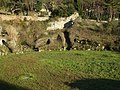

Photo: Rjdeadly, CC BY-SA 4.0 · Wikimedia Commons
At a glance
- Type
- Fortress / Tower
- Coordinates
- 41°43′44″ N, 12°39′37″ E
History and description
The Castra Albana [ˈkastra alˈbaːna] was an ancient Roman legionary fortress of the Legio II Parthica founded by the Emperor Septimius Severus (193–211) on the site of the present Albano Laziale.
It was the only permanent legionary fortress in Italy and had the role of protecting the emperor, while all other legions were distributed through the provinces for defence of the empire. It was located near to the imperial villa at the present Castel Gandolfo, and only about 20 km from Rome.
Today the remains of building both inside the castra and in the neighbouring civilian settlement, such as the so-called Baths of Caracalla and the Amphitheatre, can still be seen.
History
The fortress of Legio II Parthica was named Albana after the area which included Lacus Albanus, Mons Albanus, aqua Albana (perhaps an aqueduct on the south side of the lake), the rivus Albanus (probably the modern marana delle Pietrare near Marino) and "Albani Longani Bovillenses", the official name of the inhabitants of the municipium of Bovillae (located on the Appian Way near the modern village of Frattocchie), The adjective Albanus was also used as a poetic synonym for Romanus.
The legio II Parthica came to be known as legio Albana and its legionaries as Albani, even though the whole legion did not remain at the Castra Albana but had other encampments in Mesopotamia.
The Appian Way was built in 312 BC to connect Rome with Capua and passed through the Alban Hills. in Campania. The ease of direct communication with Rome led to many suburban villas of Roman nobles being built in the area, including the villas of Publius Clodius Pulcher (near Ercolano in Castel Gandolfo). and perhaps of Pompey the Great (in the Villa Doria)
Nevertheless, until the time of Domitian, the stretch of the Appian Way between Bovillae and Aricia (modern Frattocchie in Marino and Ariccia) was completely free of buildings.
In the Republican period, the area of the later castra was occupied by fortifications remains of which were found at various points in central Albano Laziale.
Domitian built his palace near Castel Gandolfo on an estate containing several imperial properties, with an area of about 14 km2. The villa was probably garrisoned by a detachment of the Praetorian Guard when the Emperor was in residence. The villa was frequently used by Domitian but later fell into disuse, on account of the construction of Villa of Hadrian at Tivoli in (117-136), who also began a policy of selling surplus Imperial property, including some of the villas on the edge of "Albanum Caesarum". …
Description
Like all Roman castra, the Castra Albana followed a regular design of a large fortified rectangle with rounded corners reinforced by circular turrets (an unusual feature, but similar to the castra of Hadrian's Wall in Britain), and with four gates (praetoria, decumana, principalis sinistra and principalis dextra),. The walls are of opus quadratum, one of its latest appearances in the Ager Romanus (it was supplanted by Opus latericium). The construction material is Peperino, extracted in situ from the volcanic soil on which the castra was built. The construction was made difficult by the position of the encampment on an 11 degree slope. The perimeter of the wall circuit is 1334 metres with sides northwest 434 m, southeast 437 m, northeast 224 m, southwest 239 m. The total area is around 95,000 m2.
Unlike other fortresses, there were no external defensive ditches or earthworks, as indicated by a road which ran just outside the walls.
The most substantial remains on this side are those of the porta praetoria, the monumental main entrance to the castra (instead of the more usual Porta Principalis), 36 m wide and still 14 m tall, and a unique example of legionary fortress architecture. It overlooked the Via Appia 20 m away which passed in front of it and was a form of imperial propaganda aimed at passing travellers. Located at the midpoint of the wall, the gate was incorporated into a later building until the devastating Anglo-American aerial bombardment of 1 February 1944. The central archway measures around 3 x 5 m with a height of 14 metres while the two side archways were a little over 1 x 5 m. The two side chambers each measure 5.4 x 5 m. …
Text from Wikipedia, the free encyclopedia, under CC BY-SA 4.0. Full article: «Castra Albana».
Photos
Getting there
Albano LazialeTrain, nearest
300 m as the crow flies
Castra Albana
Aeroporto di Roma-Ciampino9.6 km
Distances are as the crow flies, not walking or driving.
Loading map…
Nearby
See on the mapMore fortresses and towers in Lazio


- UNESCO


Frequently asked questions
Where is Castra Albana?
Castra Albana is in Albano Laziale, in the province of Roma (Lazio), Italy. GPS coordinates: 41.72902, 12.66021.
What else is there to see near Castra Albana?
Nearby you’ll find: Palazzo Savelli (Albano Laziale) (100 m away), Baths of Caracalla in Albano Laziale (200 m away), Villa Corsini (300 m away).
Sources and licences
Text. Wikipedia, the free encyclopedia (CC BY-SA 4.0).
Data. Wikidata (CC0); opening hours and contacts OpenStreetMap (ODbL).
Photos. Wikimedia Commons, author and licence on every image.
Credits for the 4 photos
- Porta Praetoria (Castra Albana) — Rjdeadly, CC BY-SA 4.0
- Mura-Castra Albana lato est — Gino il Pio, CC BY-SA 3.0
- Mura Castra Foscolo Albano — Gino il Pio, Public domain
- Cisternoni Albano dieci — N:D:, Public domain
Updated 28 October 2026. All sources and licences