

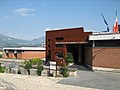


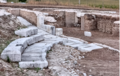

Photo: Marica Massaro, CC BY-SA 4.0 · Wikimedia Commons
At a glance
- Type
- Abbey / Monastery
- Period
- Middle Ages, 530
- Style
- Neapolitan baroque art
- Elevation
- 519 m above sea level
- Protection
- Italian national heritage
- Coordinates
- 41°29′24″ N, 13°48′50″ E
- Address
- Via Montecassino 4, 03043 Cassino
History and description
The Abbey of Monte Cassino (today usually spelled Montecassino) is a Benedictine monastery on a rocky hill about 130 kilometres (80 mi) southeast of Rome, in the Latin Valley. Located on the site of the ancient Roman town of Casinum, it is the first house of the Benedictine Order, having been established by Benedict of Nursia himself around 529. It was for the community of Monte Cassino that the Rule of Saint Benedict was composed.
The first monastery on Monte Cassino was sacked by the invading Lombards around 570 and abandoned. Of the first monastery almost nothing is known. The second monastery was established by Petronax of Brescia around 718, at the suggestion of Pope Gregory II and with the support of the Lombard Duke Romuald II of Benevento. It was directly subject to the pope and many monasteries in Italy were under its authority. In 883, the monastery was sacked by Saracens and abandoned again. The community of monks resided first at Teano and then from 914 at Capua before the monastery was rebuilt in 949. During the period of exile, the Cluniac Reforms were introduced into the community.
The 11th and 12th centuries were the abbey's golden age.
History
The history of Monte Cassino is linked to the nearby town of Cassino which was first settled in the fifth century BC by the Volsci people who held much of central Italy. It was they who first built a citadel on the summit of Monte Cassino. The Volsci in the area were defeated by the Romans in 312 BC. The Romans named the settlement Casinum and built a temple to Apollo at the citadel. Modern excavations have found no remains of the temple, but monumental remains of an amphitheatre, a theatre, and a mausoleum show the wealth of the Roman town.
Generations after the Roman Empire adopted Christianity the town became the seat of a bishopric in the fifth century AD. Lacking strong defences the area was subject to barbarian attack and became abandoned and neglected with only a few struggling inhabitants holding out.
According to Gregory the Great's hagiography of Benedict, the Life of Saint Benedict of Nursia, the monastery was constructed on an older pagan site, a temple of Apollo that crowned the hill. The biography records that the area was still largely pagan at the time; Benedict's first act was to smash the sculpture of Apollo and destroy the altar. He then reused the temple, dedicating it to Saint Martin, and built another chapel on the site of the altar dedicated to Saint John the Baptist.
Pope Gregory I's account of Benedict's seizure of Monte Cassino:
Now the citadel called Casinum is located on the side of a high mountain. The mountain shelters this citadel on a broad bench. Then it rises three miles above it as if its peak tended toward heaven. There was an ancient temple there in which Apollo used to be worshipped according to the old pagan rite by the foolish local farmers. Around it had grown up a grove dedicated to demon worship, where even at that time a wild crowd still devoted themselves to unholy sacrifices. When [Benedict] the man of God arrived, he smashed the idol, overturned the altar and cut down the grove of trees. He built a chapel dedicated to St. Martin in the temple of Apollo and another to St. John where the altar of Apollo had stood. And he summoned the people of the district to the faith by his unceasing preaching. …
Treasures
In December 1943, some 1,400 irreplaceable manuscript codices, chiefly patristic and historical, in addition to a vast number of documents relating to the history of the abbey and the collections of the Keats–Shelley Memorial House in Rome, had been sent to the abbey archives for safekeeping. German officers Lt. Col. Julius Schlegel (a Roman Catholic) and Capt. Maximilian Becker (a Protestant), both from the Panzer-Division Hermann Göring, had them transferred to the Vatican at the beginning of the battle.
Another account, however, from revisionist author Franz Kurowski's The History of the Fallschirmpanzerkorps Hermann Göring: Soldiers of the Reichsmarschall, notes that 120 trucks were loaded with monastic assets and art which had been stored there for safekeeping. Robert Edsel (2006), on the other hand, speculates it might have been looting. The trucks were loaded and left in October 1943, and only "strenuous" protests resulted in their delivery to the Vatican, minus the 15 cases which contained the property of the Capodimonte Museum in Naples. Edsel goes on to note that these cases had been delivered to Göring in December 1943, for "his birthday". This is, however, unproven.
Text from Wikipedia, the free encyclopedia, under CC BY-SA 4.0. Full article: «Abbey of Monte Cassino».
Timeline
- 530 ADBuilt
Events and people from Wikidata (CC0).
Photos
Getting there
CassinoTrain, nearest
1.7 km as the crow flies
Abbey of Monte CassinoVia Montecassino 4, 03043 Cassino
Distances are as the crow flies, not walking or driving.
Loading map…
Nearby
See on the mapMore abbeys and monasteries in Lazio

- Free 1st Sunday


- Free 1st Sunday
Frequently asked questions
Where is Abbey of Monte Cassino?
Abbey of Monte Cassino is in Cassino, in the province of Frosinone (Lazio), Italy. Address: Via Montecassino 4, 03043 Cassino. GPS coordinates: 41.49000, 13.81400.
What are the opening hours of Abbey of Monte Cassino?
According to OpenStreetMap the opening hours are: Every day: 9:00–12:30, 15:30–17:00. Always check the official website before your visit.
How old is Abbey of Monte Cassino?
Wikidata dates it to 530.
What else is there to see near Abbey of Monte Cassino?
Nearby you’ll find: Casinum (0 m away), Museo archeologico nazionale G. Carettoni di Cassino (1 km away), Mausoleum of Ummidia Quadratilla (1.1 km away).
Sources and licences
Text. Wikipedia, the free encyclopedia (CC BY-SA 4.0).
Data. Wikidata (CC0); opening hours and contacts OpenStreetMap (ODbL).
Photos. Wikimedia Commons, author and licence on every image.
Credits for the 9 photos
- Abbazia Montecassino — Marica Massaro, CC BY-SA 4.0
- "Montecasino" (22265553712) — Fondo Antiguo de la Biblioteca de la Universidad de Sevilla from Sevilla, España, CC BY 2.0
- Abbazia di Monte Cassino — Ilaria Spes, CC BY-SA 4.0
- Abbazia di Montecassino vista dal Cimitero Polacco Militare — GioSim, CC BY-SA 4.0
- Altra Visuale — Pinotto992, Public domain
- Asso di picche - Montecassino01 — GJo, Public domain
- Benedictine monks artists of Beuron Art School in Montecassino Abbey — L'Art public: revue de l'Institut international d'art public, Public domain
- Benedictine monks artists of Beuron School in Montecassino Abbey — L'Art public: revue de l'Institut international d'art public, Public domain
- Beuron Art School monks artists in Montecassino 1900 — Beuron Art School in Montecassino 1900, Public domain
Updated 28 October 2026. All sources and licences