

- UNESCO
- Free 1st Sunday
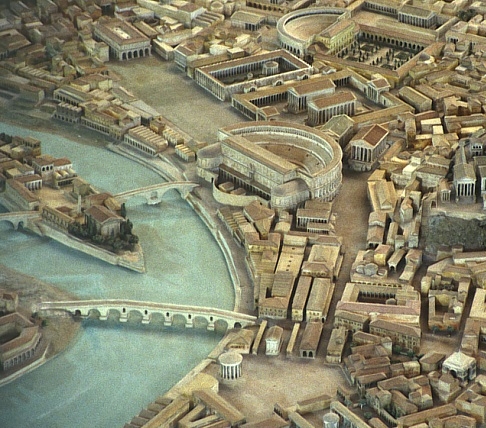
Photo: Alessandro57, Public domain · Wikimedia Commons
Archaeological site, 220 BC
Field and plaza once used for horse races in ancient Rome and the surrounding district of ancient, medieval, and modern Rome
The Circus Flaminius was a large, circular area in ancient Rome, located in the southern end of the Campus Martius near the Tiber River. It contained a small race-track used for obscure games, and various other buildings and monuments. It was "built", or sectioned off, by Gaius Flaminius in 221 BC. After Augustus divided the city into 14 administrative regions, the Circus Flaminius gave its name to Regio IX, which encompassed the Circus and all of the Campus Martius west of the Via Lata.
In its early existence, the Circus was a loop, approximately 500 meters in length stretching across the Flaminian Fields (Prata Flaminia). Varro states that the actual Circus was built around the Fields, which were already a hallowed site for games by the time the Circus was laid in 220 BC. The ludi Taurei were hosted in the Fields since they were inaugurated by Rome's last king Lucius Tarquinius Superbus (d. 495 BC).
During the 2nd century BC, this broad space was encroached upon by buildings and monuments. The circus had no permanent seating, nor were there any permanent structures to mark the perimeter of the race track. By the early 3rd century AD, the only open space that remained was a small piazza in the center, no more than 300 meters long, where the ludi (public games) had always been held.
There were many structures in the vicinity of the circus (“in circo Flaminio”). The Temple of Pietas lay on the edge of the Forum Holitorium to the southeast. The Temple of Mars was situated in the northwest. It is estimated that by 220 BC there were six temples, including one to Apollo, in the Flaminian Fields. A theatre dedicated to Apollo was also set up in 179 BC, close to the temple of Apollo, and later rebuilt under the dictatorship of Caesar. The rebuilding of the theatre necessitated shortening the Circus itself, and required that several temples be destroyed.
The temple of Apollo "in circo" acquired special significance under Augustus, as a popular legend developed that he had been sired by the god while his mother Atia was visiting the temple. Augustus undertook myriad new constructions around the Circus, and probably had it paved for the first time. Most notably Augustus demolished the small theater dedicated to Apollo, as well as the temples of Diana and Pietas, to build the Theatre of Marcellus on the eastern side of the Circus. Augustus also built the Porticus Octaviae, which hemmed in the Circus on its northeastern side. Augustus' relation Lucius Marcius Phillipus restored the Temple of Hercules Musarum with a surrounding portico that could be accessed from the Circus. …
The Circus Flaminius was never meant to rival the much larger Circus Maximus, and, unlike the Circus Maximus, it was not just an entertainment venue. It almost certainly lacked a track designed for chariot racing. The only ludi held there were the Taurian Games, which featured horseback racing around turning posts (metae). The obscure Taurian Games were held to propitiate the gods of the underworld (di inferi), and seem to have been symbolically grounded in the site itself, as they were never moved to a different circus. Equestrian events were also associated with underworld deities in other rituals and festivals in the Campus Martius. Strabo makes no mention of equestrian activities taking place in the Circus Flaminius. Valerius Maximus, who is likely to be in error, is the only ancient source that claims the Ludi Plebeii ("Plebeian Games") were held there. In 2 BC, the circus was flooded for the slaughter of 36 crocodiles to commemorate the building of the Forum of Augustus.
The Circus also hosted ceremonies related to the Roman triumph, as the Flaminian Fields traditionally figured along the triumphal route towards Capitoline Hill. In 63 BC Lucius Licinius Lucullus celebrated his triumph in the Third Mithridatic War and exhibited his spoils in the Circus, including a solid gold statue of Mithridates. Augustus did the same when he exhibited the captured insignia of the enemy armies from his campaigns in Dalmatia in the northern part of the Circus.
According to Plutarch, the Dictator Sulla massacred 6,000 prisoners in the Circus Flaminius after the Battle of the Colline Gate in 82 BC. Prisoners of war from the nearby town of Antemnae were rounded up in the Circus and slaughtered while the Senate met in the adjacent Temple of Bellona; the screams which could be heard from the Temple were a way of intimidating the senators.
The Circus Flaminius was also used as a market. Assemblies were often held within it. In 9 BC, it was the venue where Augustus delivered the Laudatio of Drusus.
The buildings remained in use until the end of the fourth century, when the area was finally abandoned. In the Middle Ages the ruins of the Stadium of Domitian (the Piazza Navona) were often incorrectly identified as the Circus Flaminius. In the 16th century the "Castrum Aureum" ("golden camp") mentioned in a papal bull of Pope Celestin III in 1192, was also identified as the Circus.
In 1555, Pope Paul IV formed the Jewish Ghetto in the area encompassing much of the former Circus Flaminius. The Great Synagogue of Rome stands roughly where the southern end of the arena was located.
Text from Wikipedia, the free encyclopedia, under CC BY-SA 4.0. Full article: «Circus Flaminius».
Events and people from Wikidata (CC0).
Distances are as the crow flies, not walking or driving.


Circus Flaminius is in Rome, in the province of Roma (Lazio), Italy. GPS coordinates: 41.89276, 12.47742.
Wikidata dates it to 220 BC.
Nearby you’ll find: Temple of Hercules Musarum (100 m away), Torre dei Grassi (100 m away), Jewish Museum of Rome (100 m away).
Text. Wikipedia, the free encyclopedia (CC BY-SA 4.0).
Data. Wikidata (CC0); opening hours and contacts OpenStreetMap (ODbL).
Photos. Wikimedia Commons, author and licence on every image.
Updated 28 October 2026. All sources and licences