




Photo: Public domain · Wikimedia Commons
Archaeological site
House of the Orchard
House in Pompeii
- Within the UNESCO World Heritage Site “Archaeological Areas of Pompei, Herculaneum and Torre Annunziata”
At a glance
- Type
- Archaeological site
- Protection
- Italian national heritage
- Coordinates
- 40°45′03″ N, 14°29′26″ E
- Address
- Scavi archeologici di Pompei - Regio I - Insula 9 - 5
History and description
House of the Orchard (Italian: Casa dei Cubicoli Floreali; also referred to as the Casa del Frutteto or the House of the Garden) is an ancient Roman residential structure located in the archaeological site of Pompeii. Situated on the south side of Via dell'Abbondanza, this house is notable for rich and decorative features. It is also known by various other names, including the House of Euplia and the House of the Flower Cubicles, due to the floral motifs found in its rooms. Like many other structures in Pompeii, it was preserved under volcanic ash following the eruption of Mount Vesuvius in 79 CE.
Architecture
The house was constructed in the late 3rd century BCE but was restructured at least four times. It was being renovated at the time of the Mount Vesuvius eruption in 79 CE. The house follows the standard Roman floor-plan, where the guest garden or atrium is an integral part of the house.
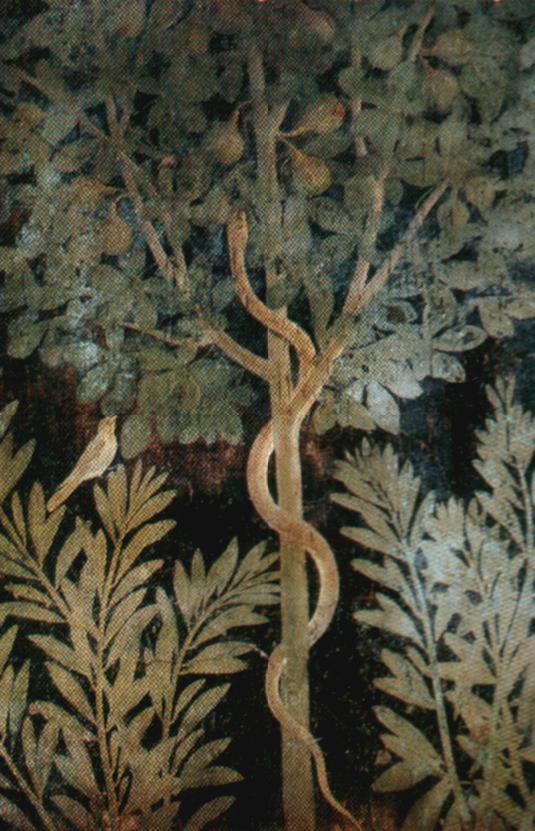
The building is embellished with detailed frescoes depicting a city garden. The paints were typically painted with fresco techniques. The house placed significant emphasis on pictorial decoration, the walls or interior spaces are a canvas for elaborate artwork.
Modern times
The residential complex was brought to light in 1913 and in 1951–52, owes its name to the refined paintings of gardens dating to the time of first roman emperor, Augustus.
It was extensively restored and reopened to the public in February 2020.
Text from Wikipedia, the free encyclopedia, under CC BY-SA 4.0. Full article: «House of the Orchard».
Timeline
- 79 ADDestruction
Events and people from Wikidata (CC0).
Photos
Getting there
Pompei Scavi - Villa dei MisteriTrain, nearest
900 m as the crow flies
House of the OrchardScavi archeologici di Pompei - Regio I - Insula 9 - 5
Porto di Castellammare di Stabia6.6 km
Aeroporto di Napoli Capodichino22.5 km
Distances are as the crow flies, not walking or driving.
Loading map…
Nearby
See on the mapMore archaeological sites in Campania

- UNESCO
- Free 1st Sunday

- UNESCO

- UNESCO

- UNESCO
- Free 1st Sunday

- Free 1st Sunday
Frequently asked questions
Where is House of the Orchard?
House of the Orchard is in Pompei, in the province of Napoli (Campania), Italy. Address: Scavi archeologici di Pompei - Regio I - Insula 9 - 5. GPS coordinates: 40.75090, 14.49067.
What else is there to see near House of the Orchard?
Nearby you’ll find: House of Venus in the Bikini (0 m away), Archaeological excavations of Pompeii (100 m away), Pompeii (100 m away).
Sources and licences
Text. Wikipedia, the free encyclopedia (CC BY-SA 4.0).
Data. Wikidata (CC0); opening hours and contacts OpenStreetMap (ODbL).
Photos. Wikimedia Commons, author and licence on every image.
Credits for the 9 photos
- Pompei-frutteto — Public domain
- Casa dei Cubicoli Floreali (Pompeii) (48443531287) — Gary Todd from Xinzheng, China, Public domain
- Casa dei Cubicoli Floreali 1 — Mentnafunangann, CC BY-SA 3.0
- Impluvium of Casa dei Cubicoli Floreali (Pompeii), 2016 — Sarahhoa, CC BY-SA 2.0
- Antigua ciudad de Pompeya, Italia, 2023-03-27, DD 223 — Diego Delso, CC BY-SA 4.0
- Monochrome Entry Mosaic (42336478424) — Tyler Bell, CC BY 2.0
- Pompei - Scavi archeologici di Pompei 021 — Cristina Morettini 95, CC BY-SA 4.0
- Pompei 2012 (8057245114) — ho visto nina volare from Italy, CC BY-SA 2.0
- Pompei 2015 (18650537068) — ho visto nina volare from Italy, CC BY-SA 2.0
Updated 28 October 2026. All sources and licences