


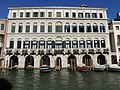


Photo: Didier Descouens, CC BY-SA 4.0 · Wikimedia Commons
Historic villa / palace
Ca' Foscari
Palace in Venice
- Within the UNESCO World Heritage Site “Venice and its Lagoon”
At a glance
- Style
- International Gothic
- Architect
- Bartolomeo Bono
- Coordinates
- 45°26′04″ N, 12°19′36″ E
History and description
Ca' Foscari, the palace of the Foscari family, is a Gothic building on the waterfront of the Grand Canal in the Dorsoduro sestiere of Venice, Italy.
It was built for the doge Francesco Foscari in 1453, and designed by the architect Bartolomeo Bon. It is now the main seat of Ca' Foscari University of Venice.
The palace is located on the widest bend of the Grand Canal. Here, during the annual Regata Storica (Historical Regatta), held on the first Sunday in September, a floating wooden structure known as the La Machina is placed (from this structure the Venetian authorities watch the race); this is also the site of the finishing line, and the venue for prize-giving. A Byzantine palace known as the "House with the Two Towers" previously stood on the site. Ca' Foscari's external courtyard is the biggest courtyard of a private house after that of the Doge's Palace.
History
Previously a Byzantine palace, known as the "House with the Two Towers", stood on the site. This was bought by the Republic of Venice in 1429 from Bernardo Giustinian, to be the residence of the vice-captain of the Republic, Gianfrancesco Gonzaga. The palace consisted of two towers flanking a lower, central block and was used for entertaining illustrious guests of the Republic, including kings and diplomats.
In 1439, the palace was given to another captain, Francesco Sforza. However, In 1447, Francesco Sforza betrayed the Republic and was deprived of the residence.
In 1453 the Republic of Venice regained possession of the palace and sold it by auction to the Doge of the time, Francesco Foscari; he had the palace demolished and rebuilt in late Venetian gothic style; the building was chosen by the doge for its position on the Grand Canal. Foscari immediately set about rebuilding the palace in a manner befitting his status: he moved the site of the new palace forward on to the bank of the Grand Canal. Buying and rebuilding the palace for himself meant for the doge affirming his political and military role: he actually represented the continuity of the military successes of that period, lasted 30 years, and was the promoter of the Venetian expansion in the mainland (terraferma). The huge new palace could hardly have been finished when Foscari was disgraced in 1457 and retired to his new home until his death.
In 1574 king Henry III of France was housed in the second floor of the building.
The most recent restoration of Ca' Foscari and the adjacent Palazzo Giustinian was commissioned in 2004, aiming to fulfill the new requirements of safety and practicality. Work lasted from January 2004 until the summer of 2006.
The palace is the headquarters of the Ca' Foscari University, which has made accessible to the public some of the most beautiful halls, such as the "Aula Baratto" and the "Aula Berengo".
In 2013, thanks to a series of important technical measures for energy efficiency and thanks to the adoption of stringent environmental management practices put in place by the Ca' Foscari University, the building obtained the LEED certificate for sustainability, thus becoming the oldest building in the world to acquire this prestigious certification.
Description
Ca' Foscari is a typical example of the residence of the Venetian nobles and merchants. The structure is one of the most imposing buildings of the city and its external courtyard is the biggest courtyard of a private house after that of the Doge's Palace. In common with other palaces, Ca' Foscari's principal and most decorated façade and entrance faced the Grand Canal—the city's main thoroughfare. This façade is characterized by a rhythmic sequence of arches and windows; this style, known as Floral Gothic, is emulated throughout the city and can be identified through the use of pointed arches and carved window heads. At Ca' Foscari, the tops of each column are decorated with carved quatrefoil patterns, whereas the Gothic capitals are adorned with foliage, animals and masks. Above the Gothic window is a marble frieze with a helmet surmounted by a lion couchant representing the role of the doge as the captain of the republic. At each side of the central helmet are two putti holding a shield symbolising the Foscari's coat of arms with the winged lion of Saint Mark, symbol of Venice.
The practical function of Venetian palaces differed from those in other Italian cities. The nobility did not derive their income from landed estates as elsewhere, but from seafaring and trade. As a result, their "fondaco" houses had to serve not only as residences but also as the headquarters for their trading ventures. The main features of these early palaces were two-storey arcades or loggias along the waterfront; on the ground floor was a portal for loading and unloading merchandise. The portal often led into an entrance hall or "portico" used for business negotiations, with storerooms and offices on either side and a kitchen at the back. The living quarters were upstairs, with the rooms leading off great T-shaped central room. A well and an open staircase were placed in the courtyard. There were low towers at each end of the façade. The House of the two Towers too used to have this structure, before Francesco Foscari decided to destroy it and rebuild it in Gothic style. …
Uses of the building
After the death of Francesco Foscari in 1457, the palace was used for various purposes. Some dates of events and particular uses of the building:
2 May 1513: Wedding party of Federico Foscari (son of Francesco Foscari) and Cecilia Venier (daughter of Giovanni Venier)
1516: Palace divided among the heirs of the Foscari family; used as lodgings for European royalty calling at Venice
1574: Accommodation (decorated with great pomp) for Henry III of France, arriving aboard the bucentaur. During this stay, the king became infatuated with Veronica Franco
1661: Heirs of the Foscari family take up residence in one wing of the palace; another wing rented to the Duke of Brunswick
1790: Death of Francesco Foscari (diplomat and historian, born 1704), last family member to live in the palace
1811: Used as a theatre by amateur actors
1835: Used by homeless families, artists (who took advantage of the view of the Grand Canal), and shopkeepers (who used it as a warehouse)
1837: Start of negotiations for the purchase of the palace by municipality of Venice
ca. 1840: Laura and Marianna Foscari (elderly daughters of Nicolò Foscari), reduced to poverty, return to live on the second floor. Meanwhile, speculators and stonecutters plunder the building and its courtyard
1845: Deed of purchase drawn up by municipality
1846-1848: Restoration work
1848: During Risorgimento uprisings and the establishment of a provisional government in Venice, rooms on the ground floor used as barracks by the civic guard created by Daniele Manin
1849: Used as temporary shelter for poor families during the bombing of Venice by the Austrians; under Austrian rule, used as army barracks
1866: End of the Third Italian War of Independence; municipality regains possession of the palace
1868: Decision to instate the Higher School of Commerce (later Ca' Foscari University) in the palace. Courses start in December 1868, even though restoration work is still ongoing
1936 and 1956: Restorations by Carlo Scarpa
2004-2006: Restoration of the palace and the adjacent Ca' Giustinian dei Vescovi. Creation of connections between the two buildings, modernisation of systems; discovery of 9th-century remains under the courtyard, and of 15th- and 16th-century elements in various rooms …
Text from Wikipedia, the free encyclopedia, under CC BY-SA 4.0. Full article: «Ca' Foscari».
People
Events and people from Wikidata (CC0).
Photos
Getting there
Venezia Santa LuciaTrain, nearest
900 m as the crow flies
Ca' Foscari
San Tomà "B"100 m
Aeroporto Marco Polo di Venezia7.9 km
Distances are as the crow flies, not walking or driving.
Loading map…
Nearby
See on the mapMore historic villas and palaces in Veneto

- Free 1st Sunday


- UNESCO

- UNESCO
- Free 1st Sunday
- UNESCO
Frequently asked questions
Where is Ca' Foscari?
Ca' Foscari is in Venice, in the province of Venezia (Veneto), Italy. GPS coordinates: 45.43446, 12.32660.
What else is there to see near Ca' Foscari?
Nearby you’ll find: Palazzo Giustinian (0 m away), Ca' Masieri (100 m away), Ca' Bernardo (100 m away).
Sources and licences
Text. Wikipedia, the free encyclopedia (CC BY-SA 4.0).
Data. Wikidata (CC0); opening hours and contacts OpenStreetMap (ODbL).
Photos. Wikimedia Commons, author and licence on every image.
Credits for the 9 photos
- (Venice) Ca' Foscari — Didier Descouens, CC BY-SA 4.0
- 0 Venise, la Ca’ Foscari — Jean-Pol GRANDMONT, CC BY 4.0
- 0 Venise, traffic sur le Grand Canal à hauteur du Ca' Foscari — Jean-Pol GRANDMONT, CC BY 4.0
- Cà Foscari from San Toma' — Stefano Remo, CC BY-SA 3.0
- Ca' Foscari 01 — Bill Rand, CC BY 2.0
- Ca' Foscari and Palazzo Giustinian 01 — Graeme Churchard, CC BY 2.0
- Ca' Foscari Aug 2020 — Kasa Fue, CC BY-SA 4.0
- Ca' foscari canal grande — Abxbay, CC BY-SA 3.0
- Ca' Foscari de Venècia — Joanbanjo, CC BY-SA 3.0
Updated 28 October 2026. All sources and licences