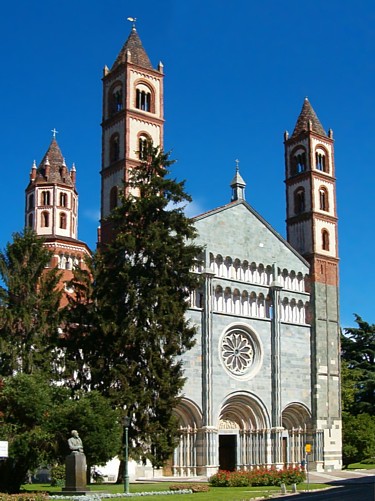


Photo: No machine-readable author provided. Idéfix~commonswiki assumed (based on copyright claims)., CC BY-SA 3.0 · Wikimedia Commons
Abbey / Monastery, 1219
Basilica di Sant'Andrea
Church building in Vercelli, Italy
At a glance
- Type
- Abbey / Monastery
- Period
- Middle Ages, 1219
- Styles
- Gothic architecture, Italian Gothic architecture
- Dedicated to
- Andrew the Apostle
- Founder
- Guala Bicchieri
- Protection
- Italian national heritage
- Coordinates
- 45°19′43″ N, 8°25′09″ E
- Address
- Piazza Roma, 35
History and description
The Basilica di Sant'Andrea is the church of a monastery in Vercelli, Piedmont, northern Italy, founded in 1219 by Cardinal Guala Bicchieri and completed in 1227. It represents an early example of Gothic architecture in Italy, inspired by Cistercian models and featuring Romanesque elements as well.
History
The basilica was built between 1219 and 1227 at the direction of Cardinal Guala Bicchieri, who had just returned from England where he had been papal legate. Bicchieri had received from King Henry III the perpetual rights to the income of St Andrew's Church, Chesterton, near Cambridge. Thanks to this financial support, the cardinal was able to call to Vercelli some Augustinian canons from Saint-Victor in Paris, giving them responsibility over the new abbey and the hospital to be built for the pilgrims who travelled the Via Francigena. The hospital was begun in 1224. Although the architect is unknown, it is presumed that the Gothic lines of the new edifice were introduced by the French clerics, who included abbot Thomas Gallus, previously a professor in the University of Paris. According to Italian art historian Giulio Carlo Argan, the architect could have been Benedetto Antelami. The style of the Romanesque elements connects the building to the architectural traditions of northern Italy and suggest the hand of an Italian master in the design.
Thanks to Bicchieri's diplomacy, the abbey was able to increase its possessions through donations and privileges from pope Honorius III and emperor Frederick II. Bicchieri died in Rome in 1227, the year in which the basilica was finished.
In the early 15th century a new bell tower was built, in a detached position, on the right side of the church. In the following century the cloister of the monastery was rebuilt, though the original small columns – in groups of four – were kept.
The complex was damaged during the Siege of Vercelli of 1617. During restorations carried out in 1818–1840, the scrinium (travelling case) of Guala Bicchieri was found in the building; it is now in the Turin City Museum of Ancient Art. Other restorations took place in 1927 and 1955–1960.
Description
The basilica is built on the Latin cross plan, with a nave and two aisles of six bays each. The aisles are lower than the nave. The right aisle has buttresses from which flying buttresses (an element typical of Gothic architecture) connect it to the nave. The transept, of five bays, has the same width and height of the nave. At the crossing is a tall octagonal lantern tower, surmounted by a belfry, also octagonal, which ends with a pyramidal cusp in brickwork. The apse has a rectangular plan, a typical feature of Cistercian Gothic edifices.
The façade features stones of different types: green stone from Pralungo, calcarenite from Montferrat and serpentine from Oria. The stone is combined with the red brickwork and white cotto of the upper part of the two side bell towers. The wide gable of the central section, the two blind arcades and the big rose window in the middle are all elements in the tradition of Lombard-Emilian Romanesque architecture. The entrance is through three portals, also in Romanesque style, with four orders of small double columns. The lunette of the central portal has a relief depicting the "Martyrdom of St. Andrew", while that of the left portal shows "Cardinal Bicchieri offering the Church to St. Andrew, enthroned". Benedetto Antelami has been suggested as the author of the two sculptures, although it is more likely that they were executed by one or more of his pupils who had worked in the Baptistery of Parma.
The interior of the basilica is fully Gothic in style, with ogival arcades supported by piers formed by a cylindrical element surrounded by eight small columns. The ceiling has quadripartite vaults. The crossing tower is supported on four pendentives which are decorated with small columns over corbels; these reach other corbels in the lantern tower where are sculptures (from Antelami's school) representing symbols of the Four Evangelists. Beyond the crossing is the chancel, with the presbytery and the rectangular choir, which is illuminated by a large rose window and three mullioned windows, and has wooden seats from the early 16th century.
Artworks include the funerary monument of abbot Thomas Gallus (early 14th century), with a fresco of Lombard school. In the first chapel in the left arm of the transept is a 15th-century painted crucifix.
Text from Wikipedia, the free encyclopedia, under CC BY-SA 4.0. Full article: «Basilica di Sant'Andrea».
Timeline
- 1219Built
Events and people from Wikidata (CC0).
Photos
Getting there
VercelliTrain, nearest
200 m as the crow flies
Basilica di Sant'AndreaPiazza Roma, 35
Distances are as the crow flies, not walking or driving.
Loading map…
Nearby
See on the mapMore abbeys and monasteries in Piedmont


- Free 1st Sunday
Frequently asked questions
Where is Basilica di Sant'Andrea?
Basilica di Sant'Andrea is in Vercelli, in the province of Vercelli (Piedmont), Italy. Address: Piazza Roma, 35. GPS coordinates: 45.32874, 8.41923.
How old is Basilica di Sant'Andrea?
Wikidata dates it to 1219.
What else is there to see near Basilica di Sant'Andrea?
Nearby you’ll find: Palazzo Arcivescovile di Vercelli (300 m away), Museo Leone (300 m away), Abbazia di Santo Stefano (500 m away).
Sources and licences
Text. Wikipedia, the free encyclopedia (CC BY-SA 4.0).
Data. Wikidata (CC0); opening hours and contacts OpenStreetMap (ODbL).
Photos. Wikimedia Commons, author and licence on every image.
Credits for the 4 photos
- Vercelli-Santandrea — No machine-readable author provided. Idéfix~commonswiki assumed (based on copyright claims)., CC BY-SA 3.0
- Basilica di Sant'Andrea (Vercelli) 10 — Carlo Dell'Orto, CC BY-SA 3.0
- Basilica di Sant'Andrea (Vercelli), esterno 02 — Mongolo1984, CC BY-SA 4.0
- Alberi Vercelli 2 — Ivan Ruggiero, I'd appreciate if you could mail me ([email protected]) if you want to use this picture out of the Wikimedia project scope. Please attribute as: Ivan Ruggiero (Wikimedia), CC BY-SA 4.0
Updated 28 October 2026. All sources and licences