


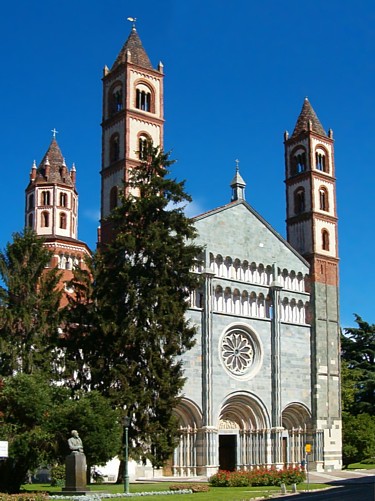
Photo: Twice25, CC BY-SA 3.0 · Wikimedia Commons
At a glance
- Type
- Abbey / Monastery
- Period
- Middle Ages, 11th century
- Style
- Romanesque architecture
- Protection
- Italian national heritage
- Coordinates
- 45°13′21″ N, 7°46′55″ E
- Address
- piazza Cardinale delle Lanze, 1 - San Benigno Canavese
History and description
Fruttuaria is an abbey in the territory of San Benigno Canavese, about twenty kilometers north of Turin, northern Italy.
History
The foundation of the abbey was patronized by Guglielmo da Volpiano, who donated the land, allowing for the first stone of a large Romanesque-style church to be laid on 23 February 1003. It was consecrated by Ottobiano, bishop of Ivrea, in the presence of Arduin, marchese d'Ivrea and King of Italy, and his consort Berta. The monastery was completed in 1006-1007 and followed the Benedictine rule as reformed at Cluny. There Arduin retired there and died in December 1015. In 1027 a bull of Pope John XIX placed the abbey and all its lands under direct papal supervision. Empress Agnes was a patron of Fruttuaria, and retired there in 1065 before moving to Rome. She was instrumental in introducing Fruttuaria's Benedictine customs, as practiced at Cluny, to Saint Blaise Abbey in Baden-Württemberg.
The greatest splendor of the abbey of Fruttuaria was in the 12th and 13th centuries when it minted its own coin. In 1265 the abbey possessed eighty-five churches in Italy alone, as well as four comuni, the quattro terre abbaziali of San Benigno Canavese, Montanaro, Lombardore and Foglizzo. Other possessions were located in France and Austria. Some 1,200 monks inhabited the monastery.
In the 14th century, decline set in, culminating in 1477 when the monks lost their privilege of naming the abbot. Nominating an absentee abbot in commendam and a vicar to represent him at the site was thenceforth a papal perquisite. In 1585 Pope Sixtus V suppressed the monastery, substituting in its buildings a college of secular priests. The last monk died in 1634.
In 1710 troops of Victor Amadeus II, Duke of Savoy, occupied the terre abbaziali, an occupation that lasted until 1741 and only ended with papal renunciation of all territorial control. …
Text from Wikipedia, the free encyclopedia, under CC BY-SA 4.0. Full article: «Fruttuaria».
Timeline
- 11th centuryBuilt
Events and people from Wikidata (CC0).
Photos
Getting there
S. Benigno CanaveseTrain, nearest
400 m as the crow flies
Fruttuariapiazza Cardinale delle Lanze, 1 - San Benigno Canavese
Aeroporto di Torino10.5 km
Distances are as the crow flies, not walking or driving.
Loading map…
Nearby
See on the mapMore abbeys and monasteries in Piedmont




- Free 1st Sunday
Frequently asked questions
Where is Fruttuaria?
Fruttuaria is in San Benigno Canavese, in the province of Torino (Piedmont), Italy. Address: piazza Cardinale delle Lanze, 1 - San Benigno Canavese. GPS coordinates: 45.22247, 7.78207.
How old is Fruttuaria?
Wikidata dates it to the 11th century.
What else is there to see near Fruttuaria?
Nearby you’ll find: Castello di Montanaro (5.6 km away), Rivarossa Castle (6 km away), Castello di Foglizzo (6.4 km away).
Sources and licences
Text. Wikipedia, the free encyclopedia (CC BY-SA 4.0).
Data. Wikidata (CC0); opening hours and contacts OpenStreetMap (ODbL).
Photos. Wikimedia Commons, author and licence on every image.
Credits for the 7 photos
- San Benigno Canavese Torino - Fruttuaria — Twice25, CC BY-SA 3.0
- San Benigno Canavese - Abbazia di Fruttuaria - 2023-09-25 09-43-09 001 — Misasar, CC BY-SA 4.0
- San Benigno Canavese - Abbazia di Fruttuaria - 2023-09-25 09-43-50 001 — Misasar, CC BY-SA 4.0
- San Benigno Canavese - Abbazia di Fruttuaria - 2023-09-25 10-12-15 001 — Misasar, CC BY-SA 4.0
- San Benigno Canavese - Abbazia di Fruttuaria - 2024-09-29 21-54-41 001 — Pampuco, CC BY-SA 4.0
- Campanile della chiesa di San Benigno — Giuseppe Barberis, Public domain
- Chiesa Parrocchiale dell'Assunta — Pmk58, CC BY-SA 4.0
Updated 28 October 2026. All sources and licences