

- Most beautiful villages
Photo: Hagai Agmon-Snir حچاي اچمون-سنير חגי אגמון-שניר, CC BY-SA 4.0 · Wikimedia Commons
Historic village
Town in the region Umbria, in Italy
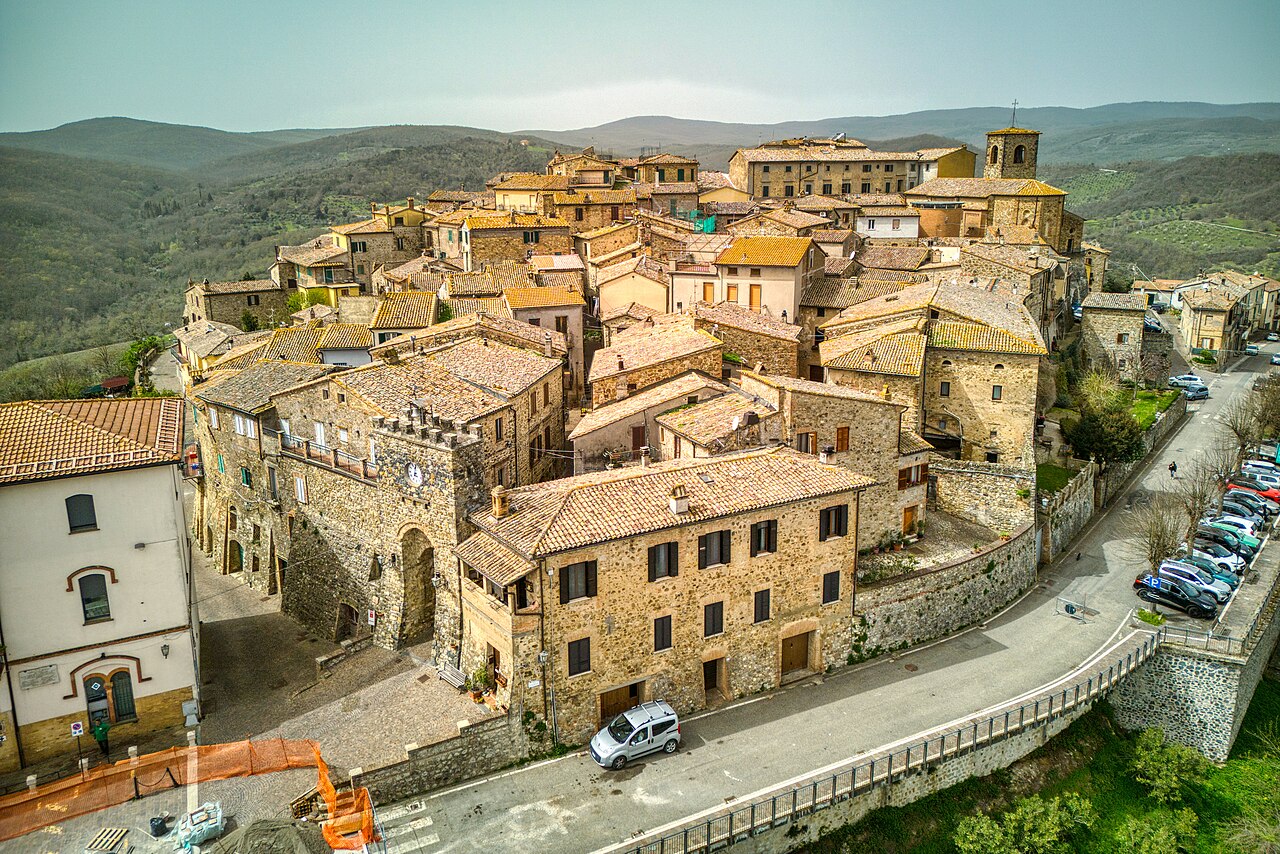
Allerona (historically known as Lerona) is a comune (municipality) in the Province of Terni in the Italian region Umbria, located about 50 km southwest of Perugia and about 60 km northwest of Terni. It is one of I Borghi più belli d'Italia ("The most beautiful villages of Italy").
The area was inhabited in antiquity by a settlement known as vicus Lerona, of Roman or pre-Roman origin, which was destroyed during the Germanic invasions.
During the Roman period the territory was crossed by the Via Cassia and the Via Traiana Nova, forming part of the route between Rome and Chiusi. Remains of this road survive, including paved sections and two milestones.
By the early Middle Ages, before the year 1000, a castle had been founded, serving as a fortress of Orvieto toward the north, in the direction of Chiusi. Control of the settlement was held by the Monaldeschi and later by the Filippeschi families. Elements of the medieval structure remain, including sections of the walls, the Porta Del Sole, the Porta Della Luna, and the urban layout.
The military campaign of Charles VIII of France in Italy in 1494–1495 led to the sack and destruction of the territory of Orvieto, including the castle of Allerona.
Municipal autonomy was established in 1585, when a statute was issued by Andrea Gavanni at the town hall of Orvieto.
Allerona formed part of the Papal States in the early modern period. During the Napoleonic era it was included in the Department of Trasimeno. After the Restoration it was placed within the Delegation of Viterbo.
In 1860 the town was occupied by the Cacciatori del Tevere under Luigi Masi and subsequently annexed to the Kingdom of Italy.
In 1895 Allerona had a population of 1,486 inhabitants.
On 28 January 1944, Allied bombing at Allerona struck a train carrying prisoners of war, causing over 400 casualties.
The principal church is the pieve of Santa Maria della Stella. The patron saint is Saint Ansanus, a Roman martyr, whose feast is celebrated on 1 December.
The parish church of Santa Maria Assunta, dating to the 15th century, is located within the historic center of Allerona and is documented as a collegiate church from 1275. By the early 16th century it was enriched with a panel by Niccolò Alunno depicting the Assumption of the Virgin surrounded by angels. The work originally included side panels with figures of Saint John the Baptist and Saint Sebastian, now preserved in the National Museum of Castel Sant'Angelo in Rome.
The church also contains a fresco by il Pordenone commissioned in 1516 by Pantasilea Baglioni, widow of Bartolomeo d'Alviano. The fresco depicts the patron alongside a Madonna and saints.
Villa Cahen was built in 1880 by the Jewish financier Edouard Cahen, who had acquired a large estate from the Bourbon del Monte family in the area known as Selva di Meana.
The property is distinguished by an extensive Italian-style garden containing a wide variety of tree and herb species, including rare examples collected from distant regions. The layout reflects a carefully designed composition enriched by both natural and artificial elements, forming a notable example of Liberty-style landscaping. The complex also includes a limonaia and greenhouses used to protect plants during winter, as well as a Japanese garden located within the park between the Italian garden and the greenhouses.
The villa is characterized by light-colored walls and articulated volumes, including a tower element. The interior is arranged over multiple levels, with service areas in the semi-basement, reception and dining rooms on the ground floor, private rooms for the owners above, and additional quarters for servants.
Text from Wikipedia, the free encyclopedia, under CC BY-SA 4.0. Full article: «Allerona».
Distances are as the crow flies, not walking or driving.


Allerona is in Allerona, in the province of Terni (Umbria), Italy. GPS coordinates: 42.81152, 11.97380.
Nearby you’ll find: Torre Alfina (6.8 km away), Castello della Sala (8 km away), Museo del fiore (8.9 km away).
Text. Wikipedia, the free encyclopedia (CC BY-SA 4.0).
Data. Wikidata (CC0); opening hours and contacts OpenStreetMap (ODbL).
Photos. Wikimedia Commons, author and licence on every image.
Updated 28 October 2026. All sources and licences