

Teramo · Abruzzo
Things to see in Teramo
In Teramo the atlas lists 22 historic places: 9 archaeological sites, 7 museums, 3 historic villas and palaces, 2 fortresses and towers and 1 castle.
Of these, 1 list opening hours and 3 have free entry.
Don’t miss: Astronomical Observatory of Abruzzo (1893), observatory in Teramo, Italy.
- 22historic places
- 51,548inhabitants
- 265 maltitude
The town
Teramo is the capital of the province of Teramo in the Italian region of Abruzzo. Near the Gran Sasso and Monti della Laga, on the first Apennine foothills of northern Abruzzo, Teramo enjoys a splendid panoramic position between the highest peaks of Abruzzo and the nearby Adriatic coast.
Text from Wikivoyage, CC BY-SA, abridged · Wikivoyage
22 places
Archaeological sites 9


Museums 7


Villas and palaces 3
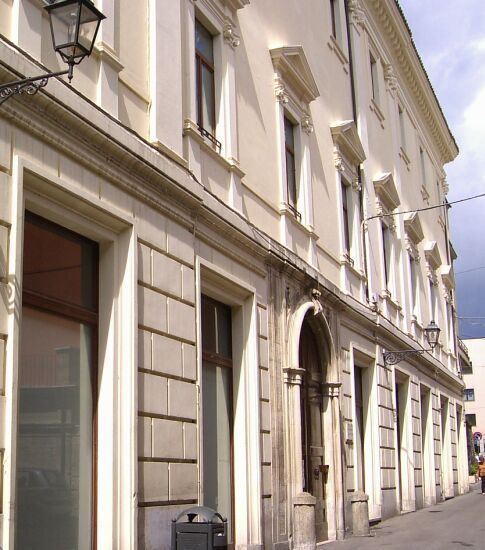


Fortresses and towers 2


Castles 1
Getting there
By plane: Nearest airports are Pescara (1.0 hour) and Rome (2.5 hours).
By train: There is train station about 1 km from downtown Teramo. There are no direct trains from Rome and most trains go to Giulianova.
By car: From Rome and west, through A24 highway, exit Teramo.
From north and south, through A14 highway, exit Teramo-Mosciano.
By bus: The bus (pullman) travels from Piazza San Francisco to the Tiburtina Rail Station in Rome.
Text from Wikivoyage, CC BY-SA, abridged · Wikivoyage
What to see, according to Wikivoyage
Medieval village, Della Monica Castle, Via del castello. The medieval village is a complex of 19th-century buildings built on the small hill of San Venanzio, through an extravagant fusion in a single structure of different architectural and artistic styles, from Neo-Gothic to Moorish, with numerous contaminations deriving from the many training experiences gained over time by its author and owner Gennaro della Monica. This group of buildings and green areas is also identified, less exactly, with the denomination of Castello Della Monica. The building is being renovated and its interior can not be visited. Cappuccini's church, Viale Mazzini. The chronicles report that the church was founded in 819; then had numerous remakes. The portal is in stone ashlars, and the facade has decorations made with cut bricks or geometric shapes rhomboidal brick, a type of decoration that leads back to the decorations of the ancient cathedral of Sancta Maria Aprutiensis. Of the extension of the fourteenth century, with the addition of two naves, remains the right aisle, interrupted by the inclusion of rooms used as sacristy, as well as small chapels, which show sixteenth-century features.
Text from Wikivoyage, CC BY-SA, abridged · Wikivoyage · Underlined names link to our own pages.