- Free 1st Sunday

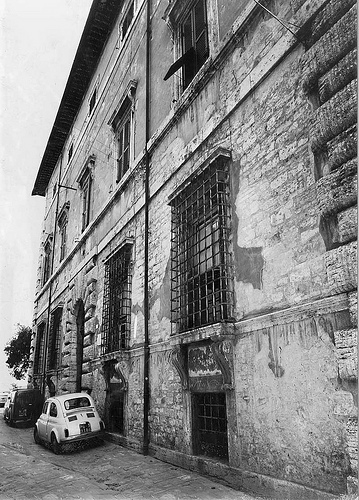
Photo Luca Vanzella, CC BY-SA 2.0
Perugia · Umbria
In Perugia the atlas lists 107 historic places: 28 museums, 18 castles, 17 historic villas and palaces, 15 fortresses and towers, 13 archaeological sites, 11 abbeys and monasteries and 5 historic theatres.
Of these, 9 list opening hours and 1 has free entry.
Don’t miss: National Gallery of Umbria (1878), Italian museum.
By date of construction, the most common period is the Middle Ages (50% of dated places) and the Modern era (20% of dated places).
Perugia is a city in the Italian region of Umbria. It has an important university that attracts many foreign students, is a major center of medieval art, has a stunningly beautiful central area and is home of the Umbria Jazz Festival. The city is also a major producer of chocolates.
Text from Wikivoyage, CC BY-SA, abridged · Wikivoyage


 Museo Civico di Palazzo Della Penna, Perugia
 Casa Museo Palazzo Sorbello
 Sala dell'udienza del Nobile Collegio della Mercanzia Centro della Scienza P.O.S.T. Casa museo degli Oddi Casa del cioccolato Perugina Laboratorio di tessitura artistica a mano Giuditta Brozzetti Museo del gioco e del giocattolo di Perugia Museo dell’accademia di belle arti Museo della Rocca Paolina Museo delle acque Museo Mura Urbiche Antiquarium of Palazzone Gipsoteca Museo del Giocattolo Museo storico della Perugina Città del Cioccolatto Torre del Cassero Archivio di Stato Antiquarium Arna città scomparsa


By plane: Perugia Airport (PEG IATA) (Perugia AirLink buses provide transfers to Perugia city centre and Assisi city centre. Price is 5 EUR one way. Timetable). An international airport with some destinations mainly served by low cost airlines.
A little further away, Pisa and Bologna are served by low cost European airlines.
The Airport in Rome is three hours away and Milan's Malpensa airport about 7 hours away. Buses from Rome Fiumicino Airport depart from the lower level parking area at regular intervals (3 hours, €20). (Many of the buses in the Tourist Bus Parking area are privately hired, and are not available to the general public. Some buses, such as the Sulga, may appear on the upper levels of Terminal C, but do not be concerned; they will arrive at the scheduled time in the lower level parking area. Check timetables online.)
By train: Trains from Rome reach Perugia in 2-3 hours and often require 1 train change, €12.10 if you take Treno Regionale, otherwise it's double. Plenty of direct trains from Florence, 2 hr, €14.65. Getting from Siena by train is troublesome, as it requires 2 train changes and takes 4 hours, €13.
The 2 train station is in the valley, a few kilometers from the centro storico (historic center) of the city. You can take the Mini Metro railway, a local bus or a taxi from the station.
By bus: Flixbus offers connections with Rome (2:15 hr), Florence (2:10 hr), Siena (1:20 hr).
Fixbus Bus station, Piazzale Umbria Jazz.
Text from Wikivoyage, CC BY-SA, abridged · Wikivoyage
Rocca Paolina. It was a Renaissance fortress, built in 1540-1543 for pope Paul III to designs by Antonio da Sangallo the Younger. The escalators from the lower town lead up through the remains of this fortress. It was built on top of medieval streets, which were used as foundations, and before coming out into daylight at Piazza Italia you go through some of these medieval streets covered with brick ceilings when the fortress was built. Little now remains of the fortress itself. Free admission. Porta Marzia (Marzia Gate). This is an Etruscan city gate built in the 3rd century BC and much later incorporated into the city walls. It is close to the remains of the Paolina Fortress. Fontana Maggiore. This large medieval fountain is found between the cathedral and the Palazzo dei Priori. It was made between 1277 and 1278 by Nicola and Giovanni Pisano as part of Perugia's celebrations of its independence. On the twenty-five sides of the basin are sculptures representing prophets and saints, the work of the seasons, signs of the zodiac, Bible scenes and events from Roman history. Perugia Cathedral (Cattedrale di San Lorenzo).
Text from Wikivoyage, CC BY-SA, abridged · Wikivoyage · Underlined names link to our own pages.