




Photo: Gianni Careddu, CC BY-SA 4.0 · Wikimedia Commons
Historic villa / palace
Palazzo delle Poste
Building in Perugia, Italy
At a glance
- Architect
- Osvaldo Armanni
- Coordinates
- 43°06′40″ N, 12°23′22″ E
- Address
- Piazza Giacomo Matteotti 1
History and description
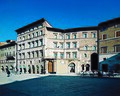
The Palazzo delle Poste (transl. Post Office Building), also known as the Palace of Justice (Palazzo di Giustizia), is located in Piazza Giacomo Matteotti in Perugia, Italy. It houses the historic local headquarters of Poste Italiane, with access from Via Fani, and the Court of Perugia, which faces the square.
History
The building stands on the former site of Palazzo Meniconi, which previously housed the mint and the first civic library.
On 16 April 1909, mayor Luciano Valentini commissioned architect Osvaldo Armanni to conduct a feasibility study for the construction of a new building. On 22 April 1910, the Municipality of Perugia signed an agreement with the Royal Government, represented by Augusto Ciuffelli, minister of Posts and Telegraphs, for the construction of the new post and telegraph building. The estimated cost was 650,000 lire, of which the State committed to funding 500,000 lire.
The building was completed in five years and officially inaugurated on 11 May 1916. It later began housing the Court of Perugia. In 2007, the criminal section of the Court was relocated to the nearby former Enel headquarters on Via XIV Settembre, previously the site of a power plant built in 1899 by the Società Anonima Elettricità Umbra.
Description
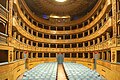
The building is an example of Renaissance Revival architecture with Art Nouveau (or Stile Liberty) influences. The decorative program was executed by several well-known artists and craftsmen: the frescoes were painted by Annibale Brugnoli with the assistance of Osvaldo Mazzerioli; the stuccoes, decorations, and sculptures were produced by Giuseppe Frenguelli, Enrico Cagianelli, and unidentified stone carvers. The ironwork was crafted by blacksmith Paride Rosi. The large polychrome stained-glass windows created by master glassmaker Ludovico Caselli Moretti have been lost.
Text from Wikipedia, the free encyclopedia, under CC BY-SA 4.0. Full article: «Palazzo delle Poste».
Timeline
- 1916Opened
Events and people from Wikidata (CC0).
Photos
Getting there
Perugia Sant'AnnaTrain, nearest
600 m as the crow flies
Palazzo delle PostePiazza Giacomo Matteotti 1
Aeroporto Internazionale dell'Umbria - Perugia "San Francesco d'Assisi"9.8 km
Distances are as the crow flies, not walking or driving.
Loading map…
Nearby
See on the mapMore historic villas and palaces in Umbria


- Free 1st Sunday


Frequently asked questions
Where is Palazzo delle Poste?
Palazzo delle Poste is in Perugia, in the province of Perugia (Umbria), Italy. Address: Piazza Giacomo Matteotti 1. GPS coordinates: 43.11108, 12.38939.
What else is there to see near Palazzo delle Poste?
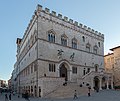
Nearby you’ll find: Palazzo del Capitano del Popolo (0 m away), Collegio della Mercanzia (100 m away), Collegio del Cambio (100 m away).
Sources and licences
Text. Wikipedia, the free encyclopedia (CC BY-SA 4.0).
Data. Wikidata (CC0); opening hours and contacts OpenStreetMap (ODbL).
Photos. Wikimedia Commons, author and licence on every image.
Credits for the 9 photos
- Perugia, palazzo delle Poste (01) — Gianni Careddu, CC BY-SA 4.0
- Perugia palazzo delle Poste — Francesco Gasparetti, CC BY 2.0
- Perugia, palazzo delle Poste (02) — Gianni Careddu, CC BY-SA 4.0
- Italia-Perugia-Tribunale di Perugia-01E — Rikki Mitterer, CC BY-SA 4.0
- Italia-Perugia-Tribunale di Perugia-08 — Asurnipal, CC BY-SA 4.0
- Italia-Perugia-Tribunale di Perugia-21E — Rikki Mitterer, CC BY-SA 4.0
- Italia-Perugia-Tribunale di Perugia-22E — Rikki Mitterer, CC BY-SA 4.0
- Italia-Perugia-Tribunale di Perugia-23E — Rikki Mitterer, CC BY-SA 4.0
- Perugia 131 — Georges Jansoone ( JoJan ), CC BY 3.0
Updated 28 October 2026. All sources and licences