




Photo: Abxbay, CC0 · Wikimedia Commons
At a glance
- Coordinates
- 43°06′34″ N, 12°23′18″ E
History and description
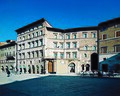
Palazzo Donini is an Italian noble palace of the 18th century located in Perugia in Piazza Italia 96. It is the centre of the Regional Council of Region of Umbria.
Characteristics
Built from 1716 to 1724 by an unknown architect, the traditional attribution is to Pietro Carattoli (although unlikely, as the artist from Perugia was barely 13 years old in 1716).
The references to sixteenth Tuscan style and coeval Roman palaces are evident. The architecture with a sober compositional order is scanned by two orders of ledges and three of windows.
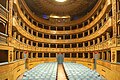
On the noble floor, curved gables alternate with triangular ones in travertine. The palace is adorned with 2 large portals, one opens on Corso Vannucci, the other on Piazza Italia. Both present 2 columns in travertine surmounted by a balcony. The inside was richly decorated between 1745 and 1750 by the best exponents of the artistic culture of Perugia at the time, coordinated by Pietro Carattoli; among which: Francesco Appiani, Anton Maria Garbi, Giuseppe Brizi, Giacinto Boccanera and Nicola Giuli.
Pietro Carattoli directed the works of wall decorations and decided the subject to represent.
The main floor contains artworks which utilize perspective and feature mythological subjects. In the Hall of Honor, above the wooden gallery, Francesco Appiani painted “Giove fulminante il cocchio dell’Orgoglio” (Jupiter hitting with lightnings Pride's Chaise). The chapel of the palace is entirely decorated with stuccoes and paintings framed in illusionistic architectural perspective. Over the altar cell there is the “Incoronazione della Vergine” (Coronation of the Virgin) by Francesco Appiani.
The “Sala del Caminetto”, decorated by Carattoli and Giacinto Boccanera, can be considered the most evocative as extreme example of the bold architectonical perspective present in the palace.
In the 19th century it was sold by Pierluigi Donini to the City of Perugia that used it as representative seat. The Austrian Prince of Klemens von Metternich with his chancellery was received there in 1819. Before hosting the Regional Council offices, the palace was the seat of the Faculty of Letters and Philosophy of the University of Perugia.
The permanent collection of Salvatore Fiume can here be seen; Salvatore Fiume was a Sicilian artist who described episodes and characters of Umbria history. Bruno Buitoni, the owner of IBP Industries who commissioned the work, gave it as a gift to the Umbria Region.
It is rather certain, from archival documents, that the palace stands on a pre-existent Roman cistern and a paleo Christian hypogeum, even if the recovered material got lost.
Text from Wikipedia, the free encyclopedia, under CC BY-SA 4.0. Full article: «Palazzo Donini».
Photos
Getting there
Perugia Sant'AnnaTrain, nearest
400 m as the crow flies
Palazzo Donini
Aeroporto Internazionale dell'Umbria - Perugia "San Francesco d'Assisi"9.9 km
Distances are as the crow flies, not walking or driving.
Loading map…
Nearby
See on the mapMore historic villas and palaces in Umbria


- Free 1st Sunday


Frequently asked questions
Where is Palazzo Donini?
Palazzo Donini is in Perugia, in the province of Perugia (Umbria), Italy. GPS coordinates: 43.10940, 12.38830.
What else is there to see near Palazzo Donini?
Nearby you’ll find: Palazzo Cesaroni (0 m away), Palazzo della Provincia e della Prefettura (100 m away), Teatro del Pavone (100 m away).
Sources and licences
Text. Wikipedia, the free encyclopedia (CC BY-SA 4.0).
Data. Wikidata (CC0); opening hours and contacts OpenStreetMap (ODbL).
Photos. Wikimedia Commons, author and licence on every image.
Credits for the 3 photos
- Palazzo donini perugia — Abxbay, CC0
- Palazzo donini perugia — Abxbay, CC0
- Palazzo Donini — Perugia-City.com, CC BY 2.0
Updated 28 October 2026. All sources and licences