



- Most beautiful villages
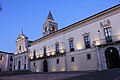
Photo: D.N.R., CC BY-SA 3.0 · Wikimedia Commons
Venosa is an Italian town and comune in the province of Potenza, in the southern Italian region of Basilicata, in the Vulture area. It is bounded by the comuni of Barile, Ginestra, Lavello, Maschito, Montemilone, Palazzo San Gervasio, Rapolla and Spinazzola. It is one of I Borghi più belli d'Italia ("The most beautiful villages of Italy").
The city was known as Venusia ("City of Venus") to the Romans, who credited its establishment—as Aphrodisia ("City of Aphrodite")—to the Homeric hero Diomedes. He was said to have moved to Magna Graecia in southern Italy following the Trojan War, seeking a life of peace and building the town and its temples to appease the anger of Aphrodite for the destruction of her beloved Troy.
The town was taken by the Romans after the Third Samnite War in 291 BC and became a colony for its strategical position between Apulia and Lucania. No fewer than 20,000 men were sent there, owing to its military importance.
Throughout the Hannibalic wars, it remained faithful to Rome, and had a further contingent of colonists sent in 200 BC to replace its losses in the war. In 190 BC the Appian Way was extended to the town. Some coins of Venusia of this period exist.
It took part in the Social War, and was recaptured by Quintus Metellus Pius; it then became a municipium, but in 43 BC its territory was assigned to the veterans of the triumvirs, and it became a colony once more.
Horace was born here in 65 BC. His father's estate in Venusia was confiscated by Augustus after his victory in the civil wars for the settlement of veterans, like many others throughout Italy.
It remained an important place under the Empire as a station on the Via Appia, though Theodor Mommsen's description of it as having branch roads to Aequum Tuticum and Potentia, and Kiepert's maps annexed to the volume, do not agree with one another.
During Late Antiquity, Venosa housed the second-largest Jewish community in Italy, following Rome. While specific founding dates are elusive, evidence suggests Jews resided in Venosa for centuries. …
The Aragonese castle, built in 1470 by Pirro del Balzo Orsini. It has a square plan with four cylindrical towers. The shining sun, the del Balzo coat of arms, is visible on the western towers. It was turned into a residence by Carlo and Emanuele Gesualdo, who added also an internal loggia, the north-western wing and bastions used as prisons. From 1612 it was the seat of the Accademia dei Rinascenti. It is now home to the National Museum of Venosa, inaugurated in 1991, with ancient Roman and other findings up to the 9th century. The entrance is preceded by a fountain conceded by King Charles I of Anjou.
Many fragments of Roman workmanship are built into the walls of the cathedral, which is due to Pirro del Balzo also (c. 1470).
The abbey church of SS. Trinità is historically interesting; it was consecrated in 1059 by Pope Nicholas II and passed into the hands of the Knights of Saint John in the time of Boniface VIII (1295–1303). In the central aisle is the tomb of Alberada, the first wife of Robert Guiscard and mother of Bohemund. An inscription on the wall commemorates the great Norman brothers William Iron Arm, Drogo, Humfrey and Robert Guiscard. The bones of these brothers rest together in a simple stone sarcophagus opposite the tomb of Alberada. The church also contains some 14th-century frescoes. Behind it is a larger church, which was begun for the Benedictines about 1150, from the designs of a French architect, in imitation of the Cluniac church at Paray-le-Monial, but never carried beyond the spring of the vaulting. The ancient amphitheatre adjacent furnished the materials for its walls.
Baroque Church of the Purgatory (or San Filippo Neri)
The Archaeological Area of Notarchirico, in the communal territory. It covers the Palaeolithic period with eleven layers dating from 600,000 to 300,000 years ago. Remains of ancient wildlife, including extinct species of elephants, bisons and rhinoceroses, have been found, as well as a fragment of a femur of Homo erectus.
Jewish catacombs with inscriptions in Hebrew, Greek and Latin show the importance of the Jewish population here in the 4th and 5th centuries.
Remains of the ancient city walls and of an amphitheatre still exist, and a number of inscriptions have been found there.
Text from Wikipedia, the free encyclopedia, under CC BY-SA 4.0. Full article: «Venosa».
Distances are as the crow flies, not walking or driving.


Venosa is in Venosa, in the province of Potenza (Basilicata), Italy. GPS coordinates: 40.96667, 15.81667.
Yes: entry is free on the first Sunday of every month, under the Italian “Domenica al museo” scheme.
Nearby you’ll find: Museo archeologico nazionale di Venosa (600 m away), Aragonese Castle (600 m away), Abbey of the Santissima Trinità (1 km away).
Text. Wikipedia, the free encyclopedia (CC BY-SA 4.0).
Data. Wikidata (CC0); opening hours and contacts OpenStreetMap (ODbL).
Photos. Wikimedia Commons, author and licence on every image.
Updated 28 October 2026. All sources and licences