


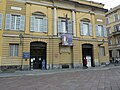


Photo: Viva-Verdi, CC BY-SA 3.0 · Wikimedia Commons
Historic theatre, 19th century
Teatro Regio (Parma)
Opera house in Parma, Italy
Parma (PR), Emilia-Romagna
At a glance
- Type
- Historic theatre
- Period
- Modern era, 19th century
- Style
- Neoclassical architecture
- Architect
- Nicolò Bettoli
- Protection
- Italian national heritage
- Coordinates
- 44°48′11″ N, 10°19′38″ E
- Address
- strada Giuseppe Garibaldi, 16/a
History and description
Teatro Regio di Parma, originally constructed as the Nuovo Teatro Ducale (New Ducal Theatre), is an opera house and opera company in Parma, Italy.
Replacing an obsolete house, the new Ducale achieved prominence in the years after 1829, and especially so after the composer Giuseppe Verdi, who was born near Busseto, some thirty kilometres away, had achieved fame. Also well known in Parma was the conductor Arturo Toscanini, born there in 1867.
As has been noted by Lee Marshall, "while not as well known as La Scala in Milan or La Fenice in Venice, the city’s Teatro Regio....is considered by opera buffs to be one of the true homes of the great Italian tradition, and the well-informed audience is famous for giving voice to its approval or disapproval – not just from the gallery."
The 1,400-seat auditorium, with four tiers of boxes topped by a gallery, was inaugurated on 16 May 1829 when it presented the premiere of Vincenzo Bellini's Zaira, a production which was staged another seven times, although it did not prove to be popular with the Parma audiences.
Construction of the Teatro Ducale
There had been a Ducal Theatre in Parma since the 17th century, the principal one being the Teatro Farnese constructed in 1618, but it was used only nine times, the last one occurring in October 1732, after which it suffered from years from neglect and further damage by American bombing in World War II. It was rebuilt in 1966.
However, the "Nuovo" replaced another existing "small and narrow" Ducal Theatre dating from 1688, which had been located in the Palazzo di Riserva. The 1,200-seat theatre was becoming obsolete due to a variety of factors, including the need to appeal to an increasing middle class desire to experience opera, but also allow for "separate and well articulated private and public spaces". After a performance of Rossini's Zelmira in 1828, it was closed and then demolished.
The newly built "Nuovo Ducale" was located on the site of the former Monastery of St. Alexander and it was located next to the Ducal Palace. Construction began in 1821 during the reign of Marie Louise, Duchess of Parma who, as Napoleon I's divorced second wife, preferred divorce rather than exile. She settled in Parma, ruling from 1816 to 1847, and under her patronage and financial support, secured the services of the architect Nicola Bettoli. Marie Louise oversaw the construction, assuring that the interior decoration reflected "the sobriety of neoclassicism and the colours white and light blue".
In 1849, restoration was called for and then, four years later under the Bourbon Duke Carlo III, more opulent decoration took place. This included the replacement of the neoclassical elements with the more sensual aspects of the mid-19th century; as Martini notes, "this rendered the theatre more splendid with extensive use of red velvet and golden ornamentation. In addition, gas lighting in the house was installed. By 1907, the stage lighting was electrified, and that of the rest of house took place during the centennial of Verdi's birth in 1913.
The architecture of the "Nuovo" …
Verdi and the Teatro Regio
Verdi, who was born and who grew up only 20 miles from Parma, was perhaps quite naturally soon adopted by the city as its native son, especially as his fame grew after the success of the 1840 Nabucco. His operas have had a special place in the Regio's programming after 17 April 1843, when Verdi came to direct his Nabucco. Since that time, the Regio has staged every one of his operas, including adaptations of original versions such as I Lombardi of 1843, which became Jérusalem for Paris in 1847 or the 1847 Macbeth which was revised in 1865.
The seasons surrounding the centennial of his birth in 1813 and the 50th anniversary of his death in 1951 were devoted solely to his operas, and between 1829 and 1979, Verdi, Donizetti, and Bellini were the most frequently staged composers, with Verdi topping the list with five of his operas, the most frequent of which was Aida with 177 performances over the 150-year period. The 2001 centennial of the composer's death resulted in a year-long celebration beginning with the Requiem and including six operas.
The "bicententario" year of 2013 prompted special celebrations which included concerts by the La Scala Orchestra, under Riccardo Chailly, and the Orchestre National de France under Daniele Gatti (which also gave the Requiem). Providing insights into working with the Teatro and with Verdi's music were singers Carlo Bergonzi, Mirella Freni, and Raina Kabaivanska as well as conductor Bruno Bartoletti. A concert by the Filarmonica Arturo Toscanini on 10 October was something of a highlight of the celebrations. It included a concert version of act 2 of Aida. Other complete operas given during the month included I masnadieri, Falstaff, and Simon Boccanegra.
Festival Verdi
In addition to its regular season, from the 1990s the company began to mount a Festival Verdi. Beginning in 2003, the celebration known as Buon Compleanno Maestro Verdi ("Happy Birthday, Maestro Verdi") has been held each 10 October with a concert of excerpts from his works and this is coupled with the month-long festival.
Along with the Verdi operas presented as part of its regular season since 2003/04, the aim of the Festival Verdi has been to present every one of the composer's operas by the bi-centennial year of 2013. However, while this was not achieved, very few operas remain to be staged (depending upon whether different versions are planned). The Festival has included associated discussions, orchestral concerts, and other relevant presentations.
The Teatro Regio's audience
Several writers have commented on the particular qualities of certain members of the audience when attending a performance at the Ducale and the Regio: "Parma's operatic public has a reputation as particularly demanding [and] famous for being unforgiving of any singer not in good voice" notes Plantamura, while Lynn goes back to the early days of the old Ducale in 1816 with an account of the way the tenor Alberico Curioni was "whistled and booed, but he would have none of it and shouted obscenities back" until the police were called and arrested him. The inaugural gala of the Teatro Regio on 16 May 1829 "was not a joyous occasion" for the audience, which gave Bellini's Zaira "a frosty reception" due to the fact that he was the second choice and that he had refused to use a libretto written by one of the company's board members.
Lynn also recounts several incidents during performances in the 19th century where the curtain was brought down due to vociferous protests from audience members, one event actually leading to the dismissal of the theatre's administration. A 21st century performance, which incited audience displeasure was the 2001 opening of a controversial production of Verdi's Macbeth, which was set during the First World War. A later performance caused competing "bravas" and booing for and against the Lady Macbeth. The theatre's administration explained it as follows: "Teatro Regio realizes that it needs to be the best because the audience are all experts".
Text from Wikipedia, the free encyclopedia, under CC BY-SA 4.0. Full article: «Teatro Regio (Parma)».
Timeline
- 1760Architectural reconstruction
- 1829Opened
- 19th centuryBuilt
- 1853Architectural reconstruction
People
Events and people from Wikidata (CC0).
Photos
Getting there
ParmaTrain, nearest
800 m as the crow flies
Teatro Regio (Parma)strada Giuseppe Garibaldi, 16/a
Aeroporto di Parma "Giuseppe Verdi"3.6 km
Distances are as the crow flies, not walking or driving.
Loading map…
Nearby
See on the mapMore historic theatres in Emilia-Romagna


Frequently asked questions
Where is Teatro Regio (Parma)?
Teatro Regio (Parma) is in Parma, in the province of Parma (Emilia-Romagna), Italy. Address: strada Giuseppe Garibaldi, 16/a. GPS coordinates: 44.80313, 10.32726.
Is Teatro Regio (Parma) wheelchair accessible?
According to OpenStreetMap data, the site is partly wheelchair accessible.
How old is Teatro Regio (Parma)?
Wikidata dates it to the 19th century.
What else is there to see near Teatro Regio (Parma)?
Nearby you’ll find: Palazzo della Provincia (100 m away), Museo Costantiniano della steccata (Parma, Italy) (100 m away), Museo Glauco Lombardi (100 m away).
Sources and licences
Text. Wikipedia, the free encyclopedia (CC BY-SA 4.0).
Data. Wikidata (CC0); opening hours and contacts OpenStreetMap (ODbL).
Photos. Wikimedia Commons, author and licence on every image.
Credits for the 9 photos
- Teatro Regio (Parma) 2013-10-13 — Viva-Verdi, CC BY-SA 3.0
- Parma - Teatro Regio - 2023-09-19 18-28-40 001 — Cartonimorti, CC BY-SA 4.0
- Parma - Teatro Regio - 2024-09-20 19-39-47 001 — Valen3399, CC BY-SA 4.0
- Parma - Teatro Regio - 2025-09-13 — Richard_00_00_00_00, CC BY-SA 4.0
- Parma - Teatro Regio2 — ho visto nina volare, CC BY-SA 2.0
- Parma – Teatro Regio (xilografia) — Unknown author Unknown author, Public domain
- Parma Teatro Regio Esterno — Zairon, CC BY-SA 4.0
- Parma-teatro-regio bg — www.bestofcinqueterre.com, CC BY-SA 4.0
- Parma, Teatro Regio — Palickap, CC BY-SA 4.0
Updated 28 October 2026. All sources and licences