


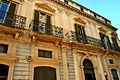


Photo: Bönisch, CC BY-SA 2.0 de · Wikimedia Commons
Archaeological site
Sassi di Matera
Human settlement in Matera, Province of Matera, Basilicata, Italy
Matera (MT), Basilicata
At a glance
- Type
- Archaeological site
- Style
- Rock-cut architecture
- Area
- 10,160,000 m²
- UNESCO World Heritage
- The Sassi and the Park of the Rupestrian Churches of Matera
- Coordinates
- 40°40′00″ N, 16°36′30″ E
History and description
The Sassi di Matera are two districts (Sasso Caveoso and Sasso Barisano) of the Italian city of Matera, Basilicata, well-known for their ancient cave dwellings inhabited since the Paleolithic period.
The "Sassi" have been described by Fodor's as "one of the most unique landscapes in Europe". Along with the park of the Rupestrian Churches, it was named a World Heritage Site by UNESCO in 1993.
History
The Sassi originate from a prehistoric troglodyte settlement and are suspected to be among the first human settlements in Italy. There is evidence that people were living here as early as the year 7000 BC.
The Sassi are houses dug into the calcarenitic rock itself, which is characteristic of Basilicata and Apulia, locally called "tufo", though it is neither volcanic tuff, nor tufa limestone. The streets in some parts of the Sassi often run on top of other houses. The ancient town grew up on one slope of the ravine created by the Gravina river. The ravine is known locally as "la Gravina".
The term sasso derives from Latin saxum, meaning a hill, rock or great stone.
In the 1950s, the government of Italy forcefully relocated most of the population of the Sassi to areas of the developing modern city. Beset by extreme poverty and riddled with malaria, the unhealthy living conditions were considered inhuman and an affront to the modern new Italian Republic of Alcide De Gasperi. However, people continued to live in the Sassi, and according to the English Fodor's guide:
Matera is the only place in the world where people can boast to be still living in the same houses of their ancestors of 9,000 years ago.
Until the late 1980s this was considered an area of poverty, since many of these houses were, and in some cases still are, uninhabitable. The current local administration, however, has become more tourism-oriented, and it has promoted the regeneration of the Sassi with the aid of the European Union, the government, and UNESCO. Today there are many thriving businesses, pubs, and hotels there, as described in an April 2015 article in The New Yorker.
Culture
The Sassi are visually reminiscent of ancient sites in and around Jerusalem, and for this reason they have been used in many Christian-themed films, including The Gospel According to St. Matthew (Pier Paolo Pasolini, 1964), The Passion of the Christ (Mel Gibson, 2004), The Nativity Story (Catherine Hardwicke, 2006) and Ben-Hur (Timur Bekmambetov, 2016).
They also appeared in Patty Jenkins's Wonder Woman (2017), serving as a location for the Amazons' city Themyscira, and Cary Joji Fukunaga's No Time to Die (2021), where a scene with James Bond's Aston Martin racing through was shot.
Music
In 2016 the band Corde Oblique released a song, "I sassi di Matera", on the album "I Maestri del Colore". The song is divided into two parts, the first inspired by the so-called Sasso Barisano, and the second by the Sasso Caveoso.
Text from Wikipedia, the free encyclopedia, under CC BY-SA 4.0. Full article: «Sassi di Matera».
Photos
Getting there
Matera CentraleTrain, nearest
600 m as the crow flies
Sassi di Matera
Distances are as the crow flies, not walking or driving.
Loading map…
Nearby
See on the mapMore archaeological sites in Basilicata

- Free 1st Sunday

- UNESCO

- Free 1st Sunday

- Free 1st Sunday

Frequently asked questions
Where is Sassi di Matera?
Sassi di Matera is in Matera, in the province of Matera (Basilicata), Italy. GPS coordinates: 40.66670, 16.60830.
What else is there to see near Sassi di Matera?
Nearby you’ll find: Ex ospedale di San Rocco (100 m away), Museo-laboratorio della civiltà contadina (200 m away), Palazzo Bronzini (200 m away).
Sources and licences
Text. Wikipedia, the free encyclopedia (CC BY-SA 4.0).
Data. Wikidata (CC0); opening hours and contacts OpenStreetMap (ODbL).
Photos. Wikimedia Commons, author and licence on every image.
Credits for the 6 photos
- Matera boenisch nov 2005 — Bönisch, CC BY-SA 2.0 de
- " 12 - ITALY - Sassi di Matera UNESCO — Pava, CC BY-SA 3.0 it
- "1993 wurden die Sassi di Matera als einzigartiges Zeugnis der Grottenkultur von der UNESCO zum Weltkulturerbe erklärt". 01 — Holger Uwe Schmitt, CC BY-SA 4.0
- "1993 wurden die Sassi di Matera als einzigartiges Zeugnis der Grottenkultur zum Weltkulturerbe erklärt" 01 — Holger Uwe Schmitt, CC BY-SA 4.0
- A panorama at Matera 01 — Maksimsokolov, CC BY-SA 4.0
- "Civita e Sasso Barisano" — Lunamarte, CC BY-SA 4.0
Updated 28 October 2026. All sources and licences