






- Most beautiful villages
Photo: Enrico Pighetti, CC BY 2.0 · Wikimedia Commons
Historic village
Comune in the Province of Macerata in the Italian region Marche
San Ginesio (MC), Marche
San Ginesio is an Italian municipality with a population of 3,040 inhabitants located in the Province of Macerata within the Marche region. It is one of I Borghi più belli d'Italia ("The most beautiful villages of Italy").
The municipality of San Ginesio is situated at an elevation of 680 metres (2,230 ft) above sea level, making it the fifth highest and the twelfth largest in terms of land area within the Province of Macerata. Positioned 60 kilometers (37 miles) from Ancona and 25 kilometers (16 miles) from Macerata, it borders the Via Picena, specifically the SS 78, which connects the Macerata territory to the Sibillini Mountains. The average minimum elevation of its territory is 196 meters (643 feet), while the maximum reaches 1,294 metres (4,245 ft). Nestled within the Sibillini Mountains National Park, its elevated position offers a sweeping panorama stretching from the Conero to the Umbrian-Marchean Apennines, encompassing views of Monte San Vicino, the entirety of the Sibillini Mountains (including Monte Vettore, Cima del Redentore, Monte Sibilla, Monte Porche, Monte Priora, Pizzo Berro, Pizzo Tre Vescovi, and Monte Rotondo), and extending as far as Monte Ascensione and the Gran Sasso. This scenic vantage point has earned San Ginesio the nickname "the balcony of the Sibillini". One of the highest inhabited points in the territory is the hamlet of San Liberato, located at approximately 800 meters (2,625 feet) above sea level.
The town, also affectionately dubbed "the town of 100 churches" due to its rich ecclesiastical heritage, occupies a privileged scenic site. From here, one can gaze upon the municipalities of Macerata, Falerone, Treia, Civitanova Marche, Gualdo, Ripe San Ginesio, Sant'Angelo in Pontano, Penna San Giovanni, and Monte San Martino, as well as the hamlets of Passo San Ginesio, Pian di Pieca, and Santa Croce (all within the municipality itself), the hamlet of Sassotetto (Sarnano), and even catch sight of the Adriatic Sea and the wind turbines of Serrapetrona. Within the municipal territory flows the Fiastra River, known in Roman times as Flussorius, which empties into the Chienti River, along with the Entogge stream, a tributary of the Fiastra, and the Fiastrone, which runs near the hamlets of Morico, Morichelli, and Pian di Pieca. To mitigate water distribution challenges, the town is equipped with a large reservoir that addresses shortages when necessary. …
The earliest known reference to the name appears as "castrum Sancti Genesij" in a document from 995. It is likely that the site, previously called "Avia" (from "a-via," linked to paganism) or "Esculanum," adopted the name San Ginesio following the arrival of the Franks under Charlemagne. Historically, other names have been attributed to the area, such as "Castrum" or "Castra" (meaning "fortified castle" due to its elevated position), "Cupra Montana" (related to the worship of the goddess Cupra), "Gineta" (tied to the goddess Gineta), and "Caput Castri" or "Oppidum" (both meaning "fortified castle").
The town’s patron saint is not Genesius of Arles nor Genesius of Brescello, as claimed by Gaetano Moroni, but rather Genesius of Rome, a mime martyred in 303 under Emperor Diocletian for refusing to mock the Christian sacrament of baptism in a performance. This act led to his recognition as the patron saint of theatrical performers. In 1601, Pope Clement VIII granted San Ginesio a relic of the saint—his left arm. However, since Genesius and the martyr Eleuterius were buried together, two "holy left arms" were sent to avoid confusion. These relics have since been preserved in the town’s main church, known as the Collegiata.
Before the establishment of the Italian Republic, which formalized the name’s spelling via a Decree of the President of the Republic in 1952, the name was not always written as the modern San Ginesio but often appeared as a single word, Sanginesio. For instance, "San Ginesio" is found in Gaetano Moroni’s dictionary (1846), while "Sanginesio" appears in the first volume of the Touring Club Italiano’s guide to Central Italy (1924).
The history of San Ginesio begins around the 1st millennium BC, when the Senones settled in the region. With the arrival of the Romans, the Gallic Senones were defeated and subjugated between the 3rd century BC and the 1st century AD. San Ginesio features a Latin cross urban layout, encircled by an imposing set of castle walls still adorned with defensive features from that era, including battlements, archer slits, and towers. Following the fall of the Roman Empire, the Goths and Lombards—the latter ousted by Charlemagne—destroyed lowland settlements, forcing inhabitants to retreat to the inner hills, where nobles traditionally hunted. With the arrival of the Normans in the 10th century, the bourgeoisie decided to erect a fortification on the highest hill to control the valley passage below, thus giving rise to San Ginesio.
Managed as a Republic, the municipality became part of the Papal States under the Egidian Constitutions in the 14th century, authored by Cardinal Egidio Albornoz. It was governed by the Da Varano family of Camerino from 1355 to 1434. During this period, a significant rivalry emerged with the March of Fermo and Fermo, culminating in the Battle of Fornarina on 30 November 1377. The weakening of the Da Varano dynasty allowed the Milanese condottiero Francesco Sforza to subdue numerous Church territories in 1434, only for them to be liberated in 1443 by another mercenary captain, Niccolò Piccinino, in the service of the papacy. It was not until 1445 that San Ginesio peacefully acknowledged its allegiance to the Papal States.
Between 1450 and the election of Pope Pius II, three hundred Ginesians were exiled, accused of conspiring against the Pope. They sought refuge in Siena, where their exemplary conduct prompted Siena’s rulers to send ambassadors to San Ginesio to plead their case, securing their pardon. Accompanied by Sienese dignitaries, the exiles returned to the "Porta Picena," bearing a wooden crucifix as a peace offering and, as a gesture of harmony, the Sienese Statutes to guide the drafting of a new municipal code. Modeled on Siena’s framework and approved by Pope Pius II in 1458, the town council commissioned a Sienese painter to create the Painting of Saint Andrew, commemorating the historic battle. …
The Collegiate Church of Santa Maria Assunta stands as the town’s main church, located in Piazza Alberico Gentili. An initial structure was erected in the 11th century atop a Paleochristian chapel dedicated to Genesius of Rome, the town’s patron saint. As the settlement expanded eastward, the public administration ordered the construction of a larger church to accommodate the growing population. The building underwent numerous modifications and restorations, beginning in 1294 under Angelo Bussi and culminating in a significant enhancement of the façade’s upper section in 1421, commissioned to Enrico Alemanno. Thanks to Alemanno’s work, it remains the only example of Flamboyant Gothic architecture in the Marche region.
The interior, divided into three naves, retains the original Paleochristian crypt and features nine chapels along its sides—six on the right and three on the left. It houses various artworks, many by local artist Domenico Malpiedi, alongside paintings and frescoes by Pietro Alemanno, Cristoforo Roncalli, Federico Zuccari, Adolfo De Carolis, Simone De Magistris, and artists from the Perugino school. Other Ginesian contributors include Stefano Folchetti and Guglielmo Ciarlantini.
On September 8, 2017, the church was included in the "First Plan of Interventions on Artistic and Cultural Heritage," approved by then Commissioner for Reconstruction Vasco Errani just before his term ended. The structure sustained significant internal and external damage, particularly to its ceiling and masonry, from the earthquake, owing to its expansive layout and size.
Some scholars propose that beneath the church floor lie the remains of Pepin the Short and his wife Bertrada of Laon, while others suggest it is not the only building in San Ginesio bearing symbols and carvings linked to the Knights Templar.
The Abbey of Santa Maria delle Macchie, located in the hamlet of Macchie, is a former Benedictine monastery. Its construction date is uncertain, but extensive spolia from the nearby Roman city of Urbs Salvia suggests an origin between the 8th and 9th centuries. Construction techniques in the crypt from the 12th century indicate a foundation post-10th century. A document from 1171 mentions the abbey, with the earliest confirmed record dating to the 13th century. …
Text from Wikipedia, the free encyclopedia, under CC BY-SA 4.0. Full article: «San Ginesio».
Distances are as the crow flies, not walking or driving.


San Ginesio is in San Ginesio, in the province of Macerata (Marche), Italy. GPS coordinates: 43.10784, 13.31667.
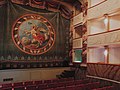
Nearby you’ll find: Castle walls of San Ginesio (100 m away), Teatro Giacomo Leopardi (200 m away), Pinacoteca Gentili (300 m away).
Text. Wikipedia, the free encyclopedia (CC BY-SA 4.0).
Data. Wikidata (CC0); opening hours and contacts OpenStreetMap (ODbL).
Photos. Wikimedia Commons, author and licence on every image.
Updated 28 October 2026. All sources and licences